
As artificial intelligence develops at extraordinary speed, China and the United States are approaching its opportunities and dangers from noticeably different directions. While concerns about job losses, privacy, misinformation and even the possibility of highly advanced AI escaping human control have become prominent in the United States, China is continuing an aggressive push to integrate the technology across its economy and society.
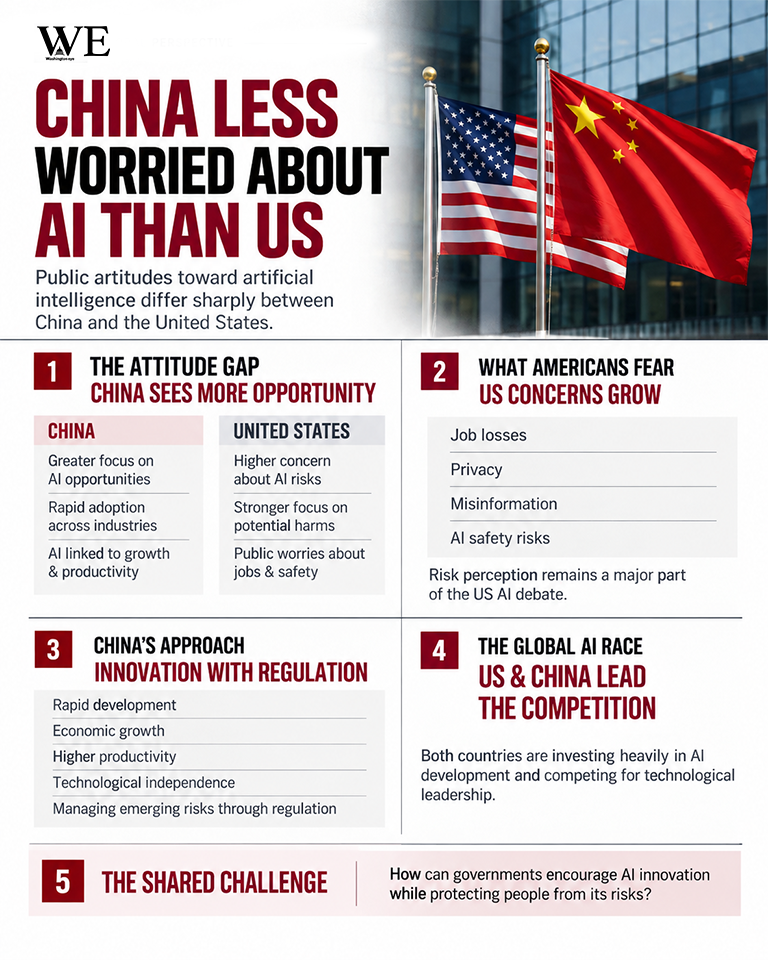
The difference does not mean China considers AI harmless. Beijing has introduced increasingly detailed safety rules and acknowledges risks ranging from cyberattacks to uncontrolled autonomous systems. But compared with much of the debate in the United States, China’s approach has generally focused on managing practical risks while continuing rapid development, rather than slowing the technology itself.
America’s Growing AI Anxiety
Public concern about artificial intelligence is particularly visible in the United States. Pew Research Center reported in 2026 that Americans remain deeply skeptical about AI’s impact. Around half of U.S. adults have used AI chatbots, but majorities believe AI is advancing too quickly and worry that it could make their personal information less secure.
About 67% of Americans have little or no confidence in the U.S. government’s ability to regulate AI effectively, while roughly six in ten lack confidence that American companies will develop and use the technology responsibly. Employment is another major concern. Research published by Anthropic in June, based on a large survey of Americans conducted in late 2025, found that AI-related job losses were the most commonly identified fear, followed by dependence on AI and misinformation.

Young Americans have become especially uneasy. Pew found that the proportion of Americans aged 18 to 34 who said they were more concerned than excited about AI rose from 40% in 2024 to 55% in 2026. At the same time, Americans increasingly view China as a serious technological competitor. In a June 2026 Pew survey, 36% of U.S. adults said China was more advanced in AI development, compared with only 12% who believed the United States was ahead. Another 18% considered the two countries approximately equal, while a third were unsure.
Why China Is Taking a Different Approach
China sees artificial intelligence as a strategic technology capable of supporting economic growth, industrial productivity and national technological independence. Beijing is promoting widespread AI adoption while Chinese companies race to develop models capable of competing with leading American systems. Companies including DeepSeek, Alibaba, Moonshot AI and Z.ai have helped narrow the technological gap between the two countries, despite U.S. restrictions intended to limit China’s access to some advanced semiconductor technology.

The Chinese government has also made AI integration part of its broader development strategy. Rather than treating increasingly capable AI as a reason to halt development, Beijing has largely sought to regulate problems as they emerge while maintaining technological momentum.
This approach partly explains why warnings from some American technology executives about extreme AI risks have received a cooler response in China. Chinese officials and researchers have sometimes viewed U.S. calls for tighter restrictions through the lens of technological competition, particularly when proposed safeguards would limit China’s access to advanced chips or AI technology.
China Is Not Ignoring the Risks
However, describing China as simply unconcerned about AI would be misleading. Chinese authorities are developing an extensive AI safety framework. Reuters reported in September that China has been preparing rules covering advanced risks such as rogue AI agents, data poisoning, algorithm manipulation and systems potentially escaping human control. Beijing is also working on mandatory national safety standards for AI agents.
Employment is another concern. AI-driven automation could affect workers in industries ranging from entertainment and education to manufacturing and professional services. Recent reporting has highlighted growing anxiety among Chinese workers about employers using AI to replace or replicate human work.
Interestingly, worries about employment are not dramatically different between ordinary Chinese and American consumers. An S&P Global survey found that 47% of surveyed Chinese internet adults and 45% of U.S. internet adults agreed that AI could someday eliminate their jobs. The contrast therefore lies less in whether risks exist and more in how governments, technology companies and public debate respond to them.
Competition, Regulation and the Future
AI has now become another major dimension of U.S.-China technological competition. Washington is debating how quickly increasingly powerful systems should be developed and how much oversight AI companies require, while Beijing is simultaneously pursuing greater technological independence, wider adoption and stronger state regulation.
Yet both countries increasingly recognize that uncontrolled AI development carries genuine risks. China is creating safety standards even as it accelerates adoption, while American policymakers, companies and researchers continue debating the balance between innovation and protection.
The coming years may therefore produce an unusual situation: the United States and China competing intensely to build more powerful AI while simultaneously searching for ways to prevent that technology from creating economic, security and social problems neither country can fully control.