
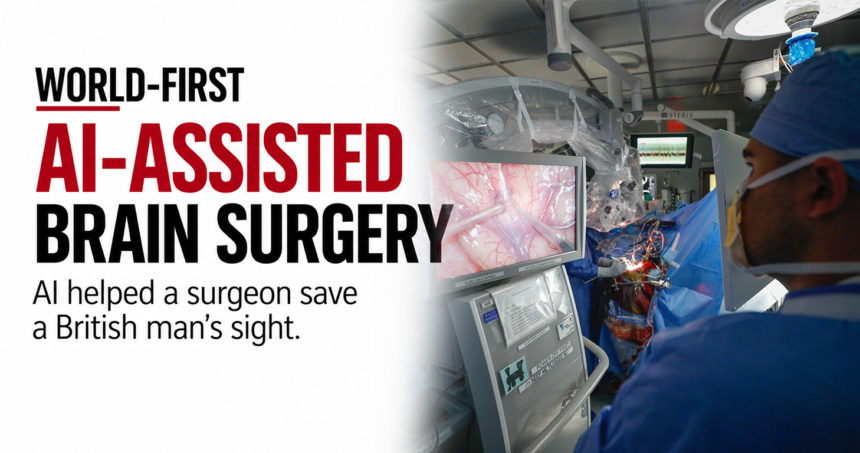
Artificial intelligence has entered one of medicine’s most delicate environments: the operating theatre. British neurosurgeons have successfully used AI to provide real-time assistance during brain surgery in a world-first procedure that helped remove a tumour while protecting a patient’s eyesight. The pioneering operation was performed at the National Hospital for Neurology and Neurosurgery (NHNN), part of University College London Hospitals (UCLH), on 48-year-old Rhys Hibbert from Bedfordshire.
Hibbert had a tumour on his pituitary gland that was threatening his vision and could eventually have left him blind. During the operation, surgeons remained completely in control, but an artificial intelligence system watched the same live surgical video and helped identify important structures that needed to be avoided. The operation took place in May 2026, while details were announced publicly in August after Hibbert had recovered. He has since returned to work, with his eyesight protected.
How Did AI Help During the Surgery?

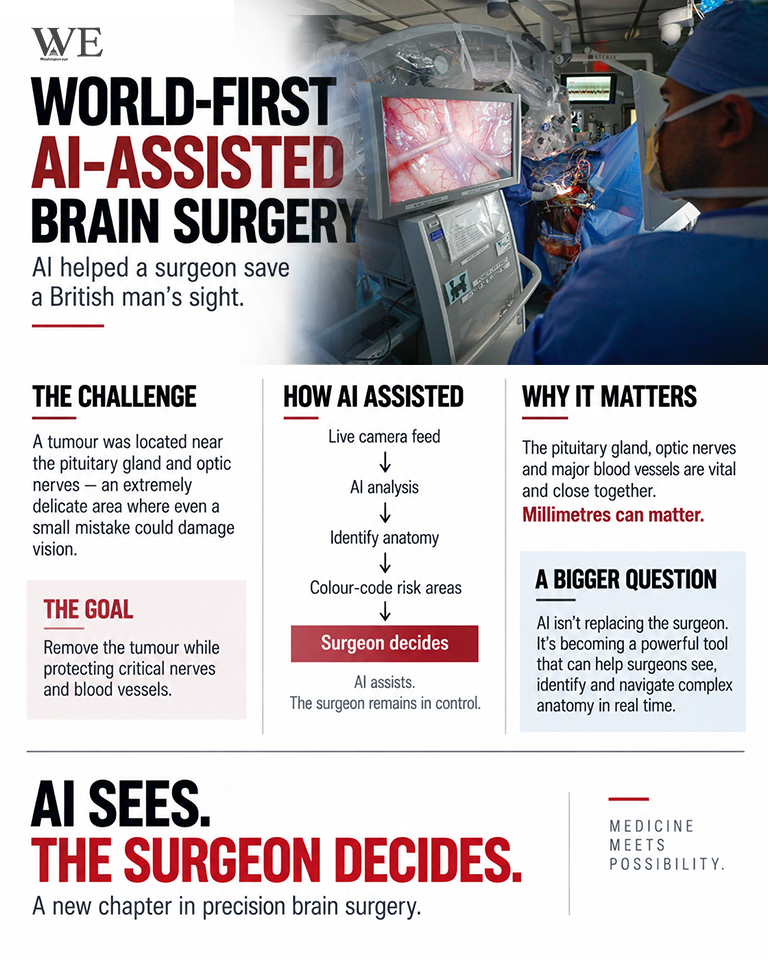
The breakthrough was not a case of an AI robot independently performing brain surgery. Instead, the technology functioned as an intelligent navigation assistant for the human surgical team. During the procedure, an endoscopic camera provided live images from inside the patient’s head. The AI analysed this video footage in real time and colour-coded important anatomical structures, helping surgeons distinguish areas such as nerves and blood vessels while removing the tumour.
The location made this particularly important. The pituitary gland sits at the base of the brain in an extremely crowded anatomical area. Important blood vessels and nerves responsible for vision lie nearby, meaning an error of only a few millimetres, or even less, can have serious consequences including blindness, stroke or death. Traditionally, surgeons rely heavily on their training, experience and pre-operative scans to navigate this anatomy. The new system adds another layer of information while the operation is actually happening.

The technology was developed at University College London’s Hawkes Institute and trained using hundreds of videos from previous brain operations. This allowed the system to learn to recognise anatomical structures encountered during pituitary surgery. Professor Hani Marcus, consultant neurosurgeon at NHNN and professor of neurosurgery at UCL, performed the operation alongside surgical resident Danyal Khan, who has been leading work on the technology.
From a Seizure to a World-First Operation
Hibbert’s medical journey began unexpectedly in December 2024 when he collapsed while taking his usual walk and suffered a seizure. Hospital investigations subsequently discovered an approximately 11-millimetre tumour in his pituitary gland. As the tumour affected his vision, surgery became necessary. Hibbert later volunteered to become the first patient to undergo the procedure using the live AI assistance system as part of a clinical trial.

The operation successfully removed the tumour while protecting his sight. Hibbert reported a dramatic improvement after waking from surgery. Within about a week, he was able to walk independently without glasses or walking aids. The successful outcome is significant because the operation demonstrates how artificial intelligence may work alongside doctors rather than replacing them. In this case, the surgeon continued to make the decisions and physically perform the operation, while AI supplied additional visual information.
Could AI Become a ‘GPS’ for Surgeons?
Researchers believe the technology could eventually develop into something resembling a navigation system for surgery. Just as a GPS identifies roads and hazards for a driver, surgical AI could potentially recognise anatomy, identify dangerous areas and alert surgeons when instruments approach structures that should be protected.
Future versions could also track surgical instruments and analyse interactions between instruments and human tissue. Researchers ultimately hope AI systems may provide increasingly sophisticated feedback during complicated operations. However, one successful procedure does not mean AI-assisted surgery is ready to replace conventional techniques. The technology remains under clinical investigation and will require further testing to establish its safety, accuracy and benefits across larger numbers of patients.
There are also broader questions surrounding responsibility. If an AI system incorrectly identifies tissue during an operation, doctors and regulators will have to determine how such errors should be handled. Medical AI therefore requires strict safeguards, clinical validation and continued human oversight. Britain’s Health Innovation Minister James Frith described the operation as an example of the potential benefits AI could bring to healthcare, while stressing the importance of appropriate safeguards.
For surgeons, the technology could eventually provide an additional pair of highly trained digital eyes during some of medicine’s most difficult procedures. For Hibbert, however, the significance is much more immediate. A tumour that threatened to take away his sight has been removed, and his operation may have provided an early glimpse of how humans and artificial intelligence could one day operate together.