

Upadacitinib trial signals a potential new era for people with widespread vitiligo
A daily oral medicine could offer a new treatment option for people living with vitiligo, after a major international clinical trial found that the drug upadacitinib helped restore skin pigmentation in some patients. The development is particularly significant because most established vitiligo therapies are creams, light-based treatments or procedures, while effective systemic options for people with extensive disease have historically been limited.
Vitiligo is a chronic autoimmune condition in which the immune system attacks melanocytes, the cells responsible for producing skin pigment. This causes distinctive white or depigmented patches that can occur anywhere on the body. The condition is not contagious, but it can have a substantial psychological and social impact, particularly when patches affect highly visible areas such as the face and hands.
What Is the New Oral Treatment?
The treatment attracting attention is upadacitinib, a Janus kinase, or JAK, inhibitor. JAK inhibitors interfere with immune signalling pathways involved in inflammation and autoimmune disease. Researchers have increasingly investigated these medicines because the immune pathways they target also appear to play an important role in vitiligo.
Results reported in August 2026 involved 614 adults and adolescents aged 12 years and older across 138 centres in 18 countries. Participants had non-segmental vitiligo, the most common form of the condition, and were given either 15 mg of upadacitinib once daily or placebo for 48 weeks.

After 48 weeks, approximately one-quarter of patients receiving upadacitinib achieved at least 75% improvement in facial pigmentation in one trial, compared with about 6% receiving placebo. A second trial produced similar results, at roughly 23% versus 7%. Significant repigmentation elsewhere on the body was reported in around one-fifth of treated patients.
These figures are encouraging but also show that the medicine is not a cure and does not work equally well for everyone. Most participants did not reach the study’s highest repigmentation targets, meaning researchers still need to determine which patients are most likely to benefit and how durable the improvement remains.
Why an Oral Treatment Matters

Current treatment depends on the extent, location and activity of vitiligo. Options include topical corticosteroids, tacrolimus or pimecrolimus, narrow-band UVB phototherapy and topical ruxolitinib. Ruxolitinib cream is an approved JAK-inhibitor treatment for non-segmental vitiligo in patients aged 12 and older, but topical treatment is naturally better suited to limited areas of skin.
An oral medicine could therefore be especially important for patients whose vitiligo covers larger areas or continues to spread. Dermatologists sometimes use oral corticosteroids such as prednisone when vitiligo is rapidly progressing, primarily to slow the development of new patches. Long-term steroid treatment, however, is limited by its potential adverse effects.
Oral JAK inhibitors could potentially address the disease throughout the body rather than requiring patients to apply medication individually to every affected patch. Research into systemic JAK inhibitors has consequently become one of the fastest-developing areas of vitiligo treatment.
Benefits, Cost and Safety
The potential benefits must be weighed against safety. Reported adverse effects with upadacitinib included respiratory infections, acne and cases of herpes zoster. JAK inhibitors as a drug class can carry more significant risks in selected patients, which means oral treatment requires medical assessment and monitoring rather than being used simply as a cosmetic pigmentation medicine.
Cost and accessibility may also determine how widely new oral therapies are adopted. JAK inhibitors are relatively sophisticated targeted medicines and can be expensive, while insurance or public-health reimbursement differs considerably between countries. Broader regulatory approval and competition could eventually influence prices.
Vitiligo itself has no single universally effective treatment. Repigmentation tends to occur more successfully on areas such as the face and neck, while the hands, fingertips and feet are considerably more difficult to treat. Even after successful treatment, pigmentation can sometimes be lost again, making maintenance therapy necessary for some patients.
The emergence of oral treatments therefore represents progress rather than a definitive solution. For decades, treatment largely focused on topical medicines, phototherapy, camouflage and, in selected stable cases, surgical techniques such as skin or cellular grafting. Targeted immune therapies are now changing that landscape.
Researchers are continuing to investigate oral JAK inhibitors including upadacitinib and other candidates, with the goal of finding treatments capable of both stopping vitiligo from spreading and restoring pigment already lost.
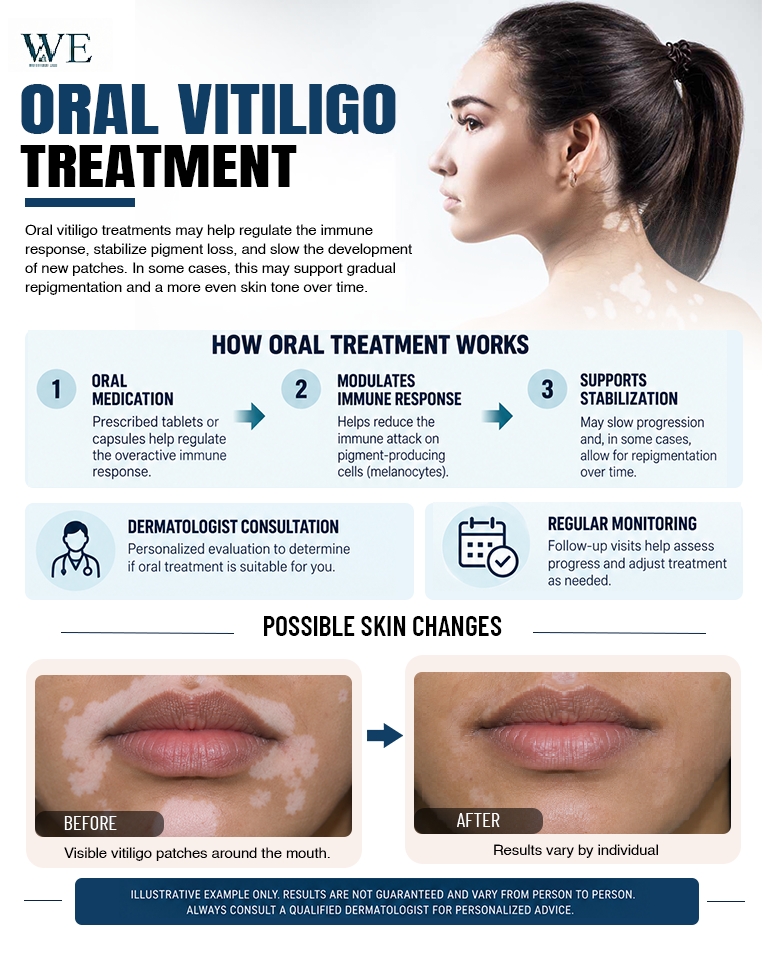
For millions of people affected by vitiligo, the possibility of an effective tablet is significant. The latest findings suggest that systemic treatment may become an increasingly important part of vitiligo management, particularly for patients with widespread or actively progressing disease. However, the benefits, long-term safety, eligibility and cost will remain central considerations as oral therapies move further into clinical practice.