Incheon Airport takes the global lead as South Korea’s tourism boom and disruption in the Middle East reshape international travel
Seoul’s Incheon International Airport has surged to the top of the global rankings for international passenger traffic, overtaking long-dominant aviation hubs including Dubai International Airport. The shift marks a major milestone for South Korea and reflects both Seoul’s rapidly expanding tourism appeal and an extraordinary change in global air-travel patterns during 2026.
According to preliminary figures from Airports Council International cited by Incheon International Airport, the South Korean hub handled approximately 38.4 million international passengers during the first six months of 2026. London Heathrow followed with about 37.8 million, while Singapore Changi recorded roughly 34.5 million. It is the first time Incheon has reached the number-one position for international passenger traffic since opening in 2001.
The achievement represents a remarkable climb. Incheon ranked around 10th globally in international passenger traffic in 2002, rose to fifth by 2018 and stood third in both 2024 and 2025. Dubai, by contrast, had been one of the world’s dominant international aviation hubs, benefiting from its strategic position between Europe, Asia and Africa and the huge connecting network operated through the United Arab Emirates.

Why Seoul Has Overtaken Dubai
A major factor behind the change has been disruption to Middle Eastern aviation following the Iran conflict in early 2026. Dubai International experienced a dramatic decline in international passenger numbers, falling from about 7.4 million passengers in February to 2.5 million in March. By June, traffic had recovered to around 4.7 million but remained well below earlier levels.

The disruption changed the way many passengers travelled between Europe and Asia. Rather than connecting through Gulf hubs, some passengers and airlines shifted toward direct services or transfers through East Asia. Incheon emerged as a major beneficiary: the number of passengers travelling from Europe to Incheon before connecting to another destination increased by roughly two-thirds during the first half of 2026 compared with the same period a year earlier.
However, Seoul’s rise cannot be explained by diverted passengers alone. South Korea itself is experiencing a major tourism boom. The Seoul Metropolitan Government reported a record 8.23 million international tourists in the first half of 2026, approximately 21% higher than the previous year. China was the biggest source market, contributing about 2.47 million visitors, followed by Japan with 1.5 million, Taiwan with 880,000 and the United States with around 620,000.
Tourists are also spending considerably more money. Foreign visitors recorded around KRW 5.62 trillion ($4 billion approximately) in card spending in Seoul during the first half of 2026, an increase of nearly 57% year-on-year. Shopping accounted for 46.4% of spending, medical and wellness services for 24.4%, food and beverages for 13.1%, and accommodation for 10.7%. The momentum has continued. Seoul recorded 1.61 million foreign visitors in July, its highest-ever monthly figure, while foreign tourist spending exceeded KRW 1 trillion for a fourth consecutive month.

Korean popular culture has become one of the strongest drivers behind this expansion. International interest in K-pop, Korean television and film, food, fashion, skincare and beauty treatments has turned Seoul into a destination where visitors increasingly seek experiences rather than simply sightseeing. Districts such as Hongdae and Seongsu have benefited alongside established tourist areas including Gangnam and Myeong-dong.
Dubai Remains a Tourism Heavyweight
The new airport ranking does not mean Dubai has lost its status as one of the world’s leading destinations. Before the 2026 disruption, the emirate was breaking tourism records. Dubai welcomed 19.59 million international overnight visitors in 2025, up 5% from 18.72 million in 2024. December 2025 alone brought more than two million visitors, the first time Dubai had exceeded that level in a single month.
Dubai also entered 2026 strongly, welcoming two million international overnight visitors in January, compared with 1.94 million a year earlier. Its enormous hotel sector remains a major economic asset: in 2025, hotel occupancy averaged 80.7%, while the average daily room rate climbed to AED579.
The comparison therefore reflects unusual global circumstances as much as a permanent change in tourist preference. Dubai remains positioned as a luxury, shopping, business and stopover destination, while Seoul is benefiting from cultural tourism, medical and beauty travel, technology, food and rapidly growing Asian travel demand.
Incheon itself has invested heavily in becoming more attractive to connecting passengers. The airport, located about 48 kilometres west of Seoul, now serves more than 100 airlines and has expanded its capacity significantly. Travellers can access an in-terminal hotel, 24-hour sauna, free sleeping areas, a museum and robotic assistance services.
For South Korea, becoming the leading international passenger hub carries benefits far beyond aviation. More passengers mean greater demand for hotels, restaurants, shopping, entertainment, transport, medical tourism and cultural attractions. With Seoul simultaneously recording historic visitor numbers and spending, tourism is becoming an increasingly valuable component of the city’s economy.
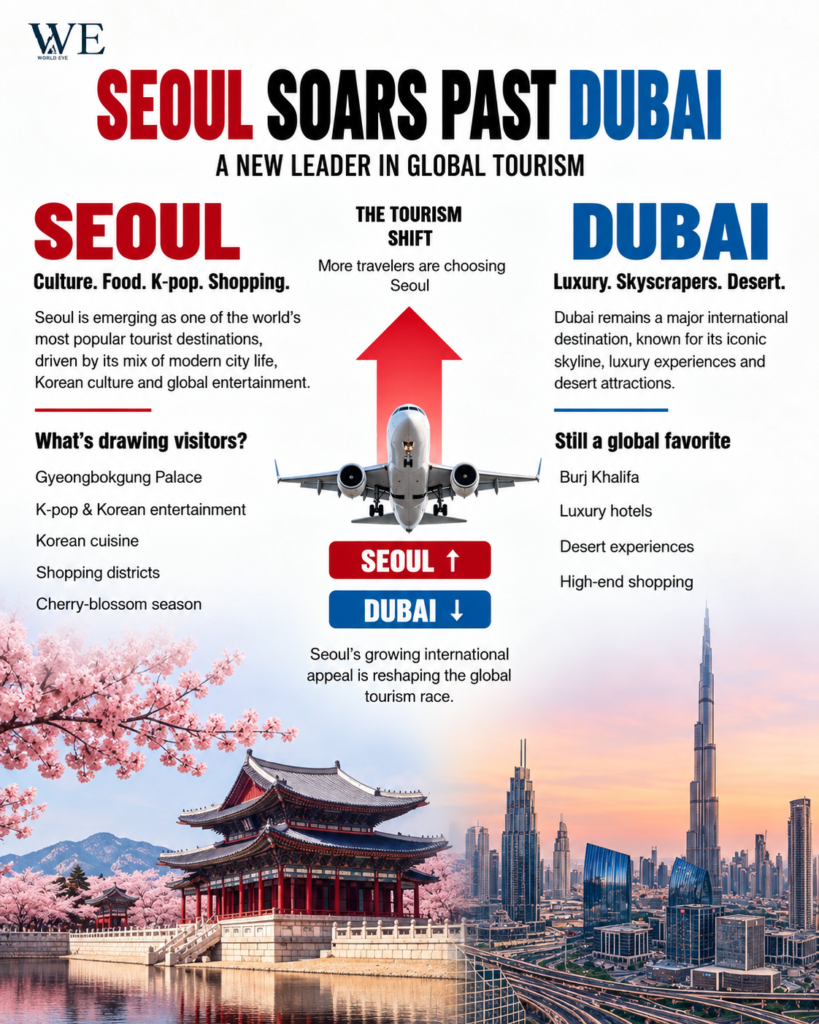
Whether Incheon can retain the top position once Middle Eastern aviation fully recovers remains uncertain. But its ascent from a relatively new airport in 2001 to the world’s busiest international passenger hub in 2026 demonstrates how dramatically the geography of global tourism and aviation is changing.