
President Donald Trump has submitted a proposed civil nuclear cooperation agreement with Saudi Arabia to Congress, advancing a multibillion-dollar partnership that could bring American nuclear reactors to the kingdom but has raised concerns about uranium enrichment and regional proliferation.
The agreement was sent to Congress on August 24, 2026, after being signed in July by US Energy Secretary Chris Wright and Saudi Energy Minister Prince Abdulaziz bin Salman. It will now undergo a 90-session-day congressional review. Unless Congress adopts a joint resolution opposing it, the pact can enter into force.
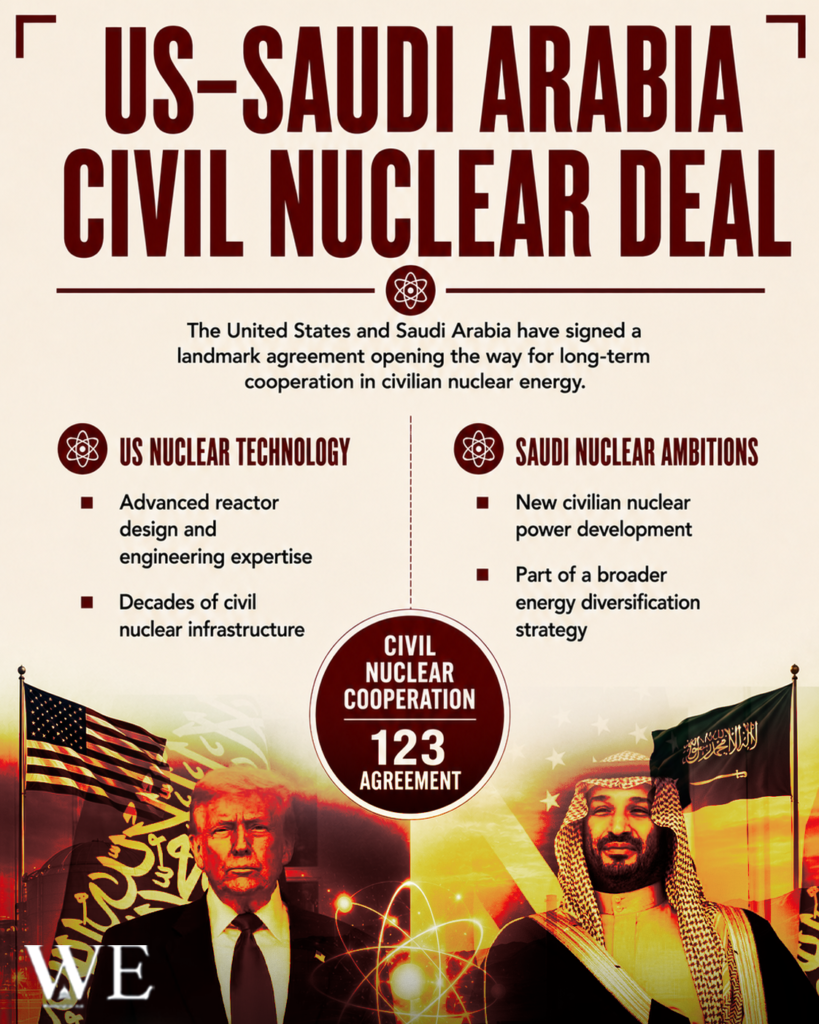
Known as a “123 Agreement” after Section 123 of the US Atomic Energy Act, the accord establishes the legal framework required before American companies can transfer significant nuclear materials, equipment or technology to another country. It does not give Saudi Arabia a nuclear weapon or immediately construct a power plant, but it opens the way for future commercial contracts and technical cooperation.
The 30-year agreement reportedly envisages the construction of Westinghouse AP1000 reactors in Saudi Arabia. The programme could be worth tens of billions of dollars and benefit American manufacturers, engineers and nuclear-fuel suppliers. The US Department of Energy says the partnership will support American jobs, strengthen energy security and maintain high nuclear-safety and non-proliferation standards.

Saudi Arabia argues that nuclear power is necessary to diversify its energy system under Vision 2030. Although it is one of the world’s largest oil producers, the kingdom consumes substantial amounts of oil and natural gas to generate electricity and desalinate seawater. Nuclear plants could provide constant low-carbon power, preserve more petroleum for export and support growing industries and data centres.
The most controversial issue is Saudi Arabia’s insistence on developing parts of the nuclear-fuel cycle, including uranium enrichment. Low-enriched uranium can fuel civilian reactors, but the same technology can produce highly enriched material for a nuclear weapon if operated at higher levels. Reprocessing spent nuclear fuel can also separate plutonium, creating another potential weapons pathway.
Unlike the 2009 US agreement with the United Arab Emirates, the Saudi pact reportedly does not permanently prohibit domestic uranium enrichment or the reprocessing of nuclear waste. The UAE accepted those restrictions under an arrangement widely described as the “gold standard” for civil nuclear cooperation.

The agreement also does not require Saudi Arabia to adopt the International Atomic Energy Agency’s Additional Protocol. That protocol gives UN inspectors broader access to nuclear-related locations, records and supply chains, improving their ability to detect undeclared activities. Instead, Washington and Riyadh have signed a separate bilateral safeguards agreement covering facilities involved in their cooperation.
Saudi Arabia is a member of the Nuclear Non-Proliferation Treaty and is legally prohibited from developing nuclear weapons. It also ended its outdated Small Quantities Protocol in 2024, allowing more comprehensive IAEA safeguards to apply. However, arms-control specialists argue that these measures remain weaker than the Additional Protocol, particularly if the kingdom eventually constructs enrichment facilities. The IAEA explains that enhanced safeguards provide greater assurance that nuclear material remains in peaceful use.
Proliferation concerns have been intensified by Saudi Crown Prince Mohammed bin Salman’s 2018 statement that the kingdom would pursue a nuclear weapon if Iran obtained one. There is currently no public evidence that Saudi Arabia is violating its treaty obligations or operating a nuclear-weapons programme, but critics fear that domestic enrichment capability could shorten the time needed to develop one during a future crisis.
Supporters argue that cooperation with Washington gives the United States greater oversight than Saudi partnerships with Russia or China would provide. Refusing an agreement, they say, would not necessarily end Riyadh’s nuclear ambitions and could instead push the kingdom towards suppliers that impose fewer transparency requirements.
The deal has also become connected to Middle Eastern diplomacy. Trump has said it will proceed only if Saudi Arabia joins the Abraham Accords and establishes formal relations with Israel. However, this appears to be a political condition imposed by the president rather than a provision within the nuclear agreement itself.
Saudi Arabia maintains that it will not recognise Israel without an irreversible path towards an independent Palestinian state. The Gaza conflict has made such normalisation significantly more difficult, leaving uncertainty over whether the nuclear agreement could take effect even if it survives congressional review.
Congress can attempt to reject the pact, but Trump could veto that decision. Overriding his veto would require a two-thirds majority in both chambers. The latest Reuters report therefore marks the beginning of a major debate over whether commercial and strategic benefits outweigh the risks of spreading sensitive nuclear technology.
The agreement could transform Saudi Arabia’s energy sector and strengthen US influence in the Gulf. Yet its future depends on three unresolved questions: whether Congress accepts its safeguards, whether Riyadh and Washington can agree on enrichment controls, and whether Saudi Arabia is willing to normalise relations with Israel without first securing meaningful progress towards Palestinian statehood.