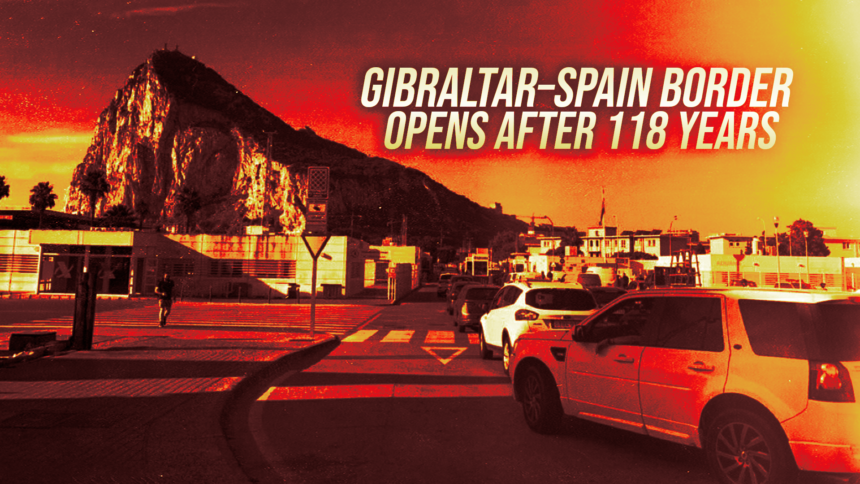
Gibraltar and Spain have entered a new era of cross-border relations after routine immigration and customs controls were removed from their land frontier for the first time in 118 years. The historic change took effect at midnight on July 15, 2026, allowing residents, workers and tourists to cross between the British overseas territory and the Spanish town of La Línea de la Concepción without stopping at passport-control booths.
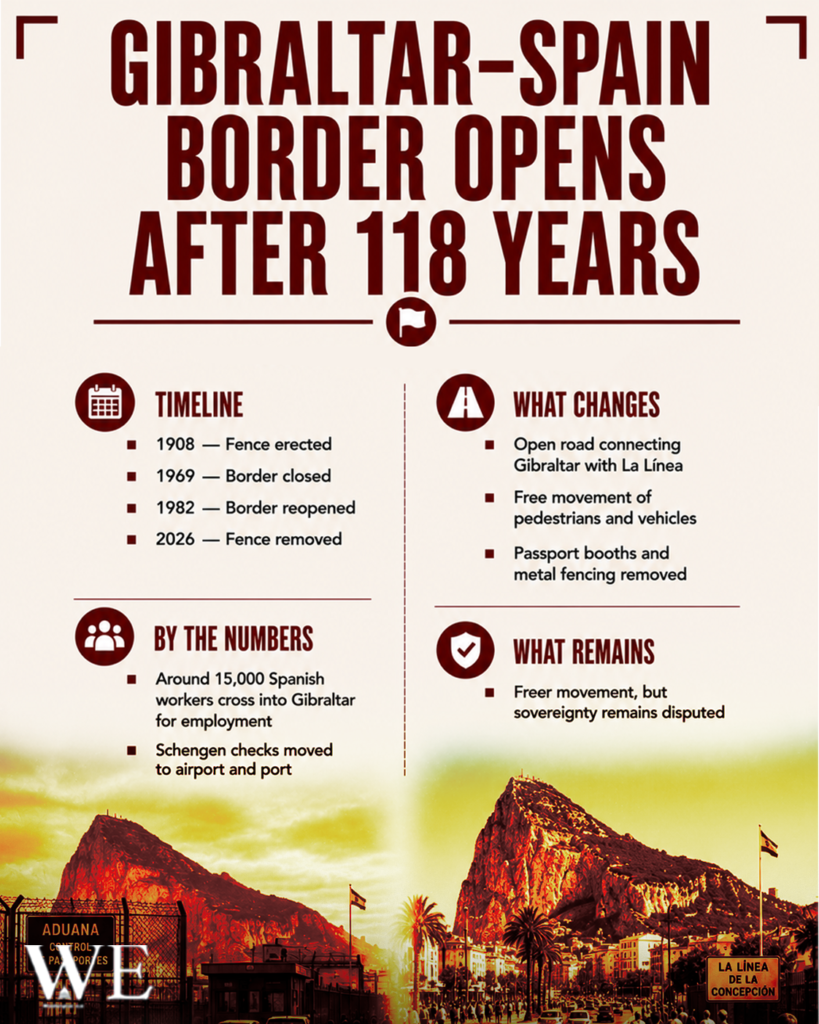
The barrier’s removal followed the signing of a landmark treaty between the United Kingdom and the European Union in Brussels on July 14. Negotiated with the participation of Spain and Gibraltar, the agreement was provisionally implemented the following day. Workers dismantled the iron gates and final sections of a fence that had physically separated Gibraltar from Spain since 1908, while crowds carrying British, Spanish and Gibraltar flags gathered to celebrate.
The development does not mean that the international boundary has disappeared or that Gibraltar has become part of Spain. Gibraltar remains a British overseas territory and is formally outside both the European Union and the passport-free Schengen area. Instead, the treaty applies Schengen border rules through a specially designed arrangement that moves routine immigration checks away from the land crossing and transfers them to Gibraltar’s airport and, when required, its seaport. The UK government says the treaty does not affect sovereignty.
Travellers arriving at Gibraltar International Airport now pass through two sets of controls. Gibraltar’s authorities conduct the territory’s own immigration checks, while Spanish officers perform the examination required for entry into the Schengen area. Once passengers complete both processes, they can travel across the land frontier into Spain without another routine passport check. Visitors arriving from the United Kingdom may also be registered under the EU’s biometric Entry/Exit System.

For most British visitors, time spent in Gibraltar now counts towards the Schengen allowance of 90 days in any 180-day period. Their passports must meet Schengen validity rules, while fingerprint and facial-image registration may be required. British-Irish dual nationals travelling on Irish passports are treated as EU citizens and are not subject to the same limits. Updated UK travel guidance explains the new entry requirements.
The agreement is especially important for the approximately 15,000 people, more than half of Gibraltar’s workforce, who cross the border each day, many of them Spanish residents employed in hotels, shops, construction, financial services and other businesses on the Rock. Under the previous system, commuters frequently experienced long queues, particularly during rush hour or periods of political tension between Madrid and London.
Gibraltar, which has a population of roughly 40,000, depends heavily on the surrounding Spanish region for workers, supplies and customers. At the same time, employment and commercial activity generated by Gibraltar are important to the neighbouring Campo de Gibraltar area of Andalucía. Removing the routine checks is expected to support tourism, investment, employment and closer economic integration across the region. The UK described the agreement as vital to Gibraltar’s economic future.

The deal also creates a customised trading system to allow goods to move across the land frontier without routine customs checks. Most goods destined for Gibraltar will first be cleared by EU customs authorities in Spain. The arrangement removes tariffs, duties and quotas between Gibraltar and the EU while requiring cooperation on taxation, environmental protection, labour standards, state aid, transport and financial crime.
The frontier has long been one of Europe’s most politically sensitive borders. Gibraltar was ceded to Britain under the 1713 Treaty of Utrecht, but Spain has continued to claim sovereignty over the territory. In 1969, Spanish dictator Francisco Franco completely closed the frontier after Gibraltar adopted a new constitution. Families were separated and thousands of Spanish workers lost their jobs. The border reopened to pedestrians in 1982 and to vehicles in 1985, but passport and customs controls remained.
Brexit made the frontier’s future even more complicated. More than 96 percent of Gibraltar’s voters supported remaining in the EU in the 2016 referendum, but the territory left with the United Kingdom. Gibraltar was not included in the main UK-EU trade agreement, raising fears of a hard border that could severely disrupt its economy. More than four years of negotiations were required to settle questions involving immigration, customs, security, taxation and the role of Spanish officers.
Spanish Prime Minister Pedro Sánchez called the barrier an “open wound” and said its removal opened a period of coexistence and shared prosperity. Gibraltar’s Chief Minister, Fabian Picardo, similarly welcomed the agreement but stressed that it had been achieved without compromising Gibraltar’s British sovereignty or constitutional position. Gibraltar’s government described the beginning of free movement as a historic moment.
Questions nevertheless remain about possible airport delays, biometric checks and the politically sensitive presence of Spanish border officers at Gibraltar’s entry points. Officials have also warned of initial operational problems as the new arrangements are introduced. Despite those challenges, the dismantling of the 118-year-old barrier represents a major symbolic and practical transformation, replacing a frontier associated with division and political pressure with a system designed around cooperation and daily movement.