

Global biofuel expansion is gathering pace in 2025 and 2026 as governments seek to reduce transport emissions, lower dependence on imported oil and support agricultural economies. New blending mandates, incentives and refinery projects are increasing demand for ethanol, biodiesel, renewable diesel and sustainable aviation fuel, although high costs and concerns about land, food and forests continue to challenge the industry.
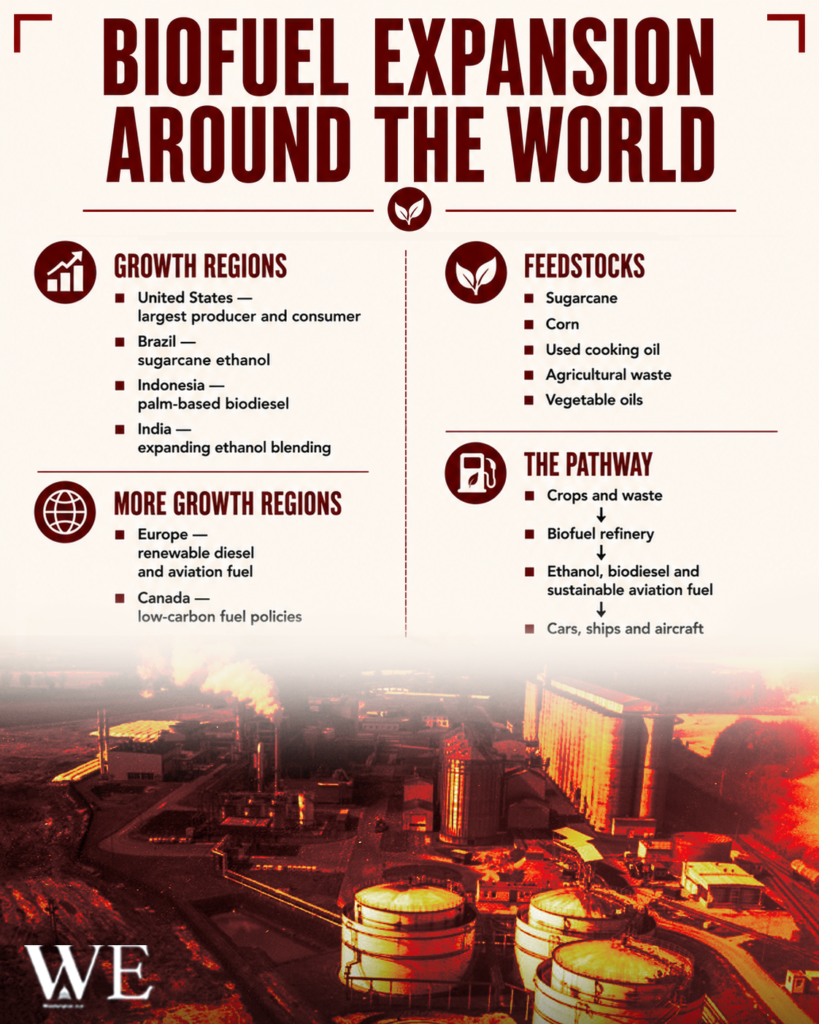
The International Energy Agency expects renewable energy’s share of global transport demand to rise from approximately 4 percent today to 6 percent by 2030. Most liquid-biofuel growth is expected in Brazil, Indonesia, India, Europe and Canada. Brazil is projected to provide about 40 percent of additional demand, followed by Indonesia at 20 percent and India at 15 percent. Sustainable aviation fuel consumption could rise from one billion litres in 2024 to nine billion litres in 2030.
Biofuels are made from biological material rather than crude oil. Ethanol is produced by fermenting and distilling sugars or starches from sugarcane, corn or other crops before blending it with petrol. Biodiesel is made by chemically processing vegetable oil, used cooking oil or animal fat. Renewable diesel and aviation fuel can be produced by hydrotreating oils and fats, converting ethanol into jet fuel, or processing agricultural and forestry residues.
The United States and Brazil remain the world’s largest ethanol producers. In March 2026, the US Environmental Protection Agency finalised record Renewable Fuel Standard requirements. Including the reallocation of volumes waived for small refineries, the total applicable requirement reached 26.81 billion ethanol-equivalent gallons for 2026, compared with a 22.33-billion-gallon standard in 2025. American producers primarily use corn for ethanol and soybean oil, fats and waste oils for renewable diesel.

Brazil introduced E30 petrol, containing 30 percent ethanol, and B15 diesel, containing 15 percent biodiesel, nationwide in August 2025. Its Fuel of the Future programme is intended to attract at least 260 billion reais in private investment. In Passo Fundo, municipal vehicles began testing BeVant, made from soy, animal fat and used oils. The fuel can completely replace diesel in standard engines but initially cost approximately 15 percent more than conventional biodiesel.
Expansion is also rapid across Asia. India achieved 20 percent ethanol blending in petrol during 2025, five years before its original deadline. Its ethanol-production capacity increased from 4.21 billion litres in 2014 to approximately 20 billion litres in 2026. Indonesia already requires palm-based B40 biodiesel and has considered introducing B50 to reduce costly diesel imports. Critics warn that higher mandates must not encourage new palm plantations in forests or peatlands.
Malaysia is building a Johor biorefinery expected to process up to 650,000 tonnes of waste oils, animal fats and residues annually when operations begin in 2028. Singapore introduced a 1 percent sustainable aviation fuel target for 2026 and is assessing an ethanol-to-jet plant capable of producing 100,000 tonnes annually. Passengers will help cover the additional expense through an aviation-fuel levy.

Europe is similarly creating demand through legislation. The European Union required sustainable aviation fuel to represent at least 2 percent of fuel supplied at major EU airports from 2025. The requirement rises to 6 percent in 2030 and 70 percent by 2050. Supply nevertheless remains limited: the International Air Transport Association expects global production of 2.4 million tonnes in 2026, representing only 0.8 percent of worldwide jet-fuel consumption.
The attraction of biofuels is their compatibility with existing vehicles and fuel-distribution systems. Properly produced fuels can lower lifecycle emissions, strengthen energy security and create rural employment. They are particularly important for aviation and shipping, where batteries remain difficult to use over long distances.
The economics, however, remain challenging. The OECD and UN Food and Agriculture Organization expect government support to remain necessary because many biofuels cost more than fossil alternatives. Sustainable aviation fuel generally costs between two and five times as much as conventional jet fuel. IATA estimated that the price premium added $3.6 billion to airline fuel costs in 2025.
Biofuels are also not automatically clean. Growing corn, sugarcane, soy or palm for fuel can compete with food production, consume water and fertiliser, or indirectly cause deforestation. Once land-use change is included, some crop-based fuels may provide far smaller carbon savings than advertised. Waste-based fuels avoid some problems, but sustainable waste supplies are limited.
Expansion will therefore be environmentally credible only if governments enforce lifecycle carbon accounting, protect ecosystems and favour wastes, residues and land-efficient crops. Biofuels can support the energy transition and reduce exposure to oil shocks, but they remain a limited resource, not a substitute for efficient transport, electric vehicles and lower fossil-fuel consumption.