
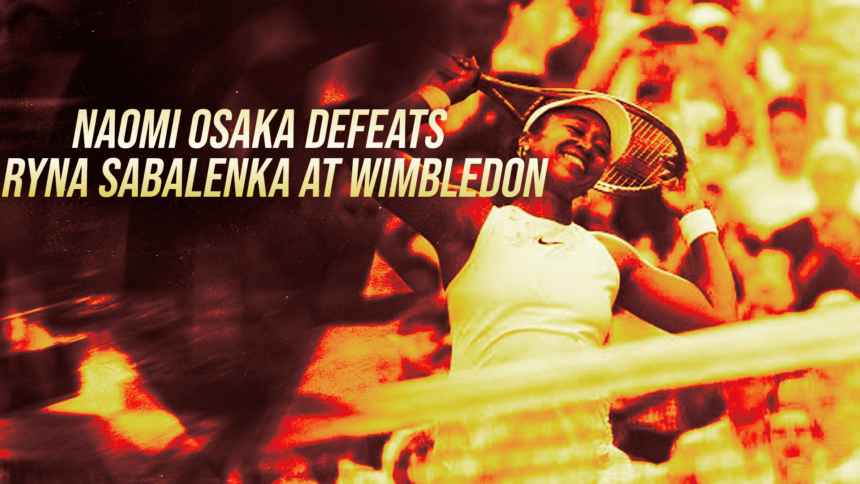
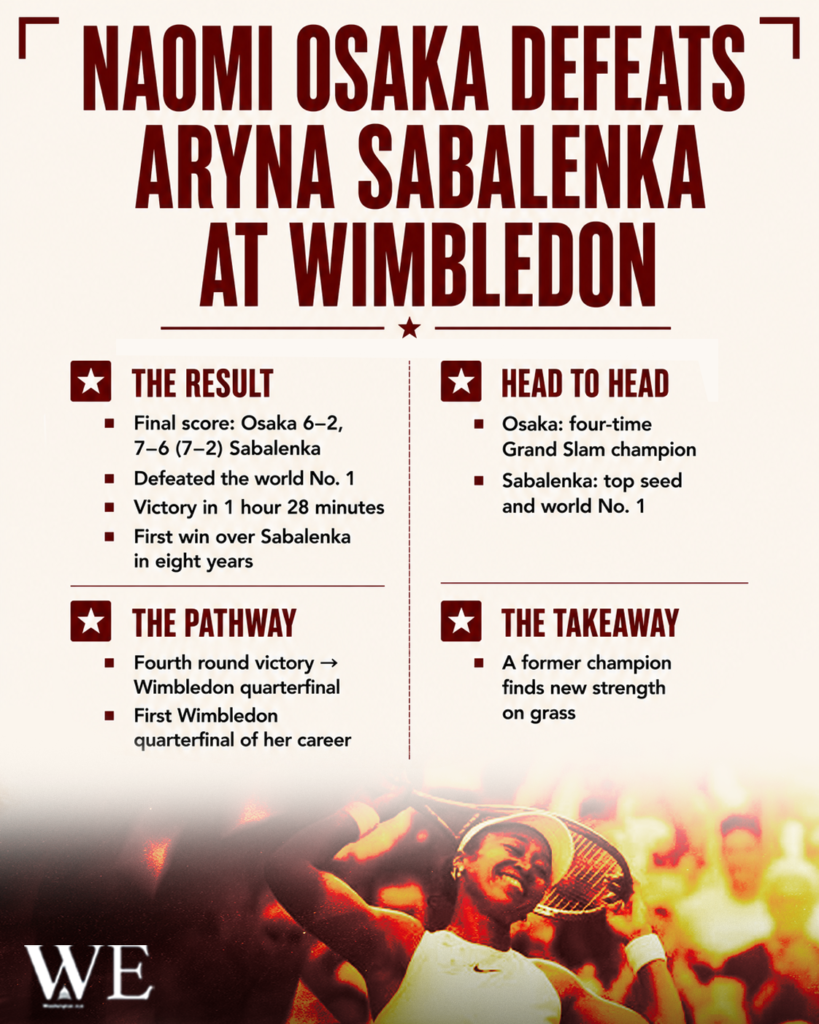
Naomi Osaka produced one of the defining performances of Wimbledon 2026 on Sunday, July 5, defeating world No. 1 Aryna Sabalenka 6–2, 7–6(2) on Centre Court. The Japanese 14th seed completed the fourth-round victory in one hour and 28 minutes, reaching the Wimbledon quarterfinals for the first time and recording her first win on the tournament’s most famous court.
The contest brought together two four-time Grand Slam champions known for powerful serves and forceful baseline hitting. Sabalenka entered as the top seed and a leading title favourite, having beaten Osaka three times during 2026, at Indian Wells, Madrid and Roland Garros. Osaka, however, arrived in strong grass-court form after defeating Elsa Jacquemot 6–1, 7–5, Anastasia Gasanova 6–3, 6–2 and Daria Kasatkina 6–1, 6–3 without dropping a set.
Sabalenka opened with a love hold, but Osaka quickly took control. A sharply angled backhand earned the first break for 2–1, beginning a run of five consecutive games. Osaka broke again for 4–1 and served out the opening set after a little more than 30 minutes. Her returns repeatedly neutralised Sabalenka’s serve, while her controlled aggression prevented the Belarusian from settling into the rallies.

The second set was more competitive. Sabalenka survived two break points during a four-deuce fifth game, saving one with an ace and another with a backhand winner. Neither player surrendered serve, forcing a tiebreak. Osaka struck an ace for 2–1 and then won six consecutive points as Sabalenka’s forehand errors increased. Sabalenka saved one match point with an ace, but Osaka converted the next to complete the upset.

The statistics reflected Osaka’s authority. She produced eight aces and 21 winners, compared with Sabalenka’s five aces and 15 winners, while winning 87 percent of her first-serve points. Her composure was especially important against an opponent whose aggressive tennis and powerful serve had made her the dominant player in the women’s rankings.
The victory was Osaka’s first over Sabalenka since the 2018 US Open and ended the world No. 1’s three-match winning run in their rivalry. It also stopped Sabalenka’s sequence of 14 consecutive Grand Slam quarterfinal appearances at tournaments she contested. Sabalenka suffered her first straight-sets Grand Slam defeat since the 2020 US Open, while her Open Era record of 21 consecutive major tiebreak victories also ended.
For Osaka, the result carried considerable importance. Before 2026, she had never progressed beyond Wimbledon’s third round. This became her sixth Grand Slam quarterfinal but her first away from hard courts. She also became the third Japanese woman in the Open Era to reach the Wimbledon singles quarterfinals, following Kimiko Date and Ai Sugiyama. The win improved her 2026 grass-court record to 8–1.

Osaka also attracted attention with her clothing. She entered Centre Court in a layered, all-white, Japanese ceremonial-style outfit created with Tokyo designer Hana Yagi. The kimono-inspired look incorporated vintage ceremonial garments, embroidered cranes, cherry blossoms and an oversized bow. Beneath it, Osaka wore a Nike tennis dress with floral details and a scalloped hem inspired by kirigami, the Japanese art of paper cutting. The ensemble complied with Wimbledon’s white dress code and was partly inspired by Lucy Liu’s character O-Ren Ishii in Kill Bill.
Afterward, Osaka said it had been a long time since she had enjoyed herself so much on court. She credited coach Tomasz Wiktorowski and her team for helping her become more comfortable on grass, while also joking that her mother’s Japanese cooking had powered her performance. Sabalenka conceded that Osaka had “overpowered” her and said her own level had been too low. Visibly frustrated, she struck a ball out of Centre Court after match point but later congratulated Osaka and wished her well.
Osaka advanced to face 10th seed Karolina Muchova in the quarterfinals. Her breakthrough run ended two days later when Muchova won 7–6(4), 6–4, but that defeat did not erase the importance of Osaka’s victory over Sabalenka. It demonstrated that, following maternity leave and a demanding return to competition, the former world No. 1 could again defeat the sport’s leading players, and compete seriously on grass.