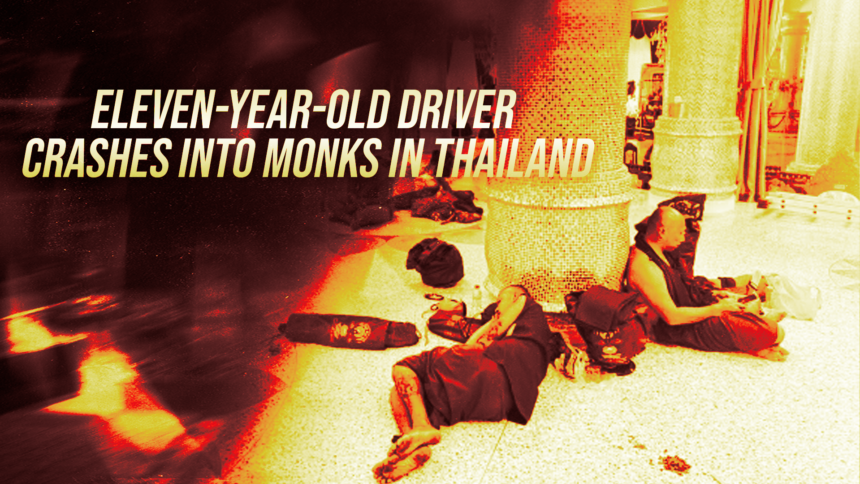
Ten Buddhist monks were killed and more than 10 others injured after an 11-year-old boy driving his family’s pickup truck crashed into a religious procession in northeastern Thailand. The tragedy occurred shortly before 11 a.m. on July 2, 2026, along the Mukdahan–Don Tan Road near Ban Na Wiang Kae in Mukdahan province, approximately 600 kilometres northeast of Bangkok.
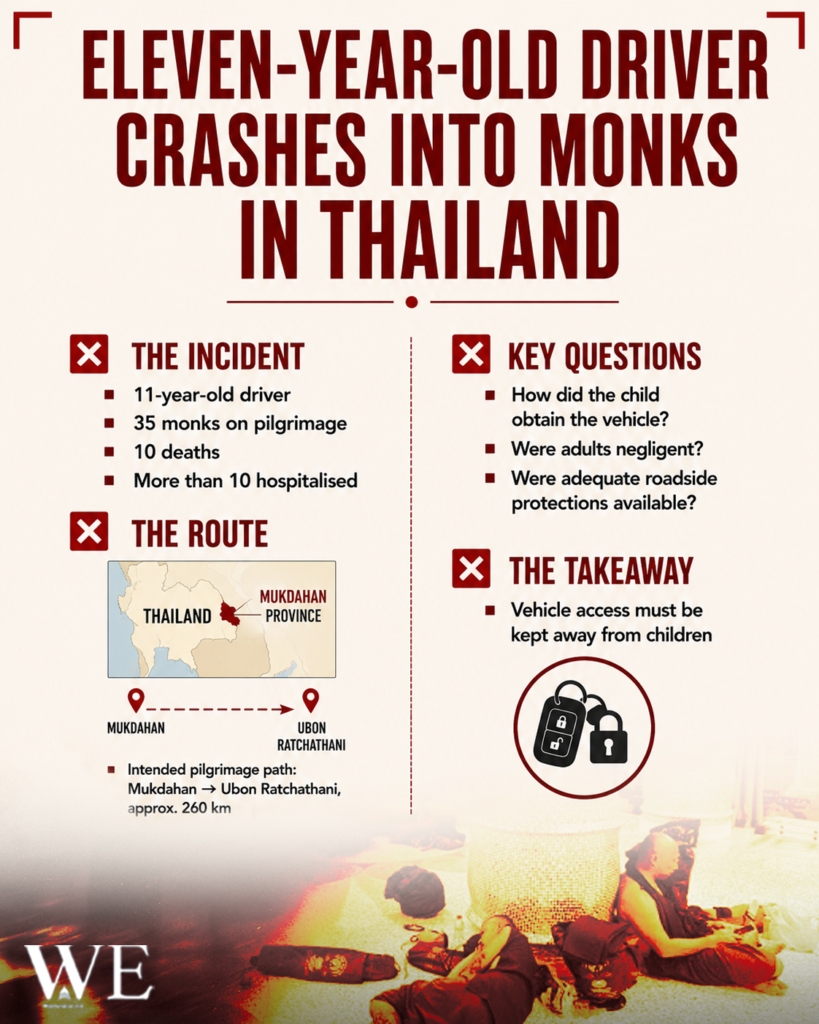
The monks were walking in single file along the roadside as part of a traditional Buddhist pilgrimage, known as tudong. The group comprised 34 monks and five lay followers travelling from Mukdahan toward neighbouring Ubon Ratchathani province. They had reportedly begun the planned 260-kilometre journey only about 30 minutes before the collision.
Security-camera footage released by the Ruam Jai Mukdahan Rescue Association showed the monks proceeding in an orderly line before the pickup suddenly entered their path. Surviving monks told investigators that the vehicle appeared to be swerving before it left the roadway and struck the procession. Five monks died at the scene, while five others later succumbed to their injuries in hospital. More than 10 people required hospital treatment, including several who were initially reported to be in critical condition.

Police said the boy had taken the pickup from his family home without permission and driven approximately 10 kilometres before the crash. Investigators later confirmed through surveillance footage and forensic evidence that he was alone inside the vehicle. The boy’s grandmother told authorities that she became aware he had taken the truck and sought police assistance to intercept it, but the collision occurred before officers could stop him.

The precise reason the boy took the vehicle remains under investigation. He had reportedly stayed home from his special-education centre that day because he was unwell. Education officials suggested he might have learned how to operate parts of the vehicle by closely observing relatives who regularly drove him to school. However, police also investigated whether anyone had directly taught him to drive. Officials have not presented evidence that the collision was intentional.
Thailand’s Ministry of Social Development and Human Security confirmed that the child was registered as having autism and required immediate psychological and welfare support. Authorities urged the public not to circulate photographs identifying him or his family. The diagnosis itself has not been established as the cause of the crash, and officials stressed the importance of avoiding speculation or the stigmatization of people with autism.
The boy’s age has significantly affected the legal proceedings. Section 73 of Thailand’s Criminal Code provides that a child aged 12 or younger cannot receive criminal punishment for an act defined as an offence. Child-protection measures can nevertheless be imposed, while investigators may examine the responsibility of parents or guardians. Mukdahan police questioned at least 28 witnesses and considered action against the boy’s mother and grandmother for alleged neglect under the Child Protection Act. Reports said investigators were examining how the child obtained the keys and whether adults had previously allowed him to operate the vehicle. No final judicial ruling was announced in the reports reviewed.

The deaths prompted mourning across predominantly Buddhist Thailand, where monks occupy a deeply respected place in public life. Mukdahan Governor Vorayan Bunarat described the tragedy as a lesson in road safety and parental responsibility, emphasizing that families must prevent children from gaining access to vehicles. King Maha Vajiralongkorn and Queen Suthida placed the injured monks under royal patronage and granted royal sponsorship for the funeral rites of those killed.
The accident has renewed concern about road safety in Thailand. The World Health Organization estimates that 18,218 people died on Thai roads in 2021, an average of about 50 deaths each day, placing the country among those with the world’s highest road-traffic death rates. The Mukdahan tragedy has added a new dimension to that debate by highlighting vehicle security, parental supervision and the protection of children with additional care needs.