

A tense moment highlighting the deep political divisions surrounding global sport unfolded recently when the President of the Palestinian Football Association reportedly refused to shake hands with the President of the Israel Football Association during an official football gathering, drawing renewed attention to the intersection of sport and geopolitics.
The incident occurred on the sidelines of an international football meeting associated with FIFA, where officials from across the world convened to discuss the future of the game, governance issues, and global tournaments. While such events typically emphasize unity, fair play, and cooperation, the refusal of a handshake underscored the enduring tensions linked to the broader Israeli-Palestinian conflict.
According to officials present, the Palestinian FA president deliberately avoided a customary handshake with his Israeli counterpart, a symbolic gesture often used in diplomacy and sport to demonstrate mutual respect despite differences. The moment, though brief, quickly gained attention as it reflected the ongoing strain between the two associations, rooted in decades of political conflict, territorial disputes, and accusations relating to restrictions on Palestinian sports activities.

The Palestinian Football Association has long raised concerns within FIFA regarding the movement of Palestinian players, restrictions on infrastructure development, and the inclusion of football clubs based in Israeli settlements located in disputed territories. These issues have repeatedly been brought before FIFA’s governing bodies, with calls for disciplinary action or policy changes. On the other hand, the Israel Football Association has defended its position, arguing that it operates within its national framework and complies with FIFA regulations.

The refusal to engage in a handshake is widely interpreted as a protest rather than a spontaneous act. Analysts note that such symbolic gestures are often used in international forums to send political messages without direct confrontation. In this case, it signals continued dissatisfaction from the Palestinian side over what it perceives as unresolved grievances within global football governance structures.
Gianni Infantino, who has repeatedly emphasized football’s role as a unifying force, has in the past urged both associations to resolve disputes through dialogue and within FIFA’s institutional framework. While there has been no official statement from FIFA specifically addressing this latest incident, the organization has historically maintained that sport should remain neutral while also acknowledging the complexities of real-world conflicts affecting its member associations.
The broader context of the incident is inseparable from the ongoing Israeli-Palestinian conflict, which has seen periods of escalation and attempts at peace negotiations over many decades. In such an environment, even sporting interactions carry political weight. Football, being one of the most globally visible sports, often becomes a platform where political tensions are reflected, amplified, or symbolically contested.

Experts in sports diplomacy argue that while gestures like handshake refusals may appear minor, they can have significant symbolic impact. They highlight how sport can both bridge divides and expose fractures. In some instances, sporting engagements have helped open channels of communication between rival sides; in others, they have mirrored the breakdown of diplomatic relations.
Reactions to the incident have been mixed. Some observers view the refusal as a legitimate expression of protest, emphasizing the importance of addressing underlying issues rather than focusing solely on symbolic acts. Others argue that such actions undermine the spirit of sport, which aims to foster respect and cooperation regardless of political differences.
Despite the tension, FIFA continues to advocate for engagement between the two associations. Previous efforts have included mediation attempts, committees to examine disputes, and proposals aimed at improving conditions for Palestinian football development. However, progress has often been slow and complicated by the broader political landscape.
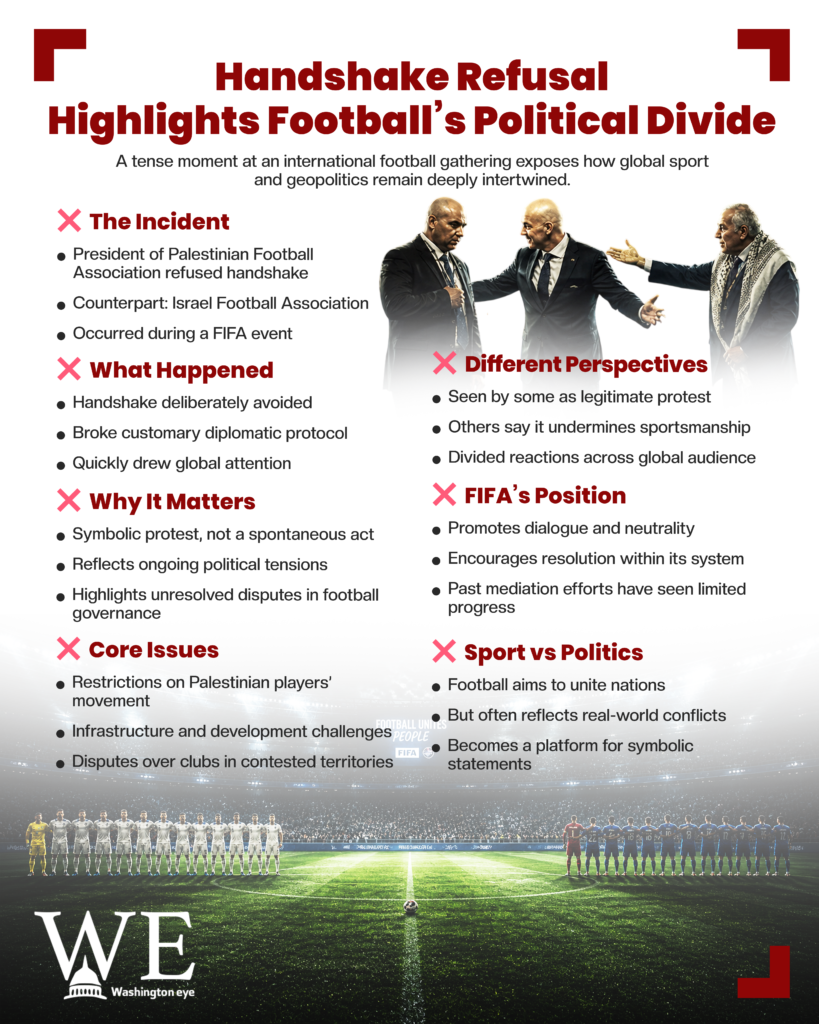
The incident serves as a reminder that global sport does not exist in isolation. While football organizations strive to promote unity, the realities of international politics frequently intrude, shaping interactions both on and off the field. As long as the underlying conflict remains unresolved, such moments are likely to recur, challenging FIFA’s vision of football as a universal language capable of transcending divisions.