
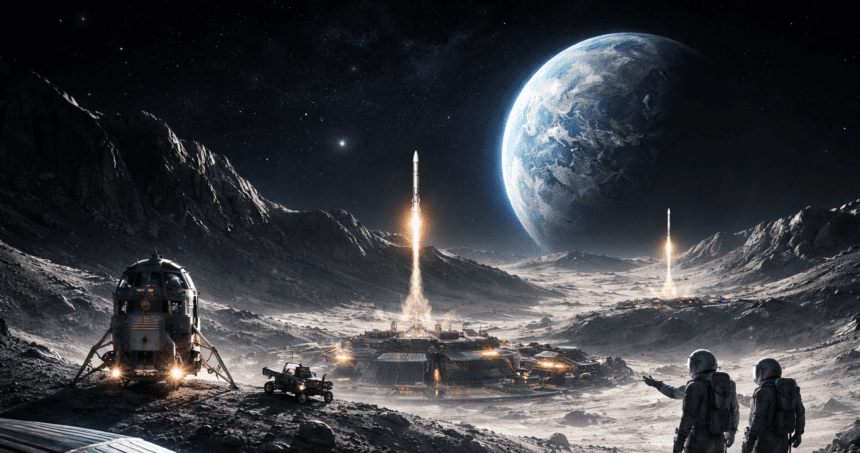
The renewed global push to return humans to the Moon marks a defining shift in space exploration, blending scientific ambition, geopolitical strategy, and commercial opportunity. More than five decades after Apollo 11 Moon Landing, space agencies are preparing for sustained lunar presence rather than brief visits. At the center of this effort is the Artemis Program, led by NASA, which aims to land astronauts near the Moon’s south pole later this decade, including the first woman and the first person of color. Unlike the Cold War-era race, today’s missions involve international partnerships, private companies, and long-term goals extending beyond symbolic achievement.
The “when” of this return is already underway. Uncrewed test flights such as Artemis I have successfully orbited the Moon, while Artemis II is expected to carry astronauts around it before a crewed landing attempt in the coming years. Parallel missions by other countries are also accelerating timelines. China has outlined plans for a lunar research station with Russia, while India’s Chandrayaan missions and Japan’s lunar exploration initiatives reflect a broader international interest. This multi-actor landscape underscores that the Moon is no longer just a destination, it is becoming a shared arena of scientific and strategic activity.
The “where” is equally significant. Unlike earlier missions that focused on equatorial regions, current efforts target the Moon’s south pole, particularly areas such as the Shackleton Crater. Scientists believe this region contains permanently shadowed craters that may hold water ice, an invaluable resource that can be converted into drinking water, breathable oxygen, and even rocket fuel. Establishing a presence here would allow astronauts to stay longer and support future missions deeper into space.

The reasons for going back, arguably the most important dimension, are both scientific and practical. First, the Moon serves as a natural laboratory for understanding the early history of the solar system. Its surface preserves geological records that Earth has lost due to erosion and tectonic activity. Second, the Moon is viewed as a testing ground for technologies needed for human missions to Mars. By developing sustainable habitats, life-support systems, and resource utilization techniques on the Moon, space agencies can reduce risks before attempting longer journeys to Mars.

Beyond science, there are strategic and economic motivations. The growing involvement of private companies, such as SpaceX and Blue Origin, signals a shift toward commercialization. These firms are developing spacecraft, landers, and infrastructure that could enable lunar tourism, mining, and logistics. Resources like helium-3, a potential fuel for future nuclear fusion, have been cited as long-term economic incentives, though practical extraction remains uncertain.
Geopolitics also plays a crucial role. Just as the original space race symbolized technological superiority, today’s lunar ambitions reflect national prestige and influence. Agreements such as the Artemis Accords aim to establish norms for peaceful exploration and resource sharing, but not all major players have signed on, raising questions about future governance of lunar activities. The Moon is increasingly seen as a strategic frontier where scientific collaboration and competition coexist.
Another key difference from past missions is the emphasis on sustainability. Unlike Apollo-era missions that lasted only days, Artemis and related programs envision months-long stays, eventually leading to a permanent or semi-permanent human presence. Concepts for lunar bases include habitats powered by solar energy, 3D-printed structures using lunar soil, and systems designed to recycle air and water. These developments align with a broader shift toward long-duration space habitation.

Public interest and inspiration remain vital drivers. The return to the Moon is framed not only as a technological milestone but as a unifying human endeavor. By involving multiple nations and private entities, space agencies hope to democratize exploration and inspire a new generation of scientists, engineers, and explorers. Educational outreach, global partnerships, and media coverage all contribute to making lunar missions a shared human narrative rather than a single nation’s achievement.
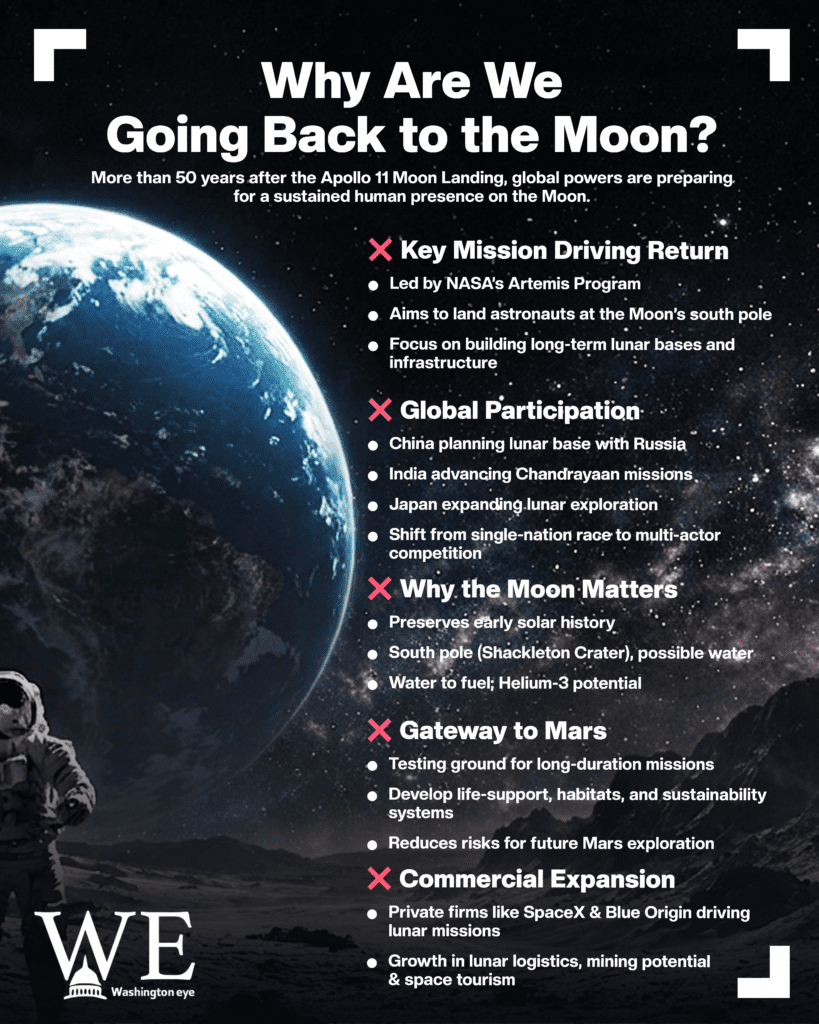
In essence, humanity is going back to the Moon not to repeat history, but to build upon it. The focus has shifted from planting flags to establishing footholds, from short visits to sustained presence, and from national rivalry to a complex mix of cooperation and competition. As missions gather momentum, the Moon is poised to become a gateway, both scientifically and symbolically, to humanity’s next great leap into the cosmos.