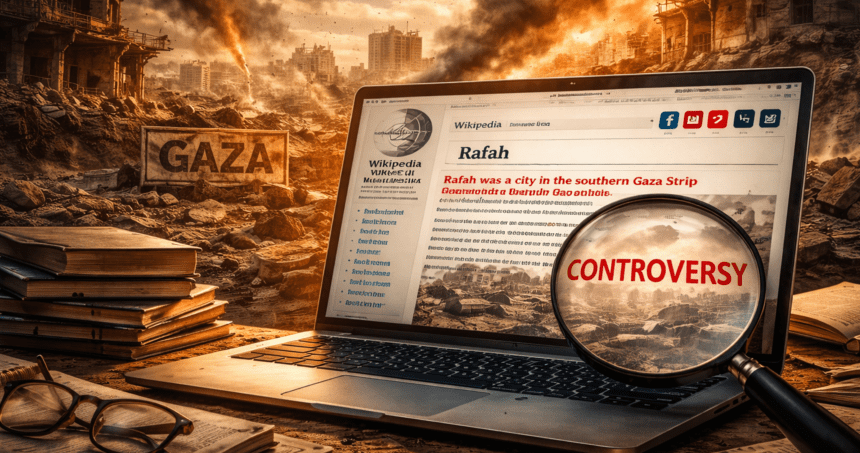
In recent days, controversy has erupted online after claims surfaced that Wikipedia has begun referring to several cities in Gaza in the past tense, describing them as “former” locations. The alleged edits, reportedly affecting cities such as Rafah and Beit Hanoun, have ignited widespread debate across social media, journalism circles, and academic communities, raising questions about narrative framing, neutrality, and the ethics of documenting an ongoing war.
The controversy emerges amid the ongoing Gaza war, which began on October 7, 2023, following a Hamas-led attack on Israel and a subsequent large-scale Israeli military response. The war has resulted in massive destruction across the Gaza Strip, with estimates suggesting that a significant portion of infrastructure, homes, roads, and public services, has been damaged or destroyed. This level of devastation has led some observers to describe entire neighborhoods and cities as effectively erased or uninhabitable.
Reports circulating online claim that Wikipedia editors have started reflecting this destruction linguistically, referring to certain Gazan localities in the past tense or labeling them as “former cities.” While the platform itself has not issued an official statement confirming a systemic policy change, the edits appear to stem from contributions by its volunteer editor community. Wikipedia operates on a decentralized model where content is written and updated by unpaid contributors worldwide, guided by principles such as neutrality, verifiability, and consensus.
The issue has quickly become politicized. Critics argue that describing cities in the past tense while the war is still ongoing may prematurely imply their permanent destruction and erase the lived reality of displaced residents who may return. Many activists and commentators have framed the move as part of a broader narrative battle over how the Gaza conflict is represented globally, particularly in digital knowledge platforms that shape public understanding.

Others, however, defend the edits as reflective of on-the-ground realities. With reports indicating that up to 70 percent of structures in Gaza have been destroyed or severely damaged, some editors argue that language must evolve to accurately describe the scale of devastation. In this view, referring to heavily destroyed areas in the past tense is not political but descriptive, capturing what they see as a form of “urbicide”, the destruction of urban life.
The debate also highlights longstanding tensions within Wikipedia regarding bias and editorial control, especially on politically sensitive topics. Previous disputes over Gaza-related pages have led to so-called “edit wars,” where contributors repeatedly override each other’s changes. In some cases, pages have been locked or restricted to prevent further conflict, underscoring the difficulty of maintaining neutrality in real-time coverage of war.
Reactions to the latest controversy have been sharply divided. Pro-Palestinian voices have accused Wikipedia of hypocrisy, arguing that similar language has not been used in other conflict zones where cities were destroyed but later rebuilt. They contend that such framing risks normalizing the idea that Gaza’s cities are gone forever, effectively aligning with narratives that deny Palestinians a future in their homeland.

On the other hand, some pro-Israel commentators and neutral observers caution against oversimplifying the issue. They emphasize that Wikipedia’s content is not dictated by governments or a central authority but is instead shaped by a complex process of sourcing, debate, and consensus among editors. They also point out that the platform has faced criticism from multiple sides, including accusations of bias both for and against Israel in different contexts.
The controversy reflects a broader phenomenon described by analysts as the “information war” surrounding Gaza, where narratives are contested not only on the battlefield but also online. According to research, the conflict has generated an unprecedented surge of digital content, propaganda, and competing interpretations, turning platforms like Wikipedia into key arenas for shaping global perception.
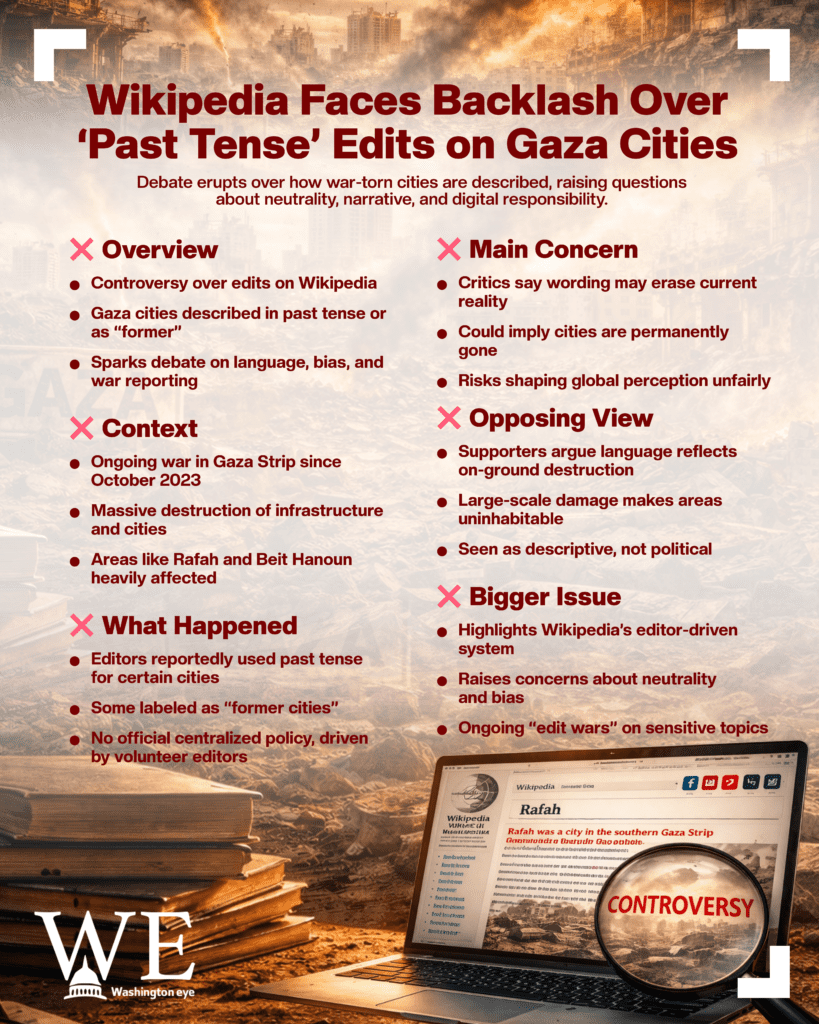
As the war continues, the debate over language on Wikipedia underscores a deeper question: how should ongoing destruction be documented in real time? For some, using past tense risks closing the door on recovery and return. For others, it is a stark acknowledgment of the scale of loss already endured.In the absence of a clear resolution, the issue is likely to persist, reflecting the broader divisions that define discourse on Gaza today, where even grammar becomes a site of conflict.