

A fresh wave of headlines this month has reignited an old anxiety: are younger people getting “less smart”? The claim centers on Generation Z, typically defined as those born from the late 1990s to the early 2010s, being the first modern cohort to perform worse than the generation before them on a cluster of cognitive and academic indicators often used as proxies for intelligence, including attention, memory, literacy, numeracy and, in some reporting, overall IQ. The argument has been amplified by neuroscientist Dr. Jared Cooney Horvath, who has publicly linked the trend to heavy screen exposure and a rapid shift toward education technology replacing deep reading and teacher-led instruction.
The “when” and “where” behind the debate are less about a single lab result and more about a convergence of data points from recent years: post-pandemic learning assessments, long-running national test trends, and decades of intelligence-testing research that suggests the famous “Flynn effect”, the 20th-century rise in IQ scores, has slowed, stalled or reversed in some countries. In OECD’s PISA 2022 results, 15-year-olds across many systems saw record drops in mathematics and a large decline in reading between 2018 and 2022, with analysts pointing to disruption, absenteeism, and broader skill erosion. In the United States, NAEP results have also documented a yearslong slide in reading and math performance that worsened around the pandemic years and has not fully rebounded.
What makes the Gen Z framing so controversial is that IQ is not the same as school performance, and it is not measured everywhere in the same way. Many of the most rigorous findings in this space come from longitudinal or population datasets (such as conscription testing in Nordic countries) that track cognitive test performance over time, showing that gains seen for much of the 1900s weakened and, in some cohorts, turned negative. A widely cited Danish analysis reported declines in young adult cognitive test scores after the late 1990s, following decades of increases. A separate peer-reviewed analysis has also described “reverse Flynn effects” in some age groups, cautioning against assuming one global pattern for all populations.

So why do some experts say Gen Z is the “first” to dip? Part of it is narrative shorthand: Gen Z is the first generation to grow up with smartphones, algorithmic feeds, and always-on digital life as the default. Horvath and like-minded commentators argue that constant partial attention, scrolling, skimming, multitasking, trains the brain away from sustained focus, which is essential for complex reading, math reasoning and memory formation. They also argue that putting tablets and screens at the center of classrooms can inadvertently reduce deep practice (like long-form reading, deliberate problem sets, handwriting, and uninterrupted discussion), replacing it with faster, thinner engagement.
Other researchers emphasize a more crowded list of drivers and warn against blaming one culprit. Pandemic-era schooling disruptions are an obvious accelerant, but not the only one: learning gaps were growing in some systems well before 2020, and inequality appears to be widening, with low-performing students slipping further behind. Meanwhile, changing reading habits, less time spent on books and long articles, more time on short video and bite-sized text, may chip away at vocabulary growth and comprehension stamina, which can drag down performance on tests that rely on those skills.
The “past versus present” comparison also depends on who is being compared. Millennials (born roughly 1981–1996) largely went through childhood before smartphones dominated daily life, while Gen Z entered adolescence as social media and mobile internet became mainstream. By the time Gen Z reached school and early work years, the attention economy was aggressively optimized for engagement, not concentration. That does not automatically mean Gen Z has lower innate ability, intelligence is shaped by environment, opportunity, nutrition, schooling quality, and cultural habits, but it does mean the cognitive “training ground” has changed dramatically.
Still, even sympathetic analysts urge caution with sweeping labels like “dumber.” IQ tests measure performance on specific tasks under specific conditions; they do not capture creativity, social intelligence, resilience, or job-relevant skills like digital navigation and multimedia communication. And “Gen Z” is not a single experience: education access, parental support, language background and socioeconomic conditions can be bigger predictors of outcomes than generation alone. The more responsible takeaway from the current debate is not that one cohort is doomed, but that modern learning environments may be producing measurable declines in foundational skills, and those declines are showing up across multiple international and national indicators at the same time.

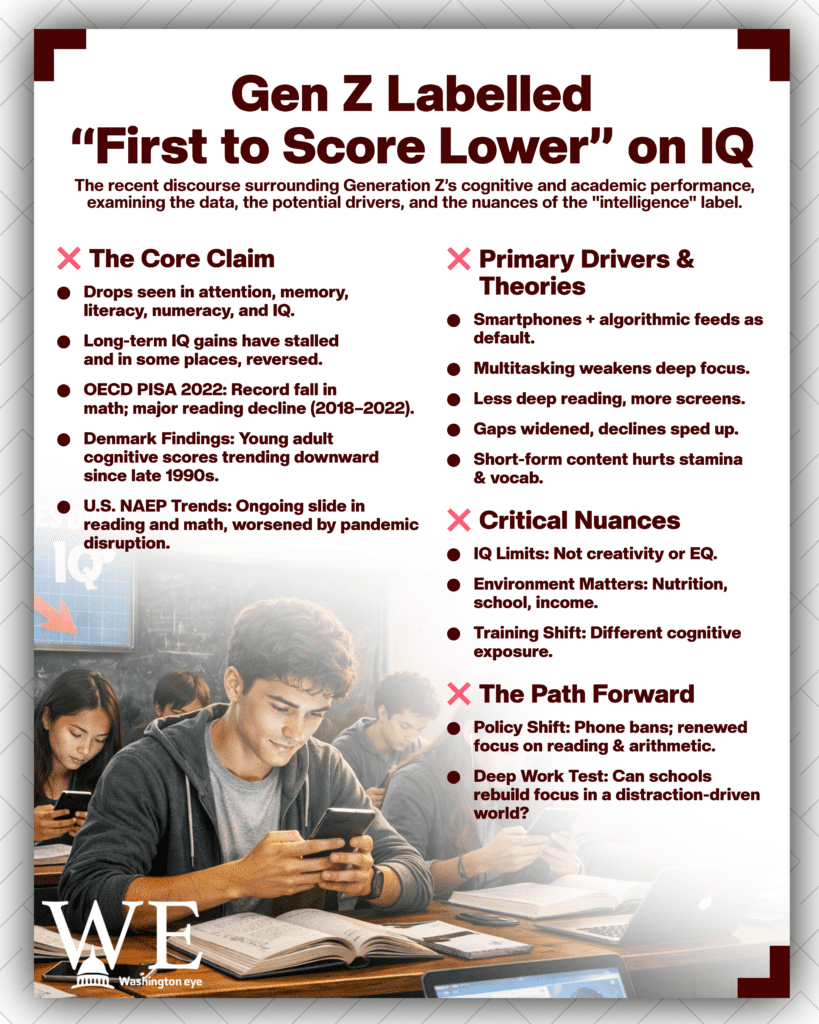
As policymakers and schools weigh responses, phone restrictions in classrooms, renewed emphasis on reading and arithmetic fundamentals, and limits on passive screen use, the argument is likely to intensify. For Gen Z, the question is no longer whether technology is part of life, but whether education systems can help students build “deep work” skills, focus, memory, reasoning, inside a world engineered for distraction.