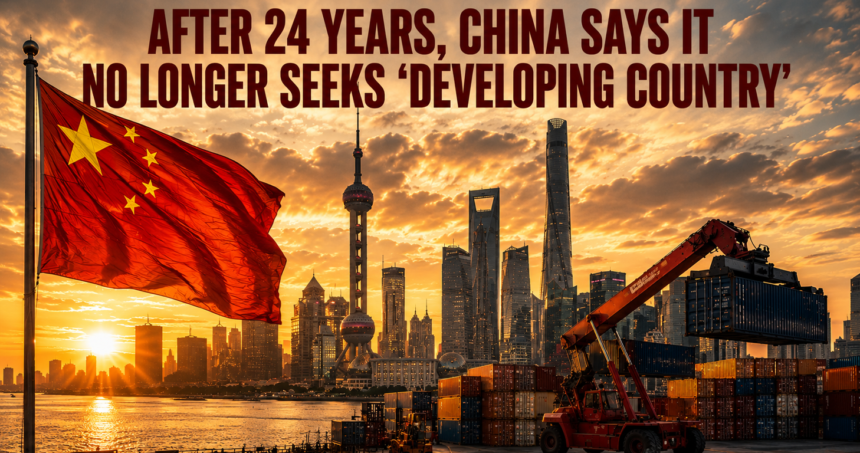
In a move that reflects its growing economic weight and evolving role in the international system, China has announced that it will no longer seek the special trade benefits traditionally granted to developing countries under future World Trade Organization (WTO) negotiations. The decision marks a significant shift nearly 24 years after China joined the WTO in 2001 as a developing country and has reignited debate over whether the world’s second-largest economy can still be considered part of the developing world.
The announcement was made by Chinese Premier Li Qiang during a high-level international development forum held alongside the United Nations General Assembly in New York. Chinese officials later clarified that Beijing would voluntarily forgo so-called “Special and Differential Treatment” (SDT) benefits in future WTO agreements. These benefits have historically allowed developing countries greater flexibility in implementing trade rules, longer transition periods, and certain exemptions from obligations faced by advanced economies.
China’s decision comes after years of criticism from the United States and several Western economies, which argued that the country’s continued use of developing-country privileges no longer reflected economic reality. China is now the world’s second-largest economy by nominal GDP, the largest exporter of goods, and a dominant force in global manufacturing and technology. Its economy is valued at more than $20 trillion, while its population exceeds 1.4 billion people.

The WTO welcomed the move. WTO Director-General Ngozi Okonjo-Iweala described the decision as a “pivotal moment” that could contribute to a more balanced and equitable trading system. Trade analysts say the announcement may help reduce long-standing tensions between Beijing and Washington over global trade rules and could remove one of the obstacles to broader WTO reform efforts.
However, China has stopped short of declaring itself a fully developed nation. Chinese diplomats stressed that while the country will no longer seek future trade advantages associated with developing-country status, it will continue to identify itself as a developing country. Officials argue that national wealth alone does not tell the full story. Despite impressive economic growth, China remains an upper-middle-income country with significant regional disparities, lower per-capita income levels than many developed nations, and persistent development challenges in rural provinces.
“China remains a key member of the Global South and will always be a developing country,” China’s WTO representative Li Yihong said while explaining the government’s position. Beijing maintains that economic development should be measured not only by aggregate GDP but also by living standards, income distribution, and social development indicators.
The distinction highlights a broader debate that has existed within international institutions for decades. Unlike the United Nations’ classification systems, the WTO does not formally define what constitutes a developed or developing country. Instead, member states largely self-identify their status, though other members may challenge claims when trade benefits are involved. This ambiguity has enabled countries such as China to retain developing-country status while simultaneously becoming economic superpowers.

Supporters of China’s decision argue that it reflects the country’s growing responsibility within the international system. They note that Beijing has become a major lender, investor, and provider of infrastructure financing across Asia, Africa, and Latin America through initiatives such as the Belt and Road Initiative. By giving up special treatment, China may strengthen its image as a responsible stakeholder in global trade governance.
Critics, however, contend that the move is largely symbolic because China is retaining its broader developing-country identity while relinquishing only future WTO privileges. Some analysts argue that Beijing seeks to enjoy the political influence that comes from leading the Global South while simultaneously leveraging the economic advantages of a major power. Others point out that China’s per-capita income remains considerably below that of advanced economies such as the United States, Germany, and Japan, suggesting that the country’s development story is still incomplete.
The decision also carries geopolitical implications. As trade tensions, technology competition, and industrial policy disputes continue to reshape the global economy, China appears eager to position itself as a defender of multilateral trade and international cooperation. Observers say the move could help Beijing build stronger partnerships with both developed and developing nations while presenting itself as a bridge between the two worlds.
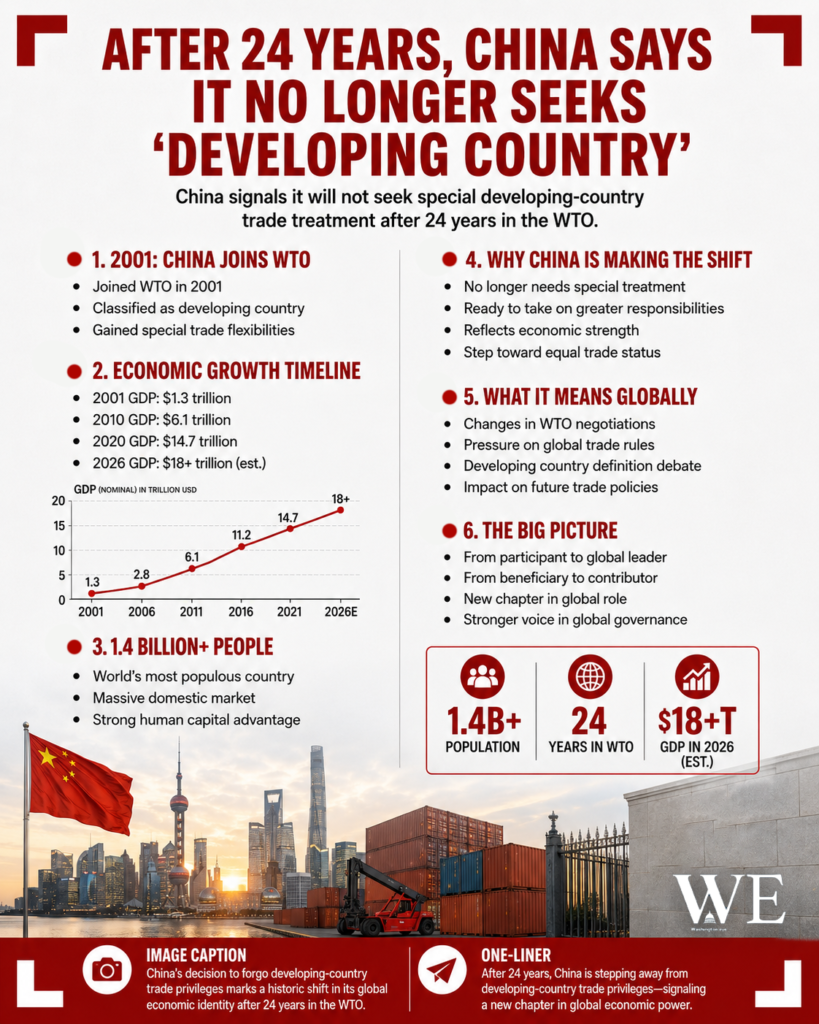
Whether China is truly a developed country remains a matter of perspective. Economically, its scale and global influence rival those of the world’s richest nations. Yet its income levels, demographic pressures, and uneven development continue to resemble characteristics associated with developing economies. What is clear is that China’s latest decision marks another milestone in its remarkable transformation from a low-income economy in the late twentieth century to one of the most influential powers shaping the twenty-first century global order.