
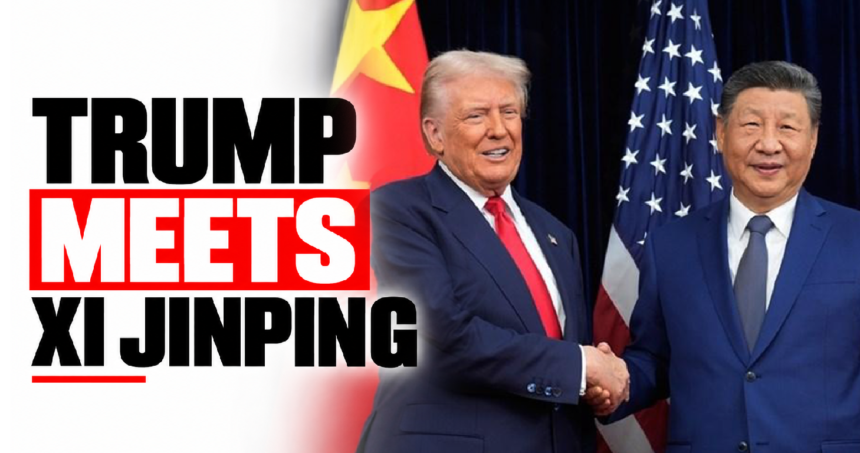
Chinese President Xi Jinping returned to the White House on September 24 for a high-profile state visit hosted by U.S. President Donald Trump, bringing the leaders of the world’s two largest economies together at a time of intense competition over trade, artificial intelligence, critical minerals, security and Taiwan.
Xi’s visit to the United States ran from September 23 to 25, 2026, at Trump’s invitation and marked his first trip to Washington in more than a decade. It also followed Trump’s visit to China earlier this year, making the reciprocal presidential meetings within six months an unusual period of intensive leader-level diplomacy between Washington and Beijing.
Trump personally greeted Xi and his wife, Peng Liyuan, at Joint Base Andrews on September 23, an unusual diplomatic gesture for a U.S. president. The following day, Trump and First Lady Melania Trump formally welcomed the Chinese president and first lady at the White House with an elaborate state arrival ceremony, military honors and a review in the Rose Garden. A state dinner was held later in the evening.

Trade, AI and Global Security Dominate Talks
Behind the ceremonial welcome were difficult negotiations over the future of U.S.-China relations. Trump and Xi discussed trade, tariffs, artificial intelligence, technology, rare-earth supplies, Taiwan and international security, including developments involving Iran, Russia and North Korea.
Trade remained one of the most important areas of negotiation. The two governments agreed to move forward with their newly established trade mechanisms and reached recommendations for more favorable tariff treatment covering $30 billion worth of non-sensitive goods in each direction. The countries also agreed to continue discussions on agricultural market access and investment.
However, the meeting did not eliminate the deeper economic rivalry between Washington and Beijing. Reuters reported that the existing trade truce was extended for another two months, giving negotiators additional time to address unresolved disputes involving tariffs, Chinese purchases, technology restrictions and supplies of rare-earth minerals.
Critical minerals remain particularly important because China plays a dominant role in global rare-earth processing and supply chains. These materials are essential for products ranging from electric vehicles and electronics to advanced military equipment.

Artificial intelligence emerged as another major area where competition and cooperation are developing simultaneously. The two countries agreed to establish a bilateral AI dialogue to discuss the risks and benefits of the technology and create a communication channel for AI-related incidents. The next exchange is expected in November 2026.
Xi said the two countries could compete in AI while still cooperating, arguing that the technology should remain under human control and that Washington and Beijing should work to prevent its misuse.
Taiwan Remains Major Point of Disagreement
Despite the warmer diplomatic atmosphere, Taiwan remained one of the most sensitive issues surrounding the summit. Beijing considers Taiwan part of China and strongly opposes U.S. arms sales to the self-governing island. Before Xi arrived in Washington, Reuters reported that he was expected to press Trump over American weapons sales to Taiwan and invoke commitments contained in the 1982 U.S.-China communiqué. The United States, meanwhile, maintains unofficial relations with Taipei and is required under U.S. law to provide Taiwan with means for its self-defense.
During the talks, Xi reiterated Beijing’s position on what it calls national reunification and territorial integrity and urged Washington to oppose Taiwanese independence and handle the issue cautiously. The visit produced no indication that the fundamental differences over Taiwan had been resolved.
International security also featured prominently. The two leaders discussed Iran and agreed that Tehran should not develop nuclear weapons. They also exchanged views on the war involving Russia and Ukraine, North Korea and broader global security concerns.
The visit additionally produced cooperation on counternarcotics and law enforcement. Both governments highlighted recent cooperation against precursor chemicals used in illegal drugs. China and the United States also agreed to work toward improved military crisis communication, an important mechanism given the risk of encounters between their armed forces in the Indo-Pacific.
Symbolism, Competition and an Attempt at Stability
Trump publicly emphasized his relationship with Xi, while the Chinese president called for what Beijing describes as “healthy competition” and greater cooperation between the two powers. Both governments portrayed continued high-level dialogue as important for keeping the relationship stable.
The diplomatic symbolism was extensive. Xi and Peng attended a state dinner at the White House, while Peng and Melania Trump visited the Smithsonian’s National Museum of Asian Art. On September 25, the two presidential couples also visited the National Archives before Xi concluded his state visit.
Yet the visit did not erase the strategic rivalry between the countries. Washington and Beijing continue to compete for technological leadership, economic influence and strategic power, while disagreements over Taiwan, trade restrictions and security remain unresolved. Analysts quoted ahead of the summit therefore emphasized that maintaining communication itself was an important objective, even without a sweeping agreement.
The visit nevertheless produced several concrete areas of cooperation, including trade mechanisms, an AI dialogue, counternarcotics efforts and plans for improved military crisis communication. Both governments also agreed to support each other as hosts of major international gatherings, with China hosting the 2026 APEC Economic Leaders’ Meeting and the United States hosting the G20 summit.
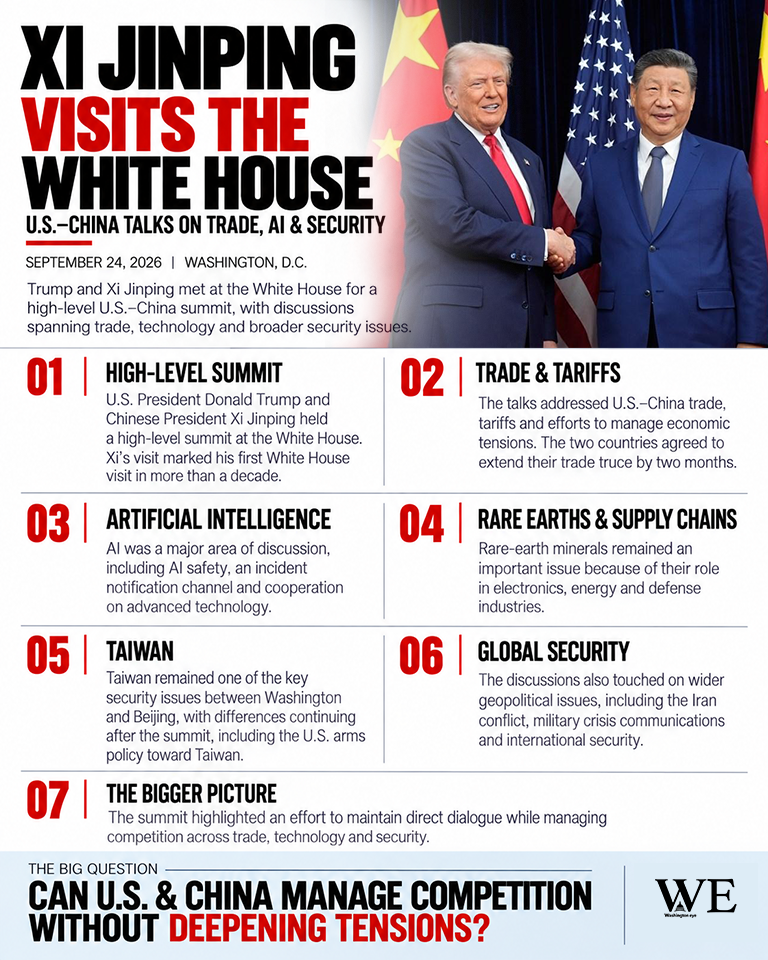
Xi’s return to Washington therefore represented less a resolution of U.S.-China competition than an effort to manage it. The two powers remain divided on some of the world’s most consequential economic and security questions, but the White House meeting demonstrated that both governments currently see direct presidential diplomacy as a way of preventing those disputes from destabilizing the wider relationship.