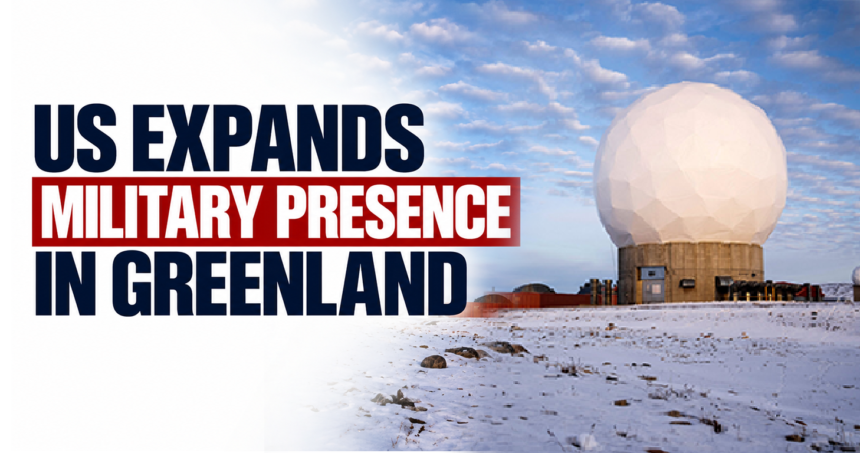
The United States is set to establish two additional military bases in Greenland under a new security agreement with Denmark and Greenland, significantly expanding Washington’s military footprint in the Arctic as competition over the strategically important region intensifies.
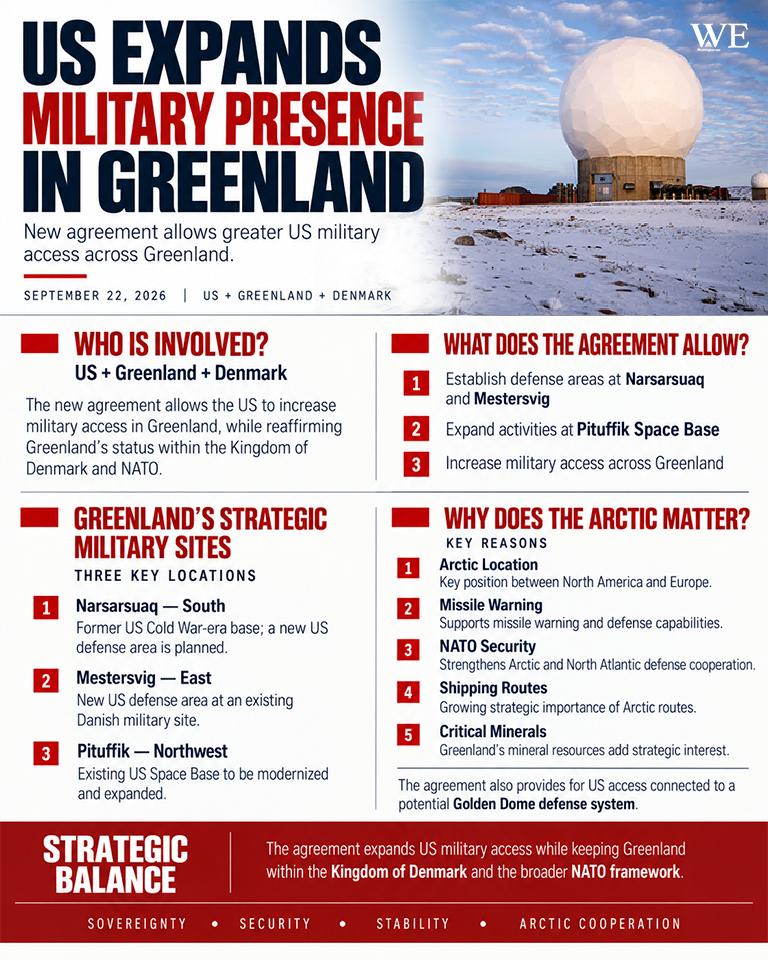
US President Donald Trump, Danish Prime Minister Mette Frederiksen and Greenlandic Prime Minister Jens-Frederik Nielsen signed the agreement on September 22, 2026, on the sidelines of the United Nations General Assembly in New York. The deal allows the United States to establish military facilities at Narsarsuaq in southern Greenland and Mestersvig on the island’s east coast, while also expanding operations at the existing Pituffik Space Base in northwestern Greenland.
The agreement represents a major development after months of diplomatic tension over Greenland. Trump had repeatedly argued that control of the vast Arctic island was essential for US national security and had previously declined to rule out economic or military pressure to acquire it. Denmark and Greenland firmly rejected any transfer of sovereignty. The new agreement offers a different outcome: Greenland remains part of the Kingdom of Denmark, while Washington receives broader military access and long-term security rights.
Where Will the New US Bases Be?
One of the new facilities will be established at Narsarsuaq, a small settlement in southern Greenland with an important place in US military history. During the Second World War and early Cold War, the area hosted the American Bluie West One air base. The United States closed the military installation in the 1950s, but its location remains strategically useful for Arctic and North Atlantic operations.

The second location will be at Mestersvig, a remote outpost on Greenland’s east coast currently used by Denmark’s Sirius Dog Sled Patrol, a specialised military unit operating in Greenland’s extreme Arctic environment. The agreement also permits Washington to expand Pituffik Space Base, currently the United States’ only active military base in Greenland.
Pituffik plays an important role in missile warning, missile defence and space surveillance because Greenland lies close to potential flight paths between Russia and North America. The agreement further allows the United States to develop elements of its proposed Golden Dome missile-defence system in Greenland as part of efforts to strengthen protection against ballistic and other missile threats.
Why Greenland Matters to the US

Greenland’s strategic importance comes primarily from its geography. The world’s largest island sits between North America and Europe and provides access to the Arctic and North Atlantic. As Arctic ice retreats, the region is becoming increasingly important for shipping, military planning and access to natural resources. Washington and its NATO allies are particularly concerned about Russian military activity in the Arctic and China’s growing economic and strategic interest in the region.
The agreement therefore goes beyond simply constructing military facilities. It restricts military activity by non-NATO countries in Greenland unless agreed by the parties and contains provisions addressing foreign investments considered potentially threatening to security. The measures are widely understood as being designed partly to limit potential Russian and Chinese strategic influence. Greenland is also rich in minerals, including rare-earth resources that have become increasingly important for advanced technologies, renewable energy equipment and defence industries.
From Annexation Dispute to Security Agreement
The deal also seeks to close one of the most difficult recent disputes between NATO allies. Trump’s previous statements about acquiring Greenland created strong opposition in Denmark and Greenland and raised concerns about relations within NATO. Public opinion in Greenland has also strongly opposed becoming part of the United States.
The final agreement stops well short of transferring Greenland to American control. Instead, it explicitly recognises Greenland’s sovereignty arrangements and right to self-determination while giving Washington expanded military access.
Danish Foreign Minister Lars Løkke Rasmussen said before the signing that the agreement should strengthen security in the Arctic and North Atlantic while respecting the Kingdom of Denmark’s “red lines.” Greenland’s participation is particularly significant because the self-governing territory has increasingly sought a greater role in decisions affecting its foreign relations and future.
Strategic Gains, But Questions Remain
Trump presented the agreement as an important security achievement, while Denmark and Greenland emphasised that the island had not been surrendered to the United States. NATO officials have also framed stronger Arctic defence as part of the alliance’s response to changing security conditions in the High North.
However, the agreement also raises questions about how an expanded military presence will affect Greenland’s communities, environment and long-term political ambitions. Greenland has a small population spread across a vast and environmentally sensitive territory, making major infrastructure and military development particularly consequential.
There is also a wider geopolitical question. Greater US and NATO activity may strengthen surveillance and defence capabilities in the Arctic, but the increased military focus could also contribute to deeper strategic competition with Russia and China.
The deal nevertheless represents a significant compromise. Washington gains the expanded Arctic military presence it has sought, while Denmark retains sovereignty and Greenland remains outside US territorial control. For the Arctic, the two new bases signal something broader: a region once considered geographically remote is becoming increasingly central to global security, military strategy and competition over resources.
As the United States prepares to return to Narsarsuaq and establish a presence at Mestersvig, Greenland is likely to remain at the centre of debates over Arctic security, NATO strategy, sovereignty and great-power competition for years to come.