
One of North America’s five Great Lakes now has two names, depending on which side of the border, or even which digital map, you are looking at. U.S. President Donald Trump signed an executive order on August 27 renaming Lake Ontario “Lake America” for federal use, extending his administration’s push to change the names of prominent geographical landmarks.
The decision came amid an escalating trade dispute between the United States and Canada and immediately triggered opposition north of the border, as well as from political leaders within the United States. But the 19,000-square-kilometre lake has not simply stopped being Lake Ontario.
Trump’s order changes how the U.S. federal government refers to the lake. Canada has not accepted the new name, meaning the unusual situation has emerged in which the same body of water is officially referred to differently by the two neighbouring countries.
Why Did Trump Rename Lake Ontario?
Trump announced the change during a period of heightened economic tension between Washington and Ottawa. The president had first raised the possibility of renaming the lake on August 25, as relations deteriorated over tariffs and cross-border trade. Two days later, he made the change official through an executive order.

The order described the lake as historically important to American trade, commerce, transportation and economic development and directed the U.S. Board on Geographic Names and the Department of the Interior to implement the new designation. Federal maps, databases, documents and communications are therefore being updated to use Lake America.
Lake Ontario is the smallest of the Great Lakes by surface area and sits directly on the international border. Canada’s province of Ontario lies to its north, west and southwest, while the U.S. state of New York borders it to the south and east. Its waters eventually flow into the St. Lawrence River, forming part of a transportation system that connects the Great Lakes with the Atlantic Ocean.
The lake is shared by both countries, which is also why Washington cannot simply determine what Canada calls it. Trump’s executive order governs American federal terminology but does not require the Canadian government, international organisations or other countries to adopt “Lake America.”

Canada Rejects the New Name
Canadian leaders responded quickly. Prime Minister Mark Carney rejected the change, while Ontario Premier Doug Ford made clear that his province would continue using Lake Ontario. New York Governor Kathy Hochul also rejected the new designation, illustrating that even within the United States, acceptance of the name is not universal.
The dispute is about more than cartography. The name Ontario has centuries of history and is derived from an Indigenous word. It predates both the founding of the United States and the creation of modern Canada. Critics therefore argue that replacing it for political reasons disregards the historical and cultural significance attached to the original name.
The controversy also comes after Trump renamed the Gulf of Mexico the Gulf of America for U.S. federal use after returning to the White House. His administration also restored the name Mount McKinley for the Alaskan mountain that had officially been known as Denali under the previous federal designation. Lake Ontario has now become another, and potentially more diplomatically sensitive, example because it is physically shared with Canada.
Google and Apple Maps Enter the Debate
The naming dispute quickly moved from government documents onto millions of smartphones. Google announced that it would follow the U.S. Geographic Names Information System, its official source for geographical names in the United States. As a result, Google Maps users in the United States see “Lake America,” while users in Canada continue to see “Lake Ontario.” People elsewhere may see both names.
Apple subsequently made a similar change to its Maps service for American users. The result is an unusual digital border: two people looking at essentially the same map from different countries can see different names printed across the same lake. The change has also produced complications. Some Canadian websites using American third-party mapping technology briefly displayed the new U.S. terminology, prompting efforts to correct their maps.
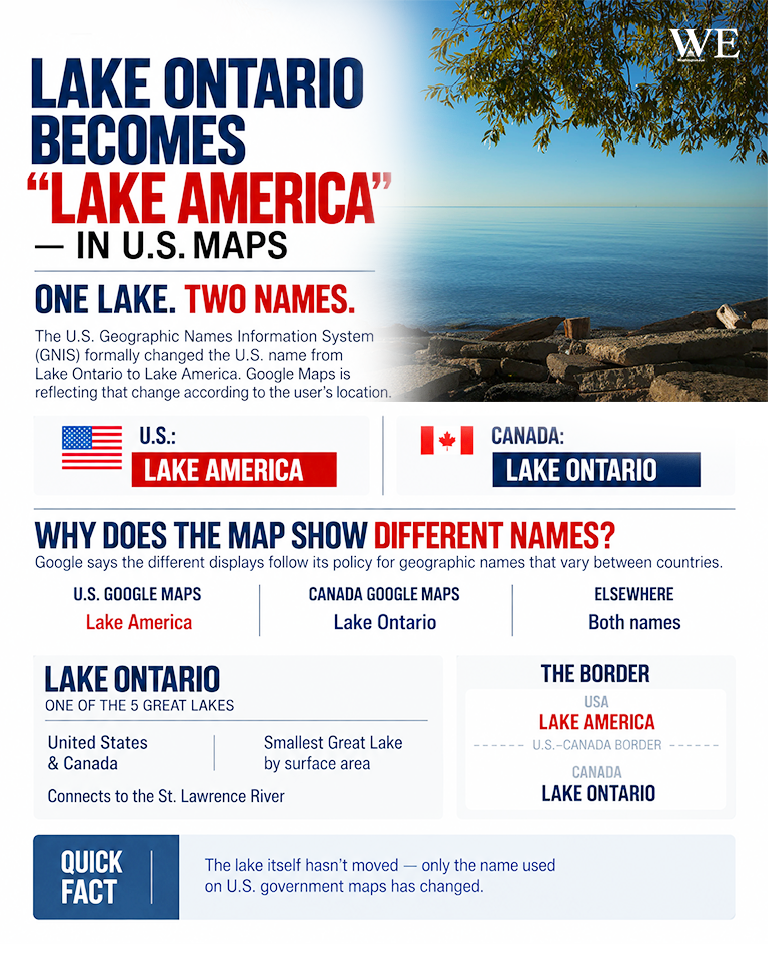
For now, therefore, the answer to the question “What is this lake called?” depends largely on who is asking. For the Trump administration and U.S. federal agencies, it is Lake America. For Canada, it remains Lake Ontario. And for a lake that has connected two countries for centuries, its new dual identity has become another symbol of the increasingly strained relationship between the United States and its northern neighbour.