
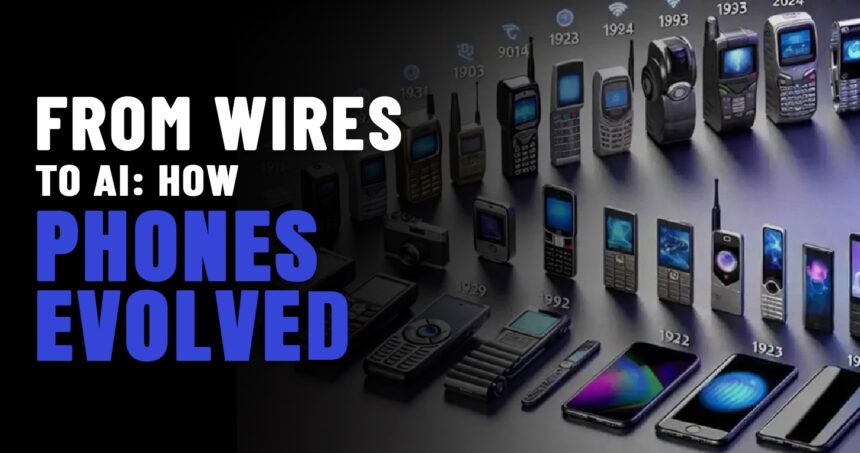
From bulky devices weighing almost a kilogram to pocket-sized computers capable of generating images, translating conversations and connecting to satellites, the mobile phone has undergone one of the most dramatic technological transformations of the modern era. In just over half a century, phones have evolved from experimental communication devices into tools that influence almost every aspect of daily life.
Today, smartphones combine cameras, maps, banking, entertainment, social media, health monitoring and artificial intelligence in a single device. But the journey began with a much simpler ambition: allowing people to make a telephone call without being connected to a wire.
From the First Mobile Call to the Nokia Era

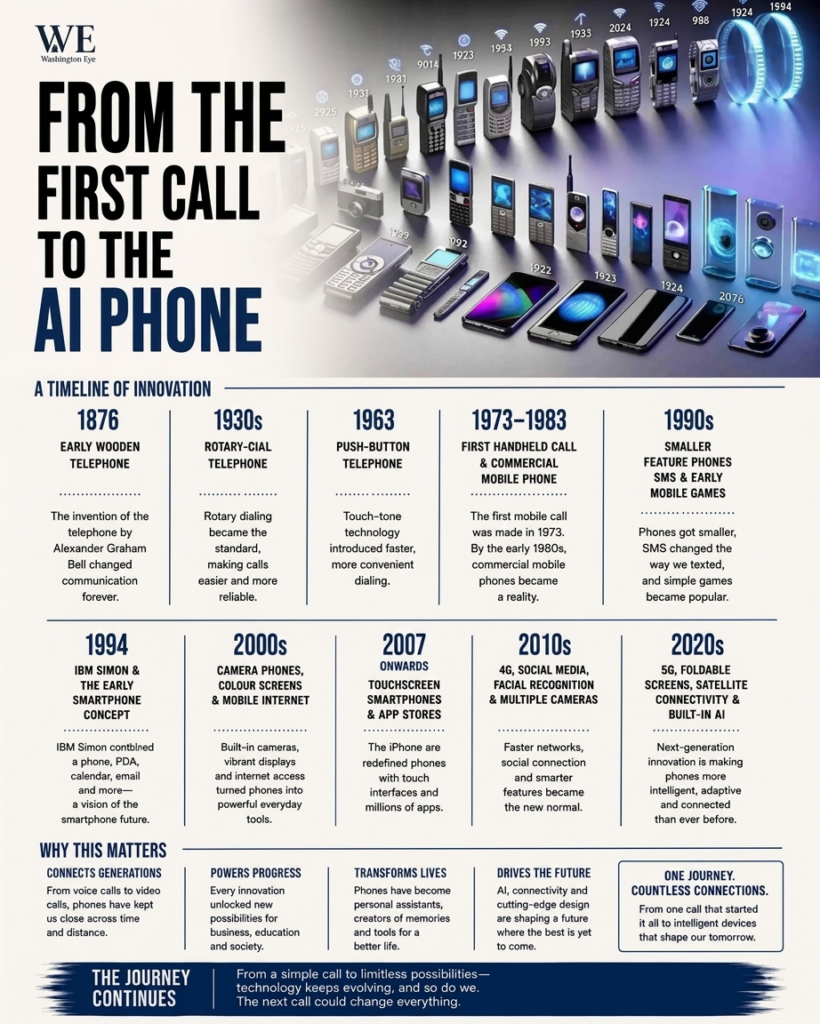
The modern mobile-phone story took a major step on April 3, 1973, when Motorola engineer Martin Cooper made a public call using a handheld cellular telephone prototype in New York City. A decade later, Motorola’s DynaTAC 8000X became the first handheld cellular phone approved for commercial sale in the United States. It was large, expensive and offered only a fraction of the battery life expected from modern phones.
The 1990s transformed mobile phones from specialist business equipment into increasingly mainstream consumer products. Devices became smaller and lighter, while 2G digital networks improved mobile communications and helped popularize text messaging.
Brands such as Nokia, Motorola and Ericsson became major players. Phones such as the Nokia 3210 and 3310 became cultural icons, remembered for their physical keyboards, replaceable batteries, durability and simple games such as Snake. Mobile phones were still primarily designed for calling and texting, but manufacturers were beginning to add features including calendars, calculators, customizable ringtones and basic internet access.
The early 2000s accelerated the transformation. Colour screens became widespread, cameras were built into phones, mobile internet improved and devices began playing music and video. Flip phones and sliding keyboards became fashionable, while BlackBerry devices gained popularity among professionals because of their mobile email capabilities.
The Smartphone Revolution
The biggest turning point arrived in 2007, when Apple introduced the original iPhone. Its large multi-touch display replaced the physical keyboards found on most contemporary smartphones and helped establish the touchscreen interface that dominates mobile technology today.
The following year brought another crucial development: Apple’s App Store opened in 2008, allowing users to download third-party applications directly onto their phones. The first commercial Android smartphone also arrived that year, helping establish Android as Apple’s major smartphone rival.
Phones rapidly stopped being primarily telephones. During the 2010s, smartphones increasingly replaced separate cameras, MP3 players, GPS navigation devices, calculators and even computers for many everyday activities. Faster 3G and 4G networks made video streaming, social media and video calls practical on the move.
Mobile photography became another battleground. Manufacturers introduced multiple rear cameras, optical stabilization, computational photography, night modes and increasingly powerful image-processing systems. Front-facing cameras and social-media platforms simultaneously helped turn the “selfie” into a global cultural phenomenon. Companies including Samsung, Apple, Google and numerous Chinese manufacturers competed to make devices faster, thinner and more powerful.
5G, Foldables and the AI Phone
By the 2020s, smartphone development had entered another phase. 5G networks offered greater speeds and lower latency, while processors became powerful enough to perform increasingly sophisticated tasks directly on devices. Foldable smartphones also attempted to reinvent the familiar rectangular handset. Flexible displays allowed some phones to unfold into tablet-sized screens, while others revived the compact flip-phone concept with modern touchscreen technology.
Artificial intelligence has since become one of the industry’s central areas of competition. Modern smartphones can remove unwanted objects from photographs, summarize information, transcribe recordings, provide real-time translation and generate or edit content using AI.
Apple, Samsung and Google have increasingly integrated generative-AI capabilities into their mobile ecosystems. The direction of development suggests that the smartphone is evolving from a device that simply responds to commands into a more context-aware digital assistant.
Satellite connectivity represents another significant change. Some modern phones can communicate with satellites when conventional cellular coverage is unavailable, particularly for emergency communications and, increasingly, messaging.
The Cost and Impact of the Smartphone Revolution
The transformation has come at a financial cost. Early mobile phones were extraordinarily expensive, and although basic modern handsets can now be bought relatively cheaply, premium smartphones commonly cost more than $1,000, with high-end foldable devices costing considerably more. Yet the broader social impact is difficult to overstate. According to the International Telecommunication Union, mobile networks and internet connectivity have expanded enormously worldwide, helping billions of people access digital services.
Smartphones have transformed journalism, commerce, education, dating, transportation and political communication. A person can film breaking news, transfer money, navigate an unfamiliar city, attend a video meeting and communicate internationally using the same device.
But that convenience has created problems. Excessive screen time, online harassment, misinformation, privacy concerns, electronic waste and the collection of personal data have become major social and regulatory issues. The constant cycle of new device releases has also raised questions about sustainability and whether consumers genuinely need frequent hardware upgrades.
The evolution is far from finished. Future phones could rely more heavily on on-device AI, flexible displays, augmented reality, satellite networks and wearable technology. Some technologists even question whether conventional smartphones will eventually be replaced by smart glasses or other AI-powered interfaces.
Whatever comes next, the transformation is extraordinary. In roughly five decades, the mobile phone has gone from a heavy device capable of little more than making a call to a powerful computer connecting billions of people.
1973: First handheld mobile-phone call
1980s: Commercial “brick” phones
1990s: 2G, SMS and smaller handsets
2000s: Cameras, colour screens and mobile internet
2007–08: Touchscreen smartphone and app revolution
2010s: 4G, social media and advanced cameras
2020s: 5G, foldables and satellite connectivity
2026: AI increasingly becomes part of the phone itself