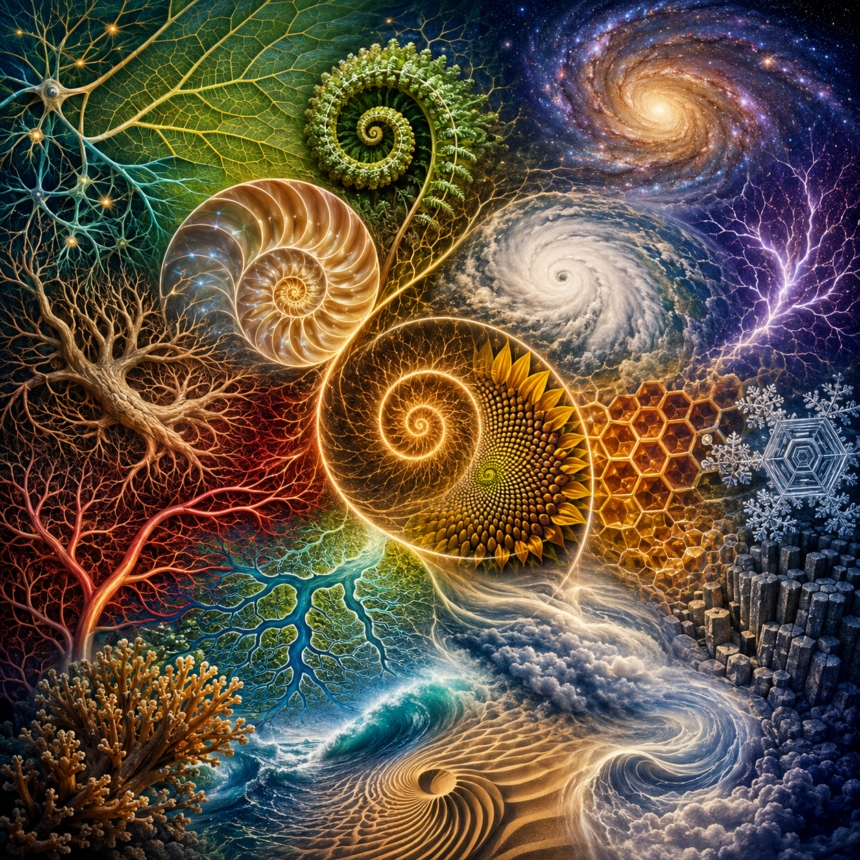
From the branching veins of a leaf to the spiral of a hurricane, nature repeatedly produces similar shapes across organisms, landscapes and even astronomical systems. Scientists sometimes describe these recurring patterns as nature’s “universal design language”, a visual vocabulary of symmetry, spirals, fractals, branches, waves, hexagons and networks.
The phrase is a metaphor rather than a scientific law. Nature does not possess a single plan imposed on every object. Instead, familiar patterns emerge because very different systems encounter the same fundamental challenges: filling space, transporting material, growing without obstruction, conserving energy and remaining stable under physical pressure.
Symmetry is among the most recognisable examples. Humans, butterflies and most other mobile animals possess approximate bilateral symmetry, with one side broadly reflecting the other. This arrangement supports forward movement and concentrates sensory organs near the direction of travel. Flowers and many stationary marine animals commonly display radial symmetry, allowing them to receive light, food or environmental signals from several directions.

Branching forms solve a different problem—how to connect a large area to a small central source. Trees divide into progressively smaller branches to expose their leaves to sunlight. Rivers combine numerous tributaries into larger channels, while lungs and blood vessels repeatedly divide to distribute air and nutrients throughout the body.

These structures are often described as fractal-like because similar branching relationships recur at different scales. A small tree branch resembles a larger limb, while the pulmonary and vascular systems contain repeated divisions from major vessels to microscopic networks. Biomedical research has used fractal analysis to study pulmonary blood flow, airway structure and disease, although biological fractals are approximate rather than infinitely repeating mathematical objects. Research indexed by the US National Library of Medicine explains the fractal organisation of branching systems in the body.
Spirals appear when something grows or moves while rotating. They occur in galaxies, cyclones, whirlpools, shells, horns and climbing plants, but they do not all arise through the same mechanism. A hurricane is shaped by moving air, pressure and Earth’s rotation, while a shell records the outward growth of an organism.
Plants provide some of the most famous spiral arrangements. In phyllotaxis, the positioning of leaves, seeds or petals, new structures often appear at angles that prevent them from sitting directly above older ones. Sunflower florets and pine-cone scales can consequently form clockwise and anticlockwise spirals whose numbers frequently belong to the Fibonacci sequence.

The so-called golden angle of approximately 137.5 degrees can produce efficient packing by distributing successive elements around a centre without creating large gaps. Botanical observations have connected phyllotaxis with Fibonacci-related fractions for centuries, as explained by the American Museum of Natural History.
However, popular accounts frequently exaggerate the reach of the Fibonacci sequence and golden ratio. Not every flower has a Fibonacci number of petals, and not every spiral is a “golden spiral.” The chambered nautilus, often presented as the perfect example, grows in a logarithmic spiral but generally does not match the golden ratio of approximately 1.618. Measurements of real shells have demonstrated considerable variation, challenging one of the most persistent myths connecting mathematics and nature. A scientific review examines how widely the golden ratio has been overstated.
Hexagons represent another form of natural efficiency. A honeycomb’s six-sided cells cover a surface without leaving gaps while using relatively little material to enclose each compartment. Similar polygonal forms can emerge in soap bubbles, cooling lava and drying mud, although the forces producing them differ. Compression, surface tension and cracking can push materials towards arrangements that distribute stress or minimise boundaries.
Animal spots and stripes illustrate how complex designs can arise without a painter or blueprint. In 1952, mathematician Alan Turing proposed that interacting chemicals moving through developing tissue could transform an initially uniform surface into spots, stripes or maze-like patterns. Small differences become amplified as one chemical activates a process and another inhibits it.
Modern studies have found Turing-like mechanisms in biological development, including the changing skin patterns of zebrafish. Reaction–diffusion mathematics has also been applied to chemical systems and materials science. The Royal Society describes Turing patterns as a major model for understanding biological self-organisation.
Waves, ripples, dunes and meandering rivers arise from the movement of fluids and particles. Cracks form when materials shrink or experience uneven stress, while snowflakes develop sixfold symmetry because of the molecular structure of ice. The final pattern is influenced by temperature, pressure, available space, growth rate and chance, meaning no two examples need to be identical.
Humans increasingly borrow these solutions through biomimicry. Architects study termite mounds for passive ventilation, engineers imitate branching networks to improve distribution systems, and material scientists reproduce water-repellent surfaces inspired by lotus leaves. Honeycomb structures are used where strength and low weight are required, including aircraft components and acoustic panels.
Nature’s design language is therefore universal not because every object follows one mystical formula, but because the same mathematics and physical laws operate everywhere. Evolution, growth and self-organisation repeatedly transform simple rules into elaborate structures. The patterns look like art, yet their beauty often begins with a practical problem, and an exceptionally efficient solution.