

The search for faster, broader and easier-to-use snakebite medicines is accelerating, with the World Health Organization issuing its first guidance for novel treatments in February 2026. The document establishes minimum and ideal standards for small-molecule drugs and engineered antibodies intended for hospitals or use before a patient reaches hospital. Scientists hope such medicines could “buy time” in remote communities, but health authorities stress that no universal cure has been approved and conventional antivenom remains the main specific treatment.
The need is enormous. WHO estimates that snakes bite about 5.4 million people annually, causing 1.8 million to 2.7 million envenomings and approximately 81,000 to 138,000 deaths. Around three times as many victims are left with amputations or other permanent disabilities. The heaviest burden falls on farmers, children and rural communities in Africa, Asia and Latin America, where transport delays, weak health systems and antivenom shortages turn treatable bites into fatal emergencies.
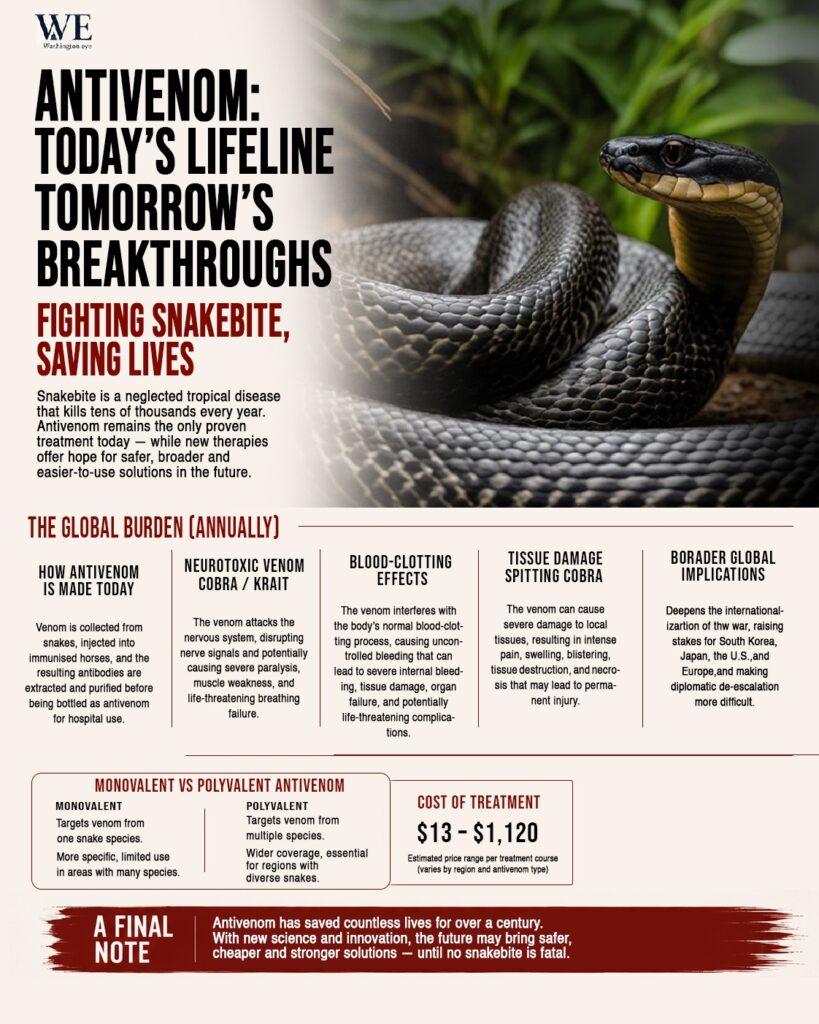
Although people commonly say “poisonous snake,” the medically correct term is venomous: venom is injected through fangs, while poison generally causes harm when swallowed, inhaled or touched. Elapid snakes such as cobras, kraits, mambas and taipans may produce neurotoxins that cause paralysis and respiratory failure. Vipers can trigger bleeding, abnormal clotting, kidney damage and shock, while several vipers and cobras produce severe local tissue destruction. Sea snakes and some terrestrial species can cause dangerous muscle injury. Treatment must therefore match the medically important snakes and venom patterns found in that region.
Conventional antivenoms are either monovalent, designed mainly for one species, or polyvalent, capable of neutralising several species. They may contain whole immunoglobulin G antibodies or purified fragments known as F(ab’)2 or Fab. Manufacturers collect venom from carefully identified snakes, inject controlled amounts into healthy horses or sheep and allow the animals to develop antibodies. Antibody-rich plasma is collected, purified, tested for potency and contamination, filled into sterile vials and supplied as liquid or freeze-dried medicine. Because animal antibodies can provoke allergic reactions, treatment requires trained clinical staff and emergency monitoring.

New approaches could eventually change this century-old process. A 2025 study in the journal Cell used antibodies obtained from American snake enthusiast Tim Friede, who had repeatedly exposed himself to venom, although experts strongly warn against copying his dangerous actions. Researchers led by immunologist Jacob Glanville combined two broadly neutralising human antibodies, LNX-D09 and SNX-B03, with the toxin inhibitor varespladib. In mouse experiments, the cocktail provided full protection against venom from 13 medically important elapid species and partial protection against six others. It did not establish a universal treatment for vipers and has not been proven safe or effective in people.
Varespladib is also being investigated as an oral medicine that blocks secretory phospholipase A2, a common venom toxin. The 95-patient BRAVO Phase II trial in India and the United States found that adding it to standard care did not significantly improve the primary outcome overall. Researchers nevertheless observed a possible benefit among patients treated within five hours. The finding is encouraging but preliminary: varespladib remains investigational and should not replace antivenom or urgent hospital treatment.
Price and access remain major barriers. Costs vary sharply according to country, product, dose and the number of vials required. One manufacturing analysis reported prices of approximately $13 to $1,120 per treatment for conventional plasma-derived antivenoms, while hospital charges can be much higher. Cold-chain transport, specialised production, small and unpredictable markets, weak procurement and counterfeit or poorly matched products further reduce access. Recombinant antibodies and nanobodies may eventually improve consistency, but complex cocktails could remain expensive without public purchasing and regional manufacturing.

Legally, every new product must pass laboratory studies, controlled clinical trials, good-manufacturing inspections and review by national medicine regulators before sale. WHO guidance is not marketing approval; it is a development standard for researchers, manufacturers and regulators. For now, anyone bitten should move away from the snake, remain still, immobilise the limb, remove rings or tight items and seek emergency care immediately. Cutting the wound, sucking out venom, applying ice or using a tight tourniquet can worsen the injury. Scientific progress offers real hope, but reliable antivenom, trained hospitals and rapid transport will determine whether that hope saves lives.