
Saudi Arabia’s expanding economy continues to attract workers from Asia, Africa and the Middle East, but a new enforcement campaign has highlighted the risks facing people who arrive without valid documents or lose their legal employment status. More than 14,000 people were arrested in a single week in late July for alleged violations of residency, labour and border-security laws.
The arrests included 7,103 residency offenders, 3,654 border offenders and 3,397 labour-law offenders, according to the Saudi Interior Ministry. Authorities also intercepted 1,418 people attempting to enter the country irregularly; 54 percent were Yemeni and 45 percent Ethiopian. People convicted of facilitating irregular entry can face up to 15 years in prison and fines reaching one million Saudi riyals. Saudi reporting on the campaign said legal proceedings were continuing against tens of thousands of detainees.
Despite strict enforcement, Saudi Arabia remains one of the world’s largest destinations for migrant labour. Official estimates show that approximately 15.7 million non-Saudis lived in the kingdom in 2024, representing 44.4 percent of its population. Foreign residents accounted for more than three-quarters of the country’s population increase that year. Saudi government statistics demonstrate how heavily construction, healthcare, transport, retail, hospitality and domestic services depend on overseas workers.

Most migrants enter legally after receiving an employment offer. The employer obtains a work visa, while the worker normally undergoes medical and security checks before travelling by air. Employment contracts are increasingly documented through the government’s Qiwa platform, after which an employer arranges the worker’s residence permit, or iqama. A permanent employment visa, intended for work lasting more than three months, costs an employer 2,000 riyals, according to Qiwa’s official guidance.

Workers from India, Pakistan, Bangladesh, Nepal, the Philippines, Egypt, Kenya and other countries are attracted by salaries that may be several times higher than earnings at home. Poverty, unemployment, debt, conflict and climate-related pressures also encourage migration. Saudi Arabia’s Vision 2030 programme, including new cities, transport networks, tourism developments and preparations for the 2034 FIFA World Cup, promises continuing demand for labour. Migrants’ remittances can pay for food, housing, education and medical treatment for entire families.
For Ethiopians and other Horn of Africa migrants unable to obtain legal visas, the journey can be deadly. The Eastern Route generally passes through Djibouti or Somalia, across the Gulf of Aden or Red Sea in overcrowded boats, through war-affected Yemen and towards Saudi Arabia’s southern border. Travellers report hunger, dehydration, detention, robbery, violence and exploitation by smugglers. The International Organization for Migration recorded 922 deaths and disappearances on the route in 2025, almost double the previous year. It also reported that 95,100 migrants were forcibly returned from Saudi Arabia to Ethiopia during 2025. The IOM called it the route’s deadliest recorded year.
Legal entry does not guarantee a safe working life. Some migrants borrow heavily to pay recruitment agents, only to discover that their salary, occupation or accommodation differs from what was promised. Low-paid workers may live in crowded compounds and work long hours in extreme heat. Losing a job can quickly become an immigration crisis because the right to remain is connected to employment. Workers who leave an abusive employer without completing the correct transfer process risk being classified as absent, detained or deported.

Saudi Arabia introduced its Labour Reform Initiative in March 2021, allowing covered private-sector expatriates to change employers and request exit or re-entry visas under specified conditions. In 2025, the government also opened a Qiwa programme allowing some workers recorded as “absent from work” to regularise their status by transferring to another employer. Saudi regulations prohibit employers from retaining domestic workers’ passports, require paid weekly rest and ban physical or verbal abuse. The Human Resources Ministry says these rules are intended to prevent exploitation and discrimination.
Rights organisations argue that implementation remains inconsistent, particularly inside private homes. In July 2026, Amnesty International reported that Filipino domestic workers had described excessive hours, degrading treatment, sexual abuse and restrictions on movement. Domestic workers remain outside the protections of the principal Saudi Labour Law and instead fall under separate regulations. Amnesty’s investigation followed similar findings involving Kenyan women in 2025.
Construction safety has also attracted scrutiny. Pakistani worker Muhammad Arshad died in March 2025 after falling while working at Al Khobar’s Aramco Stadium, a venue connected to the 2034 World Cup. Human Rights Watch has warned about heat exposure, wage theft, restrictions on unions and inadequate investigation of migrant deaths. Saudi authorities, meanwhile, point to digital contracts, wage-protection mechanisms, job-transfer services and tougher penalties for abusive or non-compliant employers.
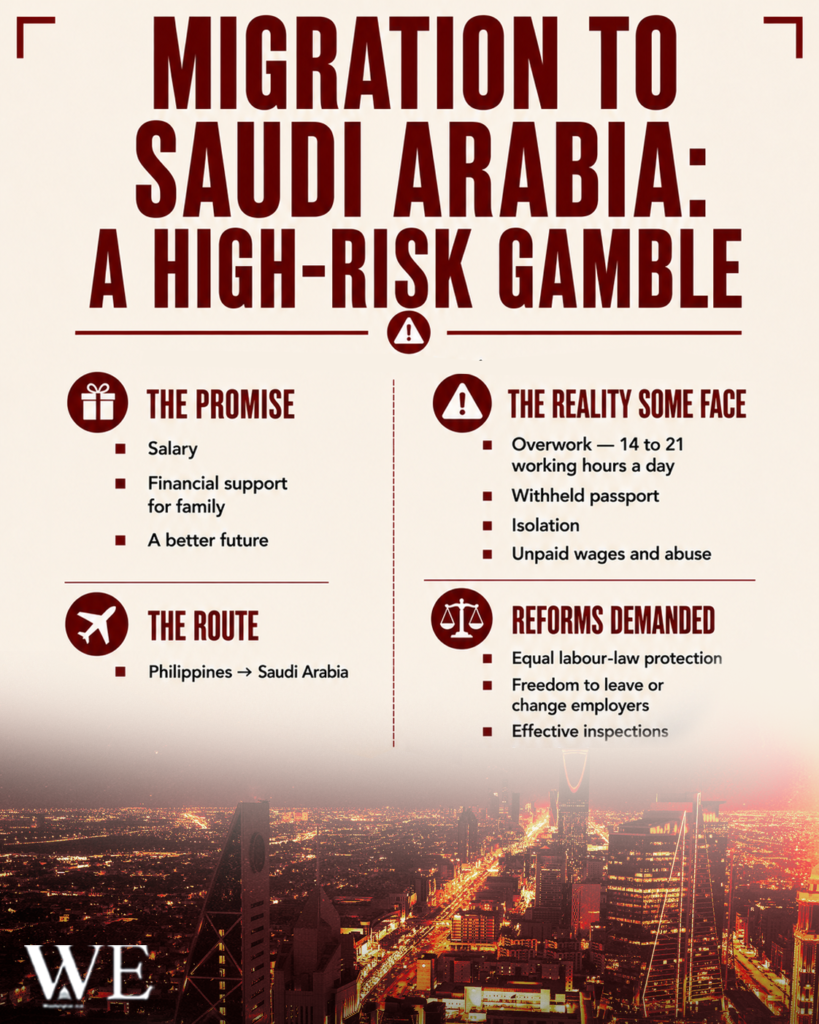
Migration to Saudi Arabia is therefore neither certain disaster nor guaranteed prosperity. Millions have secured stable incomes and improved their families’ lives, while the Saudi economy has benefited enormously from their labour. The gamble becomes most dangerous for people recruited through unlicensed agents, carrying large debts, entering through Yemen or accepting work without a verified contract. Meaningful protection will depend not only on new regulations but on accessible complaints systems, independent investigations, compensation and enforcement that treats migrants as workers with rights, not merely as temporary labour or immigration statistics.