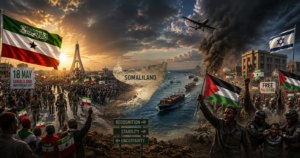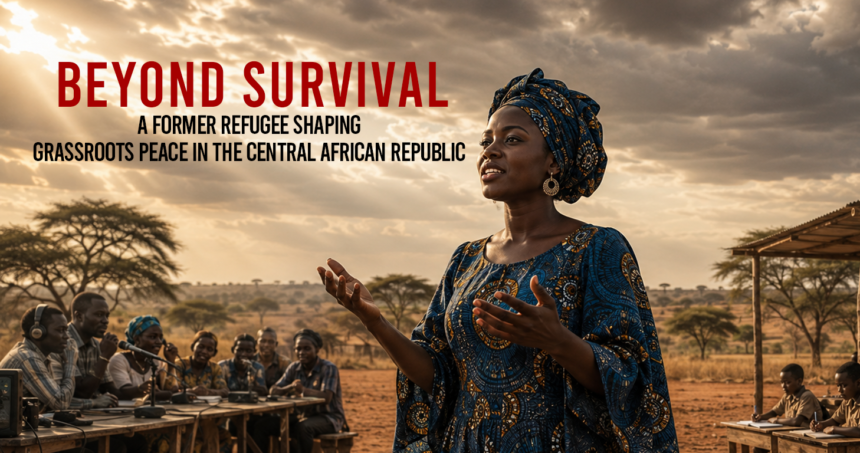
Nina Mireille Yankinon’s trajectory from displaced teenager to community peace leader in the Central African Republic illustrates how individual agency can intersect with structural fragility in a protracted conflict environment. Her experience of fleeing Batangafo for Cameroon during the 2013 violence is not an isolated story but emblematic of a wider pattern of forced displacement that has reshaped Central African society since the Seleka takeover and the rise of anti Balaka militias. When she describes how abandoning her home and “stable life” crystallised a lifelong commitment to protecting vulnerable women and children, it reflects a broader trend in which displacement becomes a catalyst for localized peacebuilding rather than only a humanitarian tragedy.
By returning home and choosing to engage in community work rather than leaving permanently, Nina aligns with a growing number of nearly twenty thousand Central Africans who voluntarily repatriated in 2024, suggesting that pockets of confidence in the peace process are emerging despite persistent insecurity. This link between return movements and grassroots leadership underscores how durable peace in the country will depend less on elite bargains and more on the capacity of returnees and refugees to reshape local governance and social relations.
From NGO Initiative to Local Peace Infrastructure
Nina’s organisation, Londo E Lekere, supported by the UN Alliance of Civilizations, operates as more than a small civil society project; it functions as micro level peace infrastructure in an environment where formal institutions remain weak. By convening radio dialogues, awareness campaigns in schools, public debates and conferences, the group creates regular public spaces where Christians and Muslims can speak to each other in a context still marked by deep mistrust since 2013. In towns like Batangafo, which shifted from a reputation for diversity to one of fear and displacement, this type of continuous contact work is a practical response to the long standing grievance that ordinary people are excluded from peace processes.
The design of these forums mirrors wider recommendations from transitional justice and refugee inclusion research that insist on giving displaced populations a direct voice in discussions on return, reconciliation and justice. In that sense, the NGO’s activities can be read as an informal implementation of these norms at community level, even as national negotiations and security sector reforms remain incomplete or delayed.
Youth and Gender: Reframing Who Counts as A Peace Actor
The resistance Nina faces from elders and traditional leaders who question a young woman’s authority points to entrenched hierarchies in Central African social and political life. Her claim that youth is an asset because it allows her to connect with adolescents excluded from dialogue challenges a dominant pattern in which young people are framed primarily as security risks or potential spoilers rather than as political stakeholders. In parallel, the documented increase in gender based violence between 2021 and 2022 highlights how women’s bodies often become battlegrounds even as women simultaneously emerge as key mediators and organisers in local peace efforts.
This tension is visible beyond her case, as other Central African women peace leaders similarly insist that they have a “great role to play” in national peacebuilding while confronting patriarchal norms that restrict their participation. Nina’s work therefore exposes a core contradiction of the current peace architecture that relies heavily on women and youth at the community level while still marginalising them in formal decision making spaces at the national level.
Education as A Strategic Peacebuilding Tool
Nina’s emphasis on education as both profession and mission fits with broader evidence that schooling can support social cohesion in societies emerging from conflict when it is locally grounded and inclusive. Through the distribution of learning materials, teacher training and engagement with parents and local leaders, her organisation uses education to encourage dialogue across ethnic and religious fault lines and to raise awareness of basic rights. This approach resonates with research that links access to education and information to reduced vulnerability to hate speech and misinformation, both of which have fuelled cycles of violence in the Central African Republic.
By tying classroom initiatives to other practical measures such as support for local farmers and the establishment of health centres, Nina integrates peace education into everyday survival concerns, which can increase the legitimacy and sustainability of her work. Her insistence that peace is built not in conference rooms but in markets and villages aligns with critiques from affected communities who feel sidelined by remote, elite driven forums and demand more inclusive, community based reconciliation strategies.
A Final Note
Nina Mireille Yankinon’s journey from refugee to peacebuilder illustrates both the possibilities and the limits of grassroots initiatives in a context where national institutions remain fragile and violence recurrent. Her story suggests that the long term stability of the Central African Republic will depend on whether national and international actors can systematically recognise, support and protect local leaders like her, while addressing structural drivers of exclusion that continue to threaten a still tentative peace.