
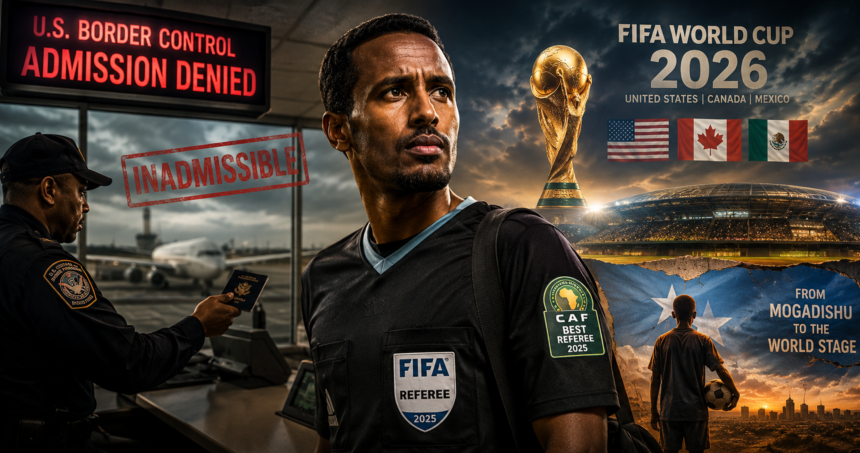
A major controversy has emerged ahead of the 2026 FIFA World Cup after Somali referee Omar Abdulkadir Artan was denied entry into the United States, preventing him from participating in football’s biggest tournament. The incident has sparked debate over immigration policies, sporting fairness, and the challenges facing international participants traveling to major global events. Artan, widely regarded as one of Africa’s top referees and the first Somali official selected to work at a FIFA World Cup, was stopped by U.S. authorities upon arrival in Miami and subsequently returned to Turkey, according to multiple media reports.
The 34-year-old referee had traveled from Istanbul to Miami ahead of the tournament, which is being co-hosted by the United States, Canada, and Mexico. He was expected to attend pre-competition seminars and training sessions for match officials before beginning his World Cup duties. However, U.S. Customs and Border Protection (CBP) determined that he was “inadmissible” after additional inspection procedures, despite reports indicating that he possessed a valid U.S. visa and had completed the necessary travel requirements.
U.S. authorities have not publicly disclosed the specific reasons behind the decision. The Department of Homeland Security stated that Artan was found inadmissible due to unspecified “vetting concerns.” CBP officials emphasized that admissibility decisions are made on a case-by-case basis using available immigration, law-enforcement, and national-security information. No further details have been released, leading to widespread speculation and criticism from football officials and supporters.
Artan’s exclusion is particularly significant because of his remarkable rise in international football. Born in Mogadishu, Somalia, he became a FIFA-listed referee in 2018 and has since officiated high-profile matches across Africa. He made history by becoming the first Somali referee to officiate at the Africa Cup of Nations and later handled major CAF Champions League fixtures. In 2025, the Confederation of African Football (CAF) named him Africa’s Best Male Referee, cementing his reputation as one of the continent’s elite officials.

His selection for the 2026 FIFA World Cup was viewed as a landmark achievement for Somali football. Somalia has faced decades of political instability and conflict, making international sporting success rare. Artan’s appointment was celebrated nationally as a symbol of resilience and progress. He was set to become the first Somali referee ever to officiate at a FIFA World Cup match, a milestone many believed would inspire a new generation of athletes and officials from the Horn of Africa nation.
FIFA confirmed that Artan will not be able to participate in the tournament. The governing body stated that immigration decisions remain the responsibility of host governments and that it has no authority over visa approvals or border admissions. FIFA added that it had been informed by U.S. authorities that Artan’s status would not be changed, effectively ending any possibility of his involvement in the competition.
The incident has generated strong reactions in Somalia. Sports officials, former players, and football administrators expressed disappointment and frustration over the decision. Ciise Aden Abshir, an adviser within Somali sports circles, described the development as a blow to the principles of fairness and inclusion that football seeks to promote. Many Somali supporters took to social media to express solidarity with Artan, arguing that sporting merit should not be overshadowed by political or immigration disputes.

The case has also reignited broader concerns about travel restrictions and immigration policies ahead of the World Cup. Somalia is among several countries affected by travel restrictions introduced under the administration of U.S. President Donald Trump. Critics argue that such measures could complicate participation for athletes, officials, journalists, and supporters from affected nations. Recent reports have highlighted similar visa-related challenges involving other World Cup participants, raising questions about accessibility and inclusivity at global sporting events.
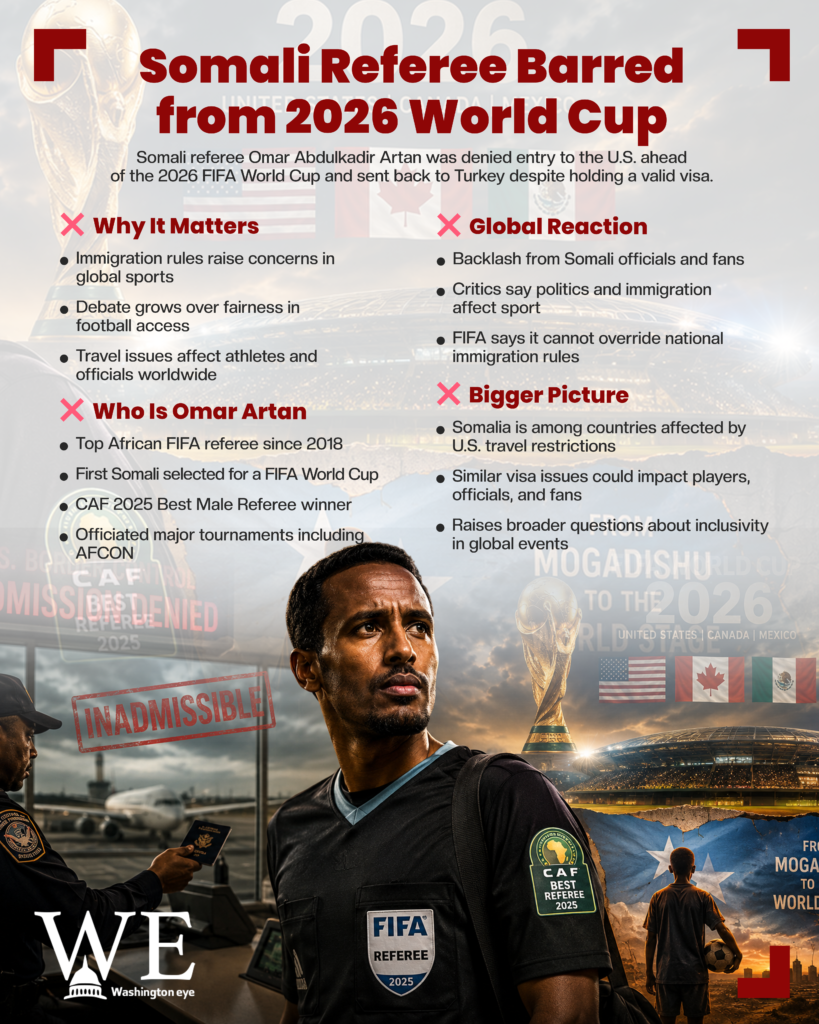
For many observers, Artan’s story extends beyond football. His rise from local Somali leagues to the world’s biggest sporting stage represented a rare success story for a country often associated with hardship. While he will not be present at the 2026 World Cup, many within the football community believe his achievements have already secured a lasting legacy. The controversy surrounding his exclusion is likely to remain a talking point throughout the tournament and may prompt renewed discussions about how host nations balance security concerns with the global spirit of sport.