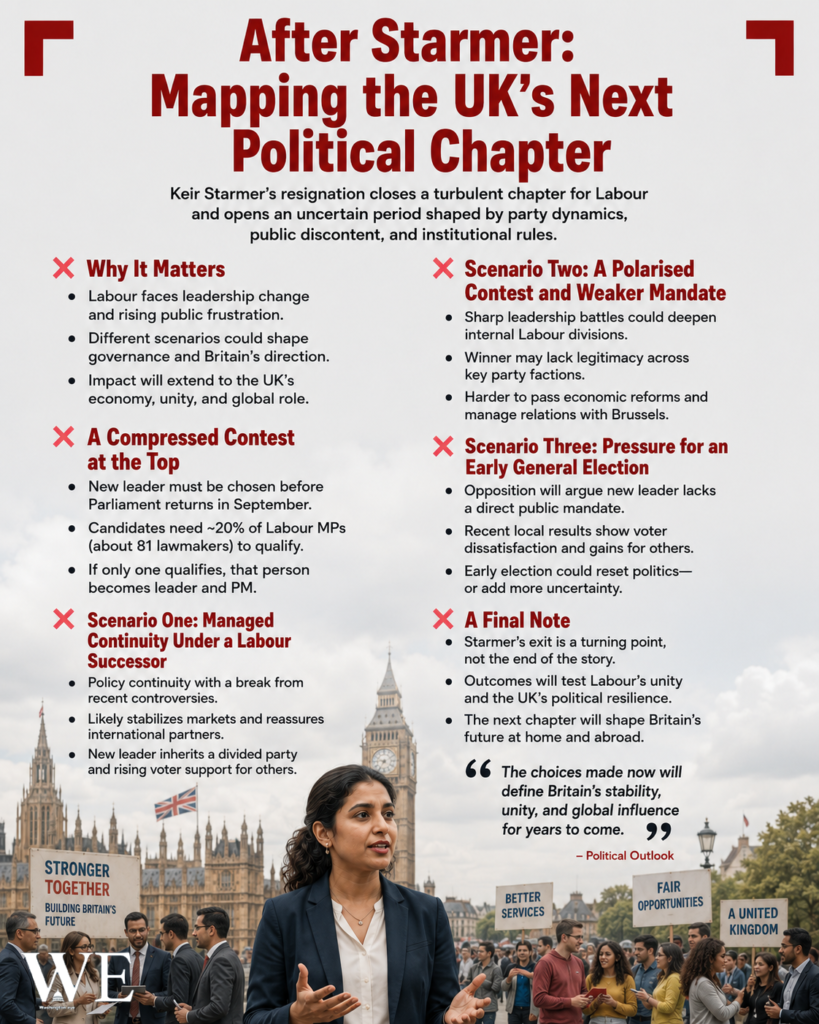
Keir Starmer’s resignation as prime minister closes a turbulent chapter for Labour and opens an uncertain period in which party dynamics, institutional rules and public discontent will interact in unpredictable ways. Rather than a single linear path, several plausible scenarios now confront the United Kingdom’s political class, each with distinct implications for governance, opposition and Britain’s external posture.
A Compressed Contest at the Top
Starmer has asked Labour’s ruling body to set a timetable that installs a new leader before Parliament returns in September, creating an unusually compressed leadership race at the apex of government. According to party rules, any contender needs nominations from about 20 percent of Labour MPs, roughly eighty one lawmakers in the current parliament, before members and affiliates can vote. If only one candidate crosses this threshold there will be no wider ballot and that figure becomes both party leader and prime minister, which could deliver a swift but highly centralised transfer of power.
This mechanism makes the parliamentary party the real gatekeeper of the transition and incentivises coordination among factions before names go to the grassroots. In practical terms it lowers the likelihood of a fragmented field and increases pressure for an early elite consensus, especially given the looming parliamentary calendar and the desire to project continuity in government.
Scenario One: Managed Continuity Under A Labour Successor
The most likely near term outcome is a Labour prime minister who promises policy continuity but offers a clearer break with the controversies that hastened Starmer’s fall, including anger over his handling of the Peter Mandelson appointment and perceptions of drift after heavy local election losses. Figures such as Andy Burnham and former ministers including Wes Streeting and Angela Rayner have been widely discussed as potential successors, each representing different emphases inside Labour without overturning its basic centrist economic approach.
A leadership change but staying within Labour would probably stabilize markets and signal to international partners that Britain’s broad policy line on Ukraine, Nato and cautious engagement with the European Union remains intact. Domestically, however, the new leader would inherit a fragmented party, with local election results having exposed rising support for smaller parties such as the Greens and Reform UK as well as nationalist forces in Scotland and Wales, making it harder to claim a clear mandate for difficult economic choices.
Scenario Two: A Polarised Contest and Weaker Mandate
A second scenario is a sharply contested leadership race that deepens internal divides and produces a winner with only limited legitimacy in the eyes of significant Labour factions. Analysts have already described an atmosphere in which each new resignation from Starmer’s team eroded authority, suggesting that underlying splits over strategy, economic policy and the handling of ethical scandals are far from resolved.
In this outcome, a bitter contest between a perceived establishment candidate and a rival promising a more radical break could weaken the eventual leader’s ability to impose discipline on backbenchers. That would complicate fiscal consolidation, social policy reforms and any attempt to recalibrate relations with Brussels, especially when the United Kingdom’s party system is already more fragmented than in previous decades.
Scenario Three: Pressure for an Early General Election
Although a change of prime minister does not constitutionally require a general election, opposition parties will argue that a new Labour leader lacks a direct popular mandate and should seek one at the ballot box. This line of attack will be strengthened by recent local election outcomes, which showcased significant voter dissatisfaction and gains for smaller parties across England, Wales and Scotland.
An early election would inject considerable uncertainty into economic planning and foreign policy, but it might also reset a political system that has cycled through multiple prime ministers within a short period. If Labour chose to resist that pressure, it would face a sustained narrative about democratic legitimacy and representation that could shape public opinion well into the next scheduled national vote before May 2029.
A Final Note
Starmer’s departure is less an endpoint than a hinge moment in which institutional rules, party calculations and a restless electorate will jointly determine the United Kingdom’s next trajectory. Whether the outcome is managed continuity, a weakened leadership or a forced return to the polls, the coming months will test both Labour’s internal cohesion and the resilience of the broader British party system.