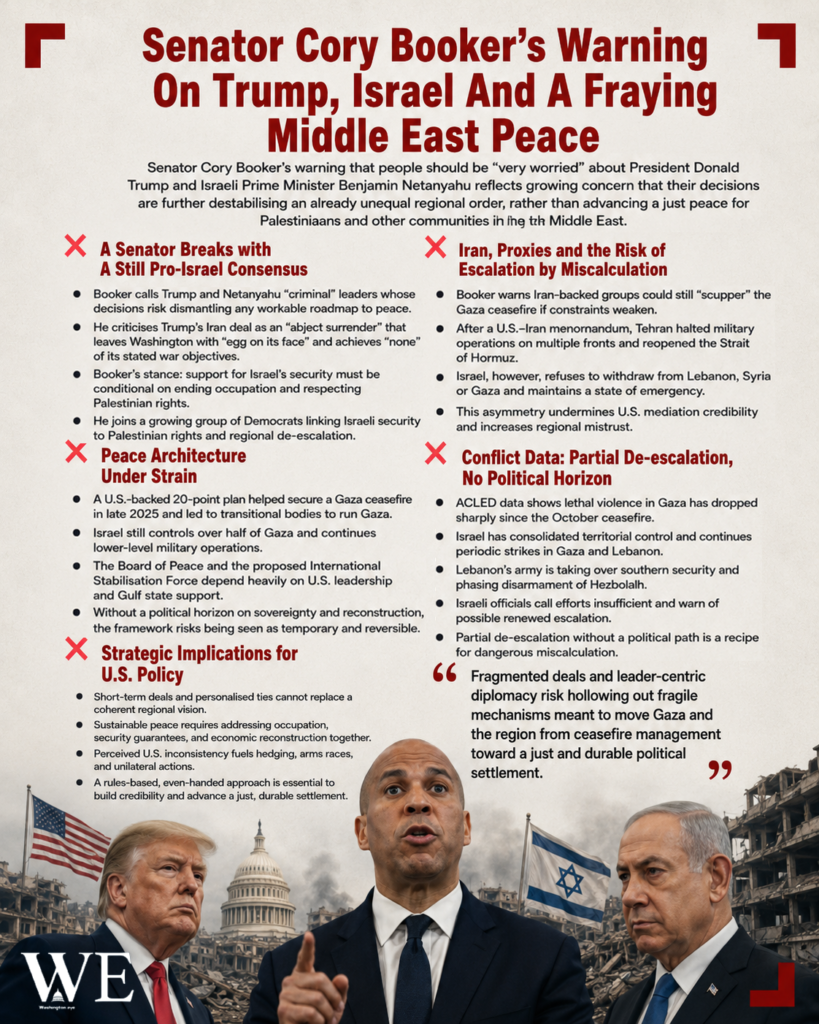
Senator Cory Booker’s warning that people should be “very worried” about President Donald Trump and Israeli Prime Minister Benjamin Netanyahu reflects growing concern that their decisions are further destabilising an already unequal regional order, rather than advancing a just peace for Palestinians and other communities in the Middle East. His remarks come as negotiations over a United States Iran memorandum of understanding unfold alongside unresolved crises in Gaza, the West Bank and Lebanon, where prolonged occupation, displacement and asymmetric uses of force continue to undermine any credible pathway to durable peace.
A Senator Breaks with A Still Pro-Israel Consensus
In his recent appearance on Meet the Press, Booker argued that Trump and Netanyahu are “criminal” leaders whose decisions risk dismantling any workable roadmap to peace, saying he “cannot wait” until they are off the world stage. Although long identified with support for maintaining Israel’s qualitative military edge, Booker has increasingly framed his stance as conditional on policies that do not harden occupation or fuel extremist violence. This places him within a growing cohort of United States Democrats who still affirm Israel’s security but link it to Palestinian rights and regional de-escalation, rather than to unilateral force or open ended control over occupied territory.
What makes this intervention notable is its timing. Booker is criticising Trump not only for rhetoric but for concrete choices: a controversial Iran deal he has branded an “abject surrender” that leaves Washington with “egg on its face”, and a broader approach that he says has achieved “none” of its stated war objectives. His argument is that this combination of concessions to Tehran and alignment with a hard line Israeli government risks empowering regional spoilers on all sides rather than stabilising the regional order.
Peace Architecture Under Strain
Booker’s alarm resonates against a complex backdrop in Gaza, where a United States-backed twenty point Comprehensive Plan helped secure a ceasefire in late 2025 and led to the creation of transitional bodies like the National Committee for the Administration of Gaza. United Nations reporting suggests that while the truce has largely held and aid flows have improved, Israel still maintains control over more than half of Gaza and continues lower level military operations, leaving fundamental issues of sovereignty, demilitarisation and reconstruction unsettled.
At the same time, the new Board of Peace arrangement in Gaza remains fragile and heavily dependent on United States leadership and Gulf state support, including plans for an International Stabilisation Force with troops pledged by Indonesia, Morocco, Kazakhstan, Kosovo and Albania. If Washington’s posture vacillates between transactional deals with Iran and close coordination with a maximalist Israeli coalition, local actors may treat the peace framework as temporary and reversible rather than as a step toward genuine conflict termination.
Iran, Proxies and the Risk of Escalation by Miscalculation
Booker has consistently portrayed Iran and its network of armed allies as a central threat to any sustainable settlement, warning that Tehran backed movements could still “scupper” the Gaza ceasefire if constraints weaken. Yet current reporting indicates that after a United States Iran memorandum of understanding, Tehran has agreed to halt military operations on multiple fronts, including in Lebanon, and to reopen the Strait of Hormuz, even as Israel refuses to withdraw from Lebanon, Syria or Gaza and maintains a nationwide state of emergency. This asymmetry feeds a perception in parts of the region that Washington is pressuring Tehran while giving Israel wide latitude to act militarily, a dynamic that can undercut the credibility of United States mediation.
Conflict data from ACLED show that while lethal hostilities in Gaza have declined dramatically since the October ceasefire, Israel has consolidated territorial control and continues periodic strikes in both Gaza and Lebanon. The Lebanese army’s efforts to take over security in the south and begin phased disarmament of Hezbollah have been dismissed by Israeli officials as insufficient, who insist that ceasefire provisions remain unmet and hint at the possibility of renewed escalation. This environment of partial de-escalation without a political horizon is precisely where miscalculation is most dangerous.
Strategic Implications for United States Policy
Booker’s critique implies that a United States strategy built on short term bargains and personalised ties to leaders like Netanyahu cannot substitute for a coherent regional vision that addresses occupation, security guarantees and economic reconstruction together. The Gaza peace architecture, Security Council resolutions endorsing transitional governance and emerging multilateral forces all depend on perceptions of fair and consistent application of international norms rather than on open-ended alignment with any single state.

For regional actors, the signal from Washington matters. If Trump is perceived as capitulating to adversaries in one arena while enabling expansive Israeli military freedom in another, incentives for hedging, new arms races and unilateral moves will grow. Booker’s warning therefore is less a partisan attack and more a diagnosis that fragmented deals and leader-centric diplomacy risk hollowing out already fragile mechanisms designed to move Gaza and the wider region from ceasefire management toward a just and durable political settlement.