
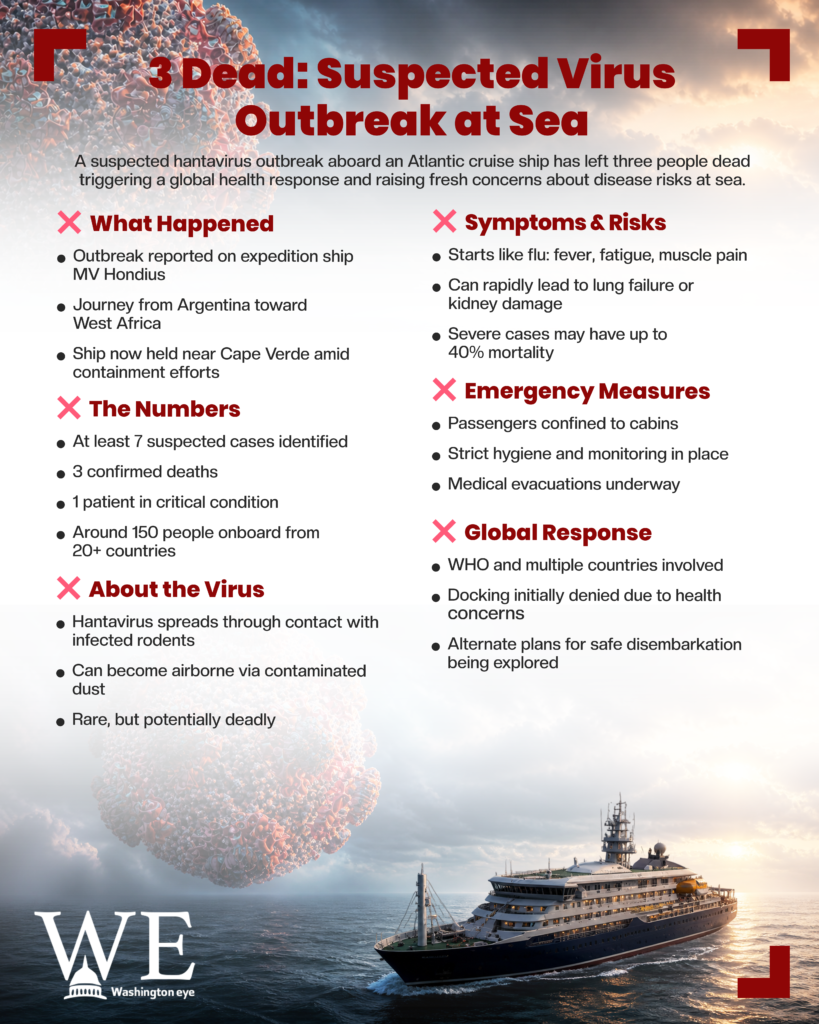
A suspected outbreak of the rare but potentially deadly hantavirus has left three passengers dead aboard an Atlantic expedition cruise ship, raising international health concerns and prompting a coordinated global response. The incident occurred on the Dutch-operated vessel MV Hondius, which was on a polar expedition journey from Ushuaia, Argentina, toward Cape Verde in West Africa. The outbreak unfolded between early April and early May 2026, with the ship currently stranded off the coast of Cape Verde as authorities manage the situation.
According to the World Health Organization, at least seven cases of hantavirus have been identified on board, including two laboratory-confirmed infections and five suspected cases. Of these, three individuals have died, one remains critically ill in intensive care in South Africa, and several others are experiencing milder symptoms. The victims include a Dutch couple and a German national, while affected passengers and crew represent multiple nationalities, highlighting the global dimension of the crisis.
The vessel was carrying approximately 147–150 people, including around 88 passengers and nearly 60 crew members from more than 20 countries. The journey had included stops in Antarctica and remote South Atlantic islands such as Saint Helena and Ascension Island before the outbreak was detected. Health officials are still investigating where exposure to the virus occurred, with early theories pointing to environmental contact either during the voyage or prior to boarding in South America.

Hantavirus is a zoonotic disease primarily transmitted to humans through contact with infected rodent urine, droppings, or saliva. The virus can become airborne when contaminated dust is disturbed, making enclosed or poorly ventilated spaces particularly risky. While most strains do not spread easily between humans, rare person-to-person transmission has been documented in specific variants, such as the Andes strain.

The illness typically begins with flu-like symptoms, including fever, fatigue, and muscle aches, but can rapidly escalate into severe respiratory distress or kidney failure. In its most serious form, Hantavirus Pulmonary Syndrome (HPS), the disease can lead to lung failure and shock, with mortality rates estimated at up to 40 percent in severe cases.
On board the ship, strict precautionary measures have been implemented to prevent further spread. Passengers have been confined to their cabins, hygiene protocols have been intensified, and medical teams are conducting continuous monitoring. Plans for medical evacuation are underway, with critically ill patients already transferred to hospitals in South Africa. Authorities in Cape Verde initially denied docking permission due to public health concerns, prompting discussions about diverting the vessel to the Canary Islands for controlled disembarkation and screening.
Despite the alarming deaths, global health officials have emphasized that the broader risk to the public remains low. The World Health Organization has stated that hantavirus outbreaks are rare and typically confined to localized exposure scenarios rather than widespread transmission events. Nonetheless, the confined environment of a cruise ship has raised concerns about rapid disease progression and delayed access to advanced medical care.

The cruise operator, Oceanwide Expeditions, is working closely with international authorities, including health agencies from the Netherlands, the United Kingdom, and South Africa, to coordinate evacuations, testing, and contact tracing. Epidemiological investigations, including virus sequencing, are ongoing to determine the exact strain and source of the outbreak.
This incident underscores the vulnerabilities of cruise travel to infectious disease outbreaks, particularly when voyages involve remote regions with limited medical infrastructure. Experts stress the importance of early detection, onboard hygiene practices, and strict adherence to safety protocols to mitigate such risks.
As investigations continue, the focus remains on containing the outbreak, ensuring the safety of those on board, and preventing any further spread beyond the vessel. The situation serves as a reminder of the unpredictable nature of zoonotic diseases and the critical need for global cooperation in managing public health emergencies.