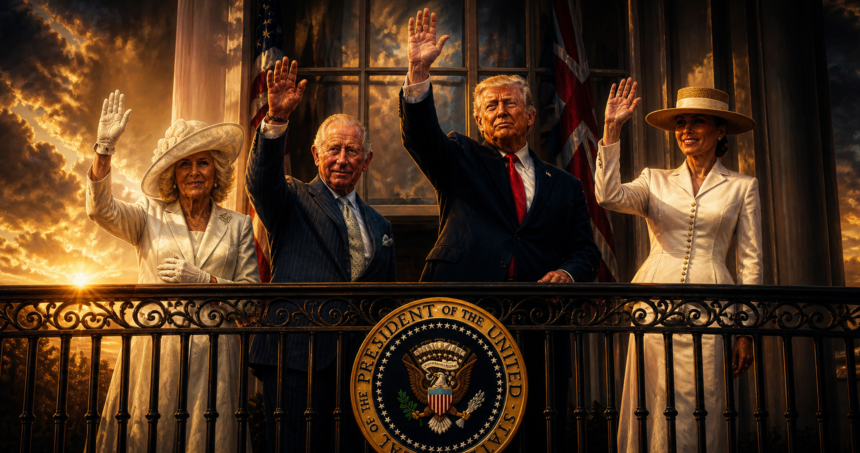
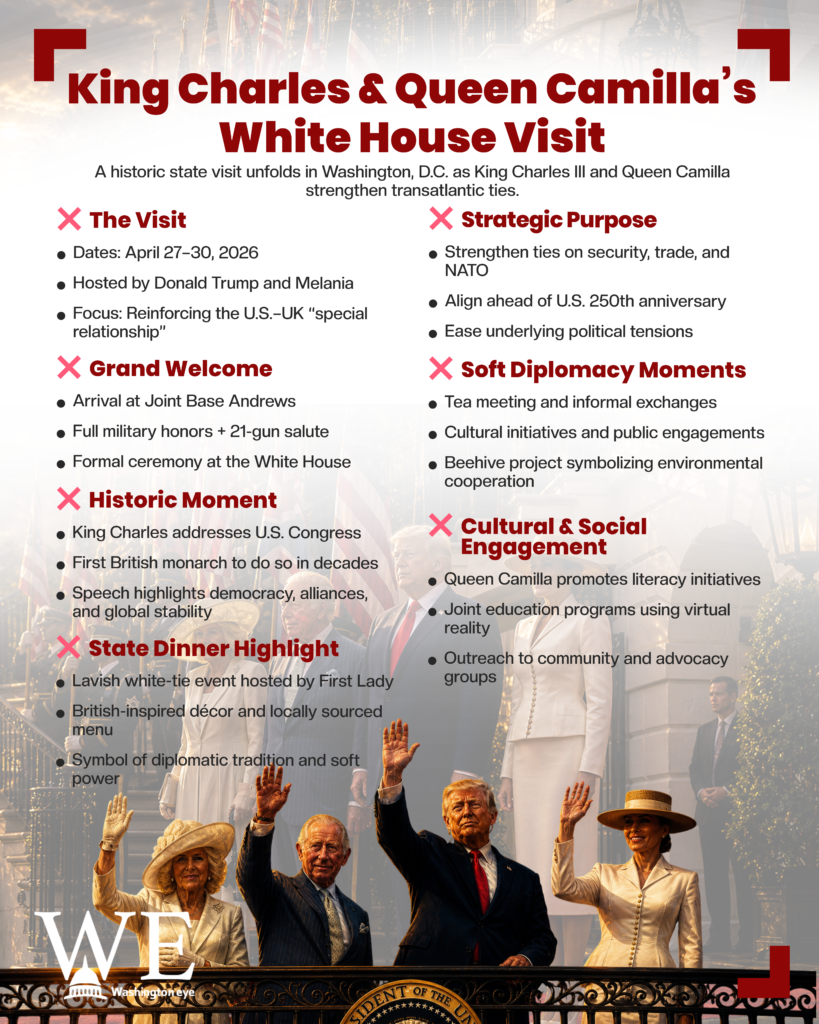
The state visit of King Charles III and Queen Camilla to the White House marked a significant moment in transatlantic diplomacy, blending ceremonial grandeur with strategic political messaging. The four-day visit, held from April 27 to April 30, 2026, took place in Washington, D.C. and surrounding regions, and was widely viewed as an effort to reinforce the “special relationship” between the United Kingdom and the United States during a period of political tension.
The royal couple arrived at Joint Base Andrews on April 27 before proceeding to the White House, where they were formally welcomed by U.S. President Donald Trump and First Lady Melania Trump. The arrival ceremony featured full military honors, including a 21-gun salute and a large ceremonial display involving hundreds of U.S. service members, underscoring the symbolic importance of the visit. The leaders shared afternoon tea inside the White House before touring the grounds, including a newly expanded beehive installation, an initiative reflecting both environmental awareness and shared agricultural heritage.
The visit’s central purpose was both commemorative and diplomatic. It coincided with preparations for the 250th anniversary of U.S. independence and aimed to reaffirm cooperation on global security, trade, and democratic values. Analysts noted that the trip also came amid underlying tensions between Washington and London, making the King’s role as a neutral diplomatic figure particularly significant.
One of the defining moments of the visit was King Charles’s historic address to the U.S. Congress, the first by a British monarch in decades. In his speech, the King emphasized shared democratic traditions, support for alliances such as NATO, and the importance of institutional checks and balances. His remarks received bipartisan standing ovations and were interpreted as a careful balance of praise and subtle critique, reinforcing unity while acknowledging global challenges.
At the White House, a lavish state dinner served as the ceremonial highlight. Organized by the First Lady, the event featured a white-tie dress code, elaborate floral arrangements inspired by British gardens, and a menu incorporating locally sourced ingredients, including honey from the White House beehives. The evening brought together political leaders, business figures, and cultural icons, showcasing American hospitality and reinforcing bilateral ties through soft diplomacy.
Beyond formal engagements, the visit included cultural and educational initiatives. A notable moment was a joint appearance by Queen Camilla and Melania Trump in a virtual reality educational program, allowing students to explore British heritage sites digitally. Queen Camilla also focused on literacy and social issues, meeting advocacy groups and community representatives, while King Charles engaged in environmental and community outreach activities.
Symbolism played a strong role throughout the visit, including coordinated fashion diplomacy between the First Lady and the Queen, which reflected unity and mutual respect. Meanwhile, lighter moments, such as the presentation of White House honey and informal exchanges between leaders, helped humanize the high-level diplomatic interactions.

The visit concluded on April 30 with farewell ceremonies, marking the end of a trip widely described as a success in soft diplomacy. Observers noted that despite geopolitical complexities, the visit helped ease tensions and project stability in U.S.–UK relations. While the long-term political impact remains uncertain, the symbolic value of the visit, combining tradition, diplomacy, and modern engagement, was broadly acknowledged as a defining moment early in King Charles’s reign.