
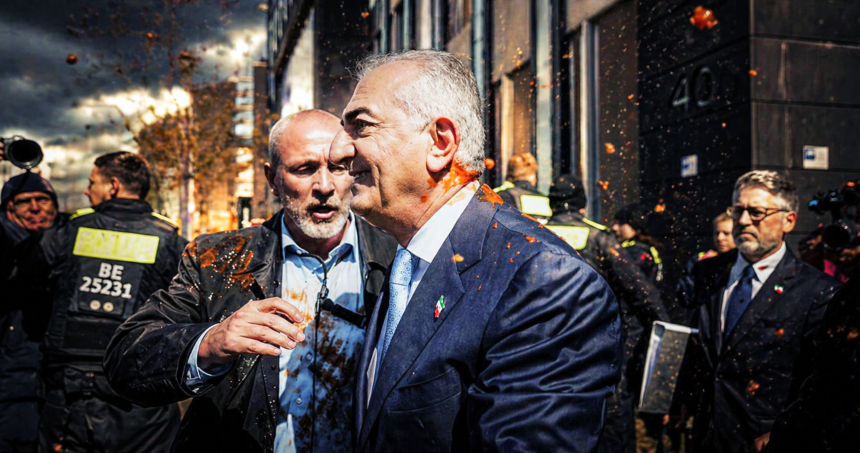
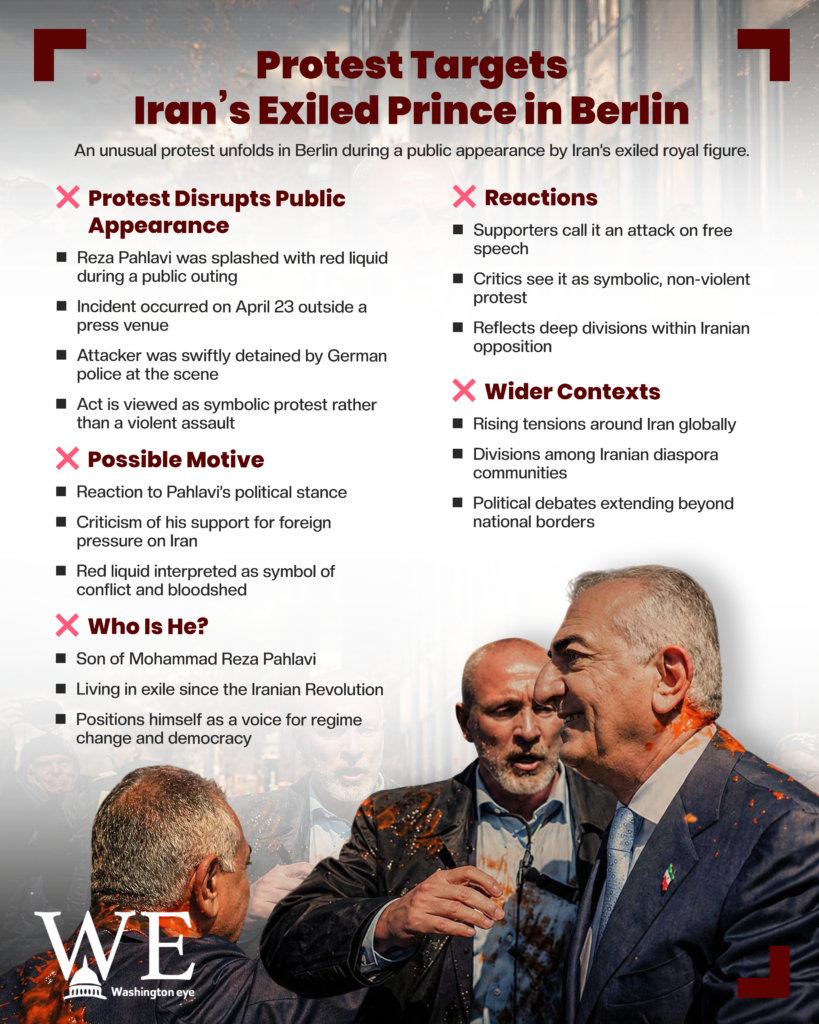
Iran’s exiled crown prince Reza Pahlavi was targeted in an unusual protest incident in Berlin this week when a protester hurled a red liquid at him as he exited a press event, underscoring the deep political divisions surrounding his role in Iran’s opposition movement. The episode occurred on April 23 outside Germany’s federal press conference venue, moments after Pahlavi had concluded remarks criticizing ongoing diplomatic approaches toward Iran and calling for stronger international action against the country’s ruling establishment.
According to multiple reports, the attacker approached Pahlavi from behind and splashed a red substance, widely described as tomato juice or paint, onto his back and neck before being quickly restrained by security personnel and detained by German police. Authorities did not immediately release the suspect’s identity, citing privacy laws, but confirmed that the incident appeared to be a politically motivated protest rather than a coordinated security threat.
The motive behind the act appears tied to Pahlavi’s recent political statements, particularly his support for U.S. and Israeli military actions against Iran and his calls for regime change. Activists opposing foreign intervention and Pahlavi’s stance reportedly sought to symbolically condemn his position, with the red liquid interpreted by some observers as representing bloodshed linked to conflict.

Despite the dramatic nature of the attack, Pahlavi remained uninjured and composed. Footage from the scene shows him continuing to acknowledge supporters and proceeding to his vehicle without interruption. He later continued his engagements in Germany, where he had been meeting political figures and attempting to rally international backing for Iran’s opposition movement.

Reza Pahlavi is the son of Mohammad Reza Pahlavi, Iran’s last monarch who was overthrown during the 1979 Islamic Revolution. Living in exile for decades, he has increasingly positioned himself as a potential transitional leader for Iran, advocating secular democracy and urging Iranians to challenge the current regime. In recent years, particularly amid unrest and protests, he has emerged as a visible figure among segments of the Iranian diaspora and opposition groups, though his leadership remains contested and divisive.
The Berlin visit itself was already politically charged. Pahlavi used the platform to criticize European governments for what he described as passive engagement with Tehran and called for stronger support for Iranian protesters. However, reports indicated that the German government declined to formally meet him, reflecting cautious diplomatic positioning amid broader geopolitical tensions.
Reactions to the incident have been mixed. Supporters condemned the act as an attack on free speech and democratic advocacy, arguing that political disagreement should not escalate into physical protest. Critics, however, framed it as a symbolic and non-violent expression of dissent, pointing to the broader polarization within Iranian opposition circles, where Pahlavi’s alignment with Western military actions remains controversial.
The incident also highlights growing tensions among Iranian diaspora communities across Europe. Demonstrations both supporting and opposing Pahlavi were reported during his visit, reflecting ideological divides over the future of Iran and the methods required to achieve political change. Analysts note that such divisions may complicate efforts to present a unified opposition front internationally.
While the act itself did not result in injuries or escalation, it has drawn attention to the increasingly charged atmosphere surrounding Iranian politics abroad. As global debates over Iran intensify, particularly in light of recent conflicts and internal unrest, figures like Pahlavi continue to attract both strong support and equally vocal opposition.
For now, German authorities are expected to continue investigating the incident, though it is being treated as an isolated act of protest. The episode, however, serves as a vivid reminder of how deeply international and emotionally charged Iran’s political future has become, extending far beyond its borders into diaspora communities and global political arenas.