
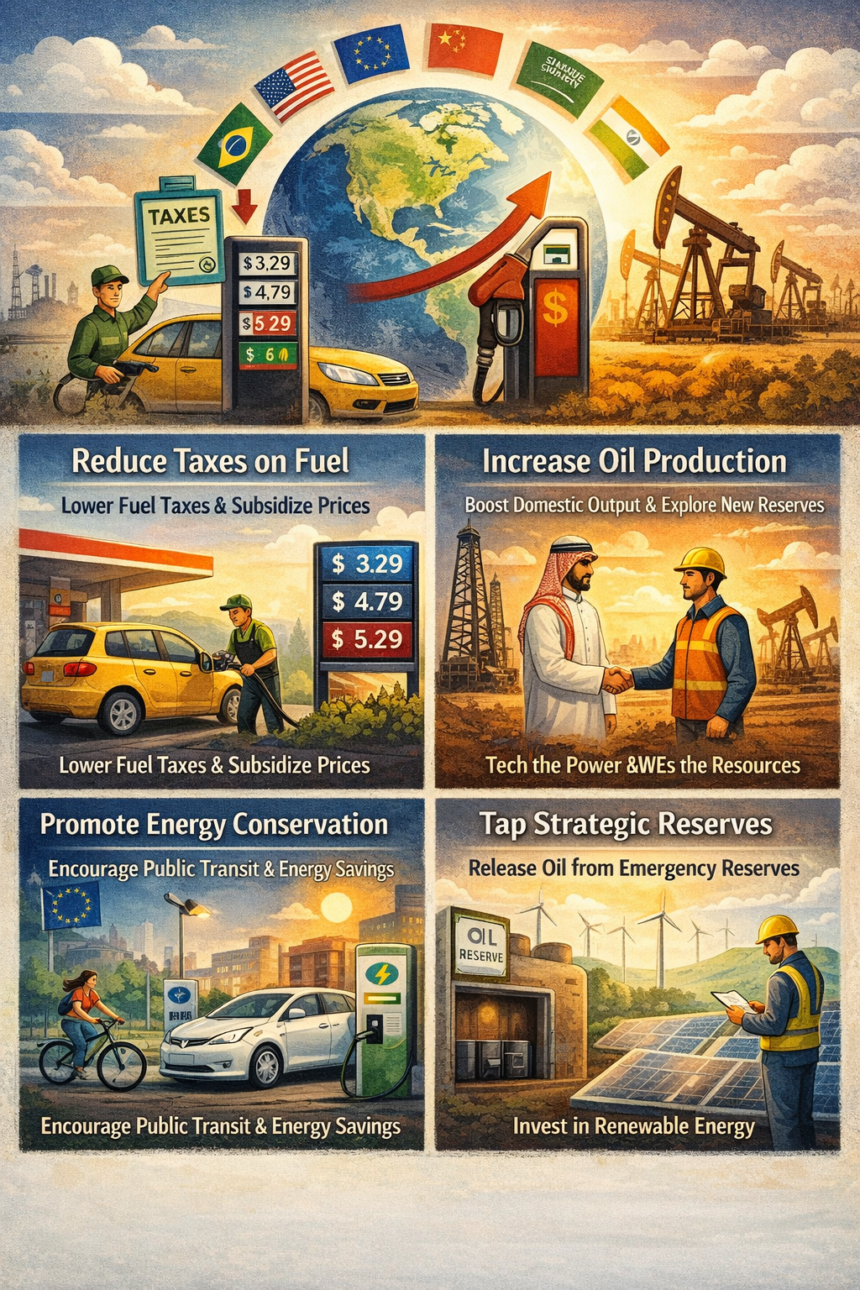
The sharp rise in global oil prices in early 2026 has triggered a wave of economic and policy responses across the world, as governments scramble to protect their economies and citizens from the cascading effects of energy shocks. The surge, which began in late February following escalating conflict in the Middle East and disruptions to the Strait of Hormuz, a route that carries roughly 20% of global oil supply, has pushed crude prices above $100–110 per barrel, reigniting fears of inflation, slowed growth, and global instability.
Countries across Europe, Asia, Africa, and the Americas have responded with a mix of emergency measures, subsidies, austerity policies, and long-term structural adjustments. In Europe, governments are balancing fiscal pressure with public relief. France has rolled out targeted fuel subsidies and direct payments to low-income households, while Italy has introduced temporary tax cuts on fuel. Germany, instead of subsidies, has focused on regulatory measures such as limiting daily fuel price increases to prevent volatility. Meanwhile, the United Kingdom has announced financial support packages for heating oil users while considering broader consumer protection reforms.
In Asia, where many economies are heavily dependent on imported energy, responses have been more interventionist. Countries such as India, Indonesia, and Thailand have introduced fuel rationing, subsidies, and alternative sourcing strategies, including negotiations with non-traditional suppliers like Russia. The Philippines has implemented compressed workweeks and is exploring new oil procurement channels to stabilize supply. Japan has deployed billions in reserves to cap fuel prices, highlighting the scale of intervention required in energy-importing nations.
Developing countries, particularly in South Asia and Africa, are among the most affected due to limited fiscal space and high dependence on imported fuel. Pakistan, for instance, has adopted austerity measures, reduced government fuel consumption, and introduced targeted subsidies to protect vulnerable sectors such as transport. African economies, including Nigeria and Kenya, are facing rising inflation and pressure on food production, as fuel costs directly impact agriculture and logistics.

In contrast, energy-exporting countries are experiencing a mixed impact. While higher oil prices boost revenues for producers, disruptions in supply chains and infrastructure, especially in the Gulf region, have limited their ability to fully capitalize on the price surge. Some producers have also reduced output due to logistical constraints and security concerns, further tightening global supply.
Globally, governments are also encouraging behavioral changes to reduce fuel consumption. Measures such as promoting remote work, reducing travel, encouraging public transport, and even shortening workweeks have been adopted in countries including Denmark, Bangladesh, and Australia. In some regions, public transport has been made temporarily free to reduce reliance on private vehicles.
International organizations have stepped in to stabilize markets. The International Energy Agency (IEA) has coordinated the release of approximately 400 million barrels from strategic reserves, one of the largest such interventions in history. However, experts warn that these measures may only provide temporary relief if geopolitical tensions persist.
The economic consequences are already visible. Inflation has surged across the eurozone, surpassing central bank targets, while in the United States, gasoline prices have crossed $4 per gallon, increasing pressure on households and businesses. The International Monetary Fund has cautioned that prolonged energy disruptions could slow global growth and exacerbate inequality, particularly in debt-laden economies.
Overall, the global response to rising oil prices reflects a combination of short-term crisis management and longer-term energy strategy shifts. While wealthier nations are deploying financial buffers and strategic reserves, poorer countries are forced to rely on austerity and limited subsidies. The crisis underscores the fragility of global energy systems and may accelerate the transition toward renewable energy as countries seek to reduce dependence on volatile fossil fuel markets.