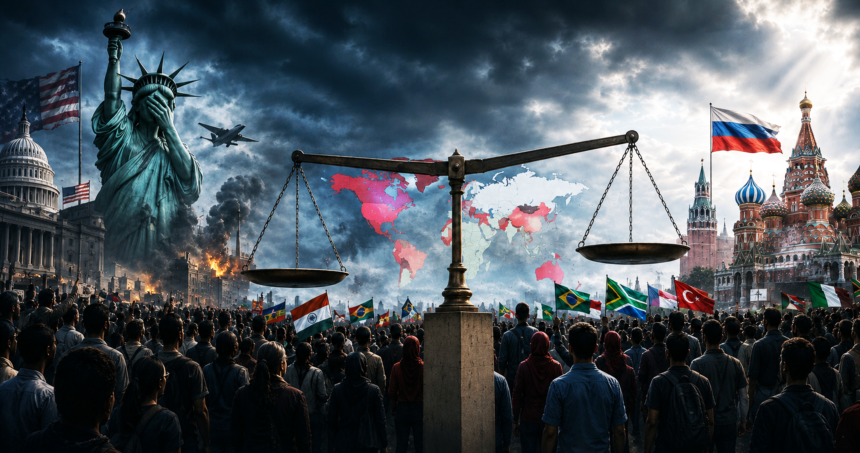
A new global survey has sparked international debate after revealing that many people around the world now view the United States more negatively than Russia, reflecting growing dissatisfaction with Washington’s foreign policies, military actions, and global leadership under President Donald Trump’s second term. The findings, published ahead of the 2026 Copenhagen Democracy Summit, showed that the United States recorded a lower global perception score than Russia for the second consecutive year, marking a dramatic shift in international public opinion.
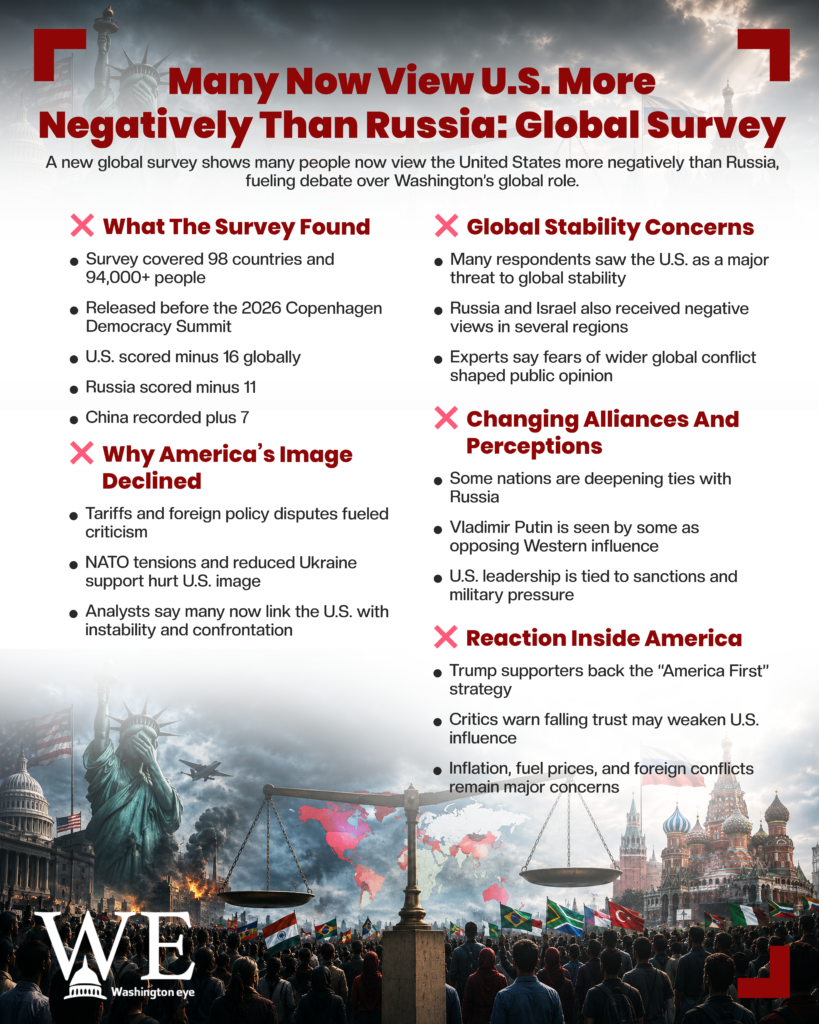
The survey, commissioned by the Denmark-based Alliance of Democracies Foundation and conducted by polling firm Nira Data, collected responses from more than 94,000 participants across 98 countries between March and April 2026. According to the report, the United States received a global net perception score of minus 16, while Russia stood at minus 11 and China at plus 7. The index measures whether countries are viewed positively or negatively on a scale from minus 100 to plus 100.
Researchers and political analysts say the decline in America’s image is linked to a series of controversial policies and international disputes. Among the most frequently cited reasons were Washington’s aggressive tariff policies, tensions with NATO allies, threats regarding Greenland, reductions in military support for Ukraine, and the broader impact of the U.S.-Israeli conflict with Iran. Many respondents also expressed concern over rising oil prices, military escalation in the Middle East, and fears of instability caused by geopolitical confrontation.
Former NATO Secretary General Anders Fogh Rasmussen, founder of the Alliance of Democracies Foundation, said the findings were “saddening but not shocking,” arguing that recent U.S. foreign policy decisions had damaged trust among traditional allies. He pointed specifically to disputes within NATO, the threat of withdrawing from the alliance, and confrontational rhetoric toward European partners.

The survey also revealed that the United States was increasingly viewed as one of the countries posing the greatest threat to global stability, ranking behind only Russia and Israel in some responses. Analysts say this perception reflects global anxiety over military conflicts and fears that superpower rivalries could deepen existing crises.
Public opinion in several parts of Asia, Africa, and the Middle East appeared particularly critical of Washington. In Southeast Asia, some countries have increasingly turned toward Russia for energy and economic partnerships after disruptions linked to the Iran conflict. Experts cited in regional reports said Russian President Vladimir Putin is often viewed in some areas as a strong leader resisting Western influence, while U.S. leadership is increasingly associated with economic pressure and military intervention.
Inside the United States, reactions to the international survey have been sharply divided. Trump supporters argue that the administration’s “America First” approach prioritizes national interests rather than international popularity. They say tariffs and hardline policies are necessary to protect American industries, strengthen borders, and counter rivals such as China and Iran. Republicans also point to domestic concerns about inflation, manufacturing, and energy independence as justification for the administration’s actions.
Critics, however, say the damage to America’s global reputation could weaken its diplomatic influence, economic partnerships, and leadership role in international institutions. Recent polls inside the United States show growing dissatisfaction with Trump’s handling of foreign affairs and the economy, particularly after the military confrontation with Iran pushed fuel prices higher and increased fears of a wider conflict.
Political communication experts say the results also reflect a broader transformation in the global information environment. Social media platforms, digital news ecosystems, and online political polarization have amplified international criticism of major powers. Unlike in previous decades, global audiences now react instantly to wars, sanctions, diplomatic disputes, and viral political statements, shaping international perceptions in real time.
Despite the negative rankings, analysts caution that the survey does not necessarily mean Russia is widely trusted or admired globally. Russia still holds an overall negative score, particularly in Europe and among countries strongly supportive of Ukraine. However, the data suggests that perceptions of the United States have deteriorated faster than perceptions of Russia in recent years.
Observers say the findings highlight a changing global order in which no single country dominates international opinion as strongly as in the past. With rising geopolitical tensions, economic uncertainty, and growing skepticism toward traditional Western leadership, experts believe global perceptions will continue to shift depending on how governments respond to crises, diplomacy, and public concerns in the years ahead.