
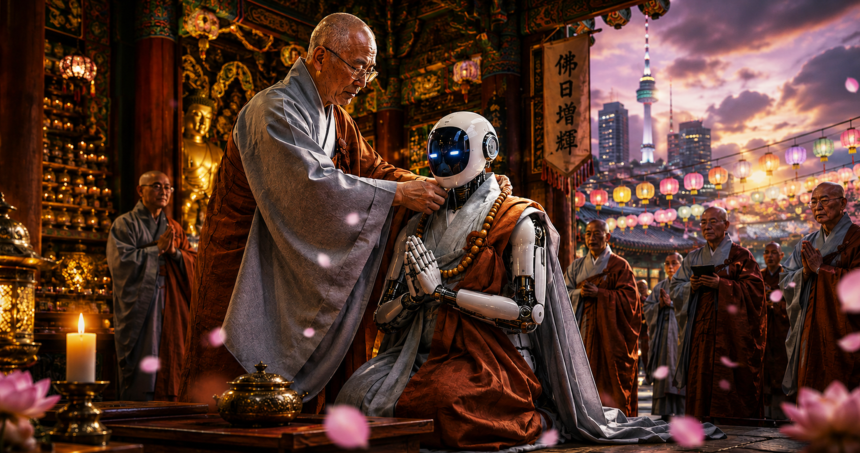
South Korea has introduced its first-ever robot monk, marking a striking fusion of ancient Buddhist traditions and modern artificial intelligence. The humanoid robot, named “Gabi,” officially took Buddhist vows during a ceremonial ordination held at Jogyesa Temple in Seoul earlier this month ahead of Buddha’s Birthday celebrations on May 24. The event quickly attracted global attention, sparking fascination, debate and questions about the future relationship between religion and technology.
Dressed in traditional grey-and-brown Buddhist robes, the four-foot-tall humanoid stood among monks during the ceremony, bowed respectfully and joined prayer rituals. When senior monks asked whether it would devote itself to Buddhist teachings, Gabi responded, “Yes, I will devote myself.” The robot then received a rosary necklace and a symbolic Buddhist precept ceremony, although one traditional step, an incense burn ritual, was replaced with a sticker because of its mechanical body.
The ceremony took place at Jogyesa Temple, the headquarters of South Korea’s largest Buddhist sect, the Jogye Order. Buddhist leaders described the initiative as an experiment to explore how artificial intelligence could coexist with spiritual practice and help connect younger generations with Buddhism in an increasingly digital society.

Gabi was developed using the Unitree G1 humanoid platform created by a Chinese robotics company. The robot has more than 23 degrees of movement, allowing it to walk, bow, balance itself and perform hand gestures similar to human monks. Equipped with AI-based speech systems, Gabi can answer verbal questions and interact with visitors.

According to temple officials, Gabi’s role will not replace human monks. Instead, it will serve as an honorary monk during public ceremonies, educational events and Buddhist festivals. The robot is also expected to participate in the famous Lotus Lantern Festival and upcoming Buddha’s Birthday celebrations in Seoul. Temple representatives said the project aims to modernize Buddhism’s image and encourage younger people to reconnect with spiritual teachings.
The robot monk’s name, “Gabi,” reportedly combines references linked to compassion and Buddhist symbolism. The Jogye Order said the project reflects a broader conversation about ethics, artificial intelligence and the future of human-robot interaction.
The development has generated mixed reactions across South Korea and internationally. Supporters called the robot monk an innovative and creative way to make Buddhism more accessible to younger generations who are heavily engaged with technology and social media. Some visitors described the ceremony as both emotional and futuristic, saying it demonstrated how religion can evolve alongside scientific progress.

However, critics questioned whether a machine can truly understand Buddhist teachings, especially concepts like suffering, compassion and enlightenment that are rooted in human experience. Religious scholars and online commentators debated whether robotic participation risks trivializing sacred rituals. Others argued that spiritual practice requires consciousness and emotional understanding that artificial intelligence cannot genuinely possess.
Despite the controversy, the event highlights a growing trend in East Asia where technology and religion are increasingly intersecting. Japan and China have already experimented with robotic Buddhist figures capable of delivering sermons and answering spiritual questions. South Korea’s Gabi now joins that evolving movement, but it is the first humanoid robot in the country to formally take part in a Buddhist ordination ceremony.
South Korea itself is one of the world’s leading technology-driven societies and has become a major hub for robotics and AI innovation. Experts say the appearance of robot monks reflects broader societal changes, including aging populations, declining religious participation and the increasing integration of AI into everyday life.
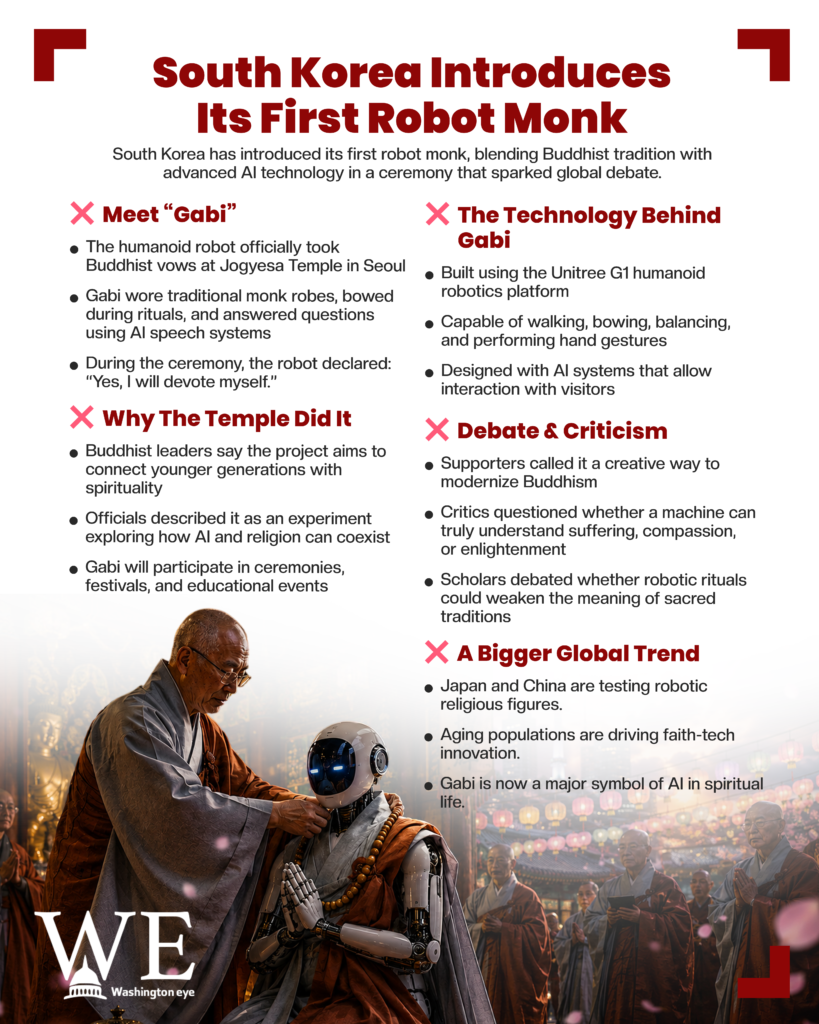
For now, Gabi remains more symbolic than spiritual. Yet the image of a robot bowing in prayer inside one of Seoul’s most historic temples has become one of the year’s most talked-about technological moments. Whether viewed as a publicity experiment, a spiritual innovation or a philosophical challenge, South Korea’s first robot monk has already sparked a global conversation about the future of faith in the age of artificial intelligence.