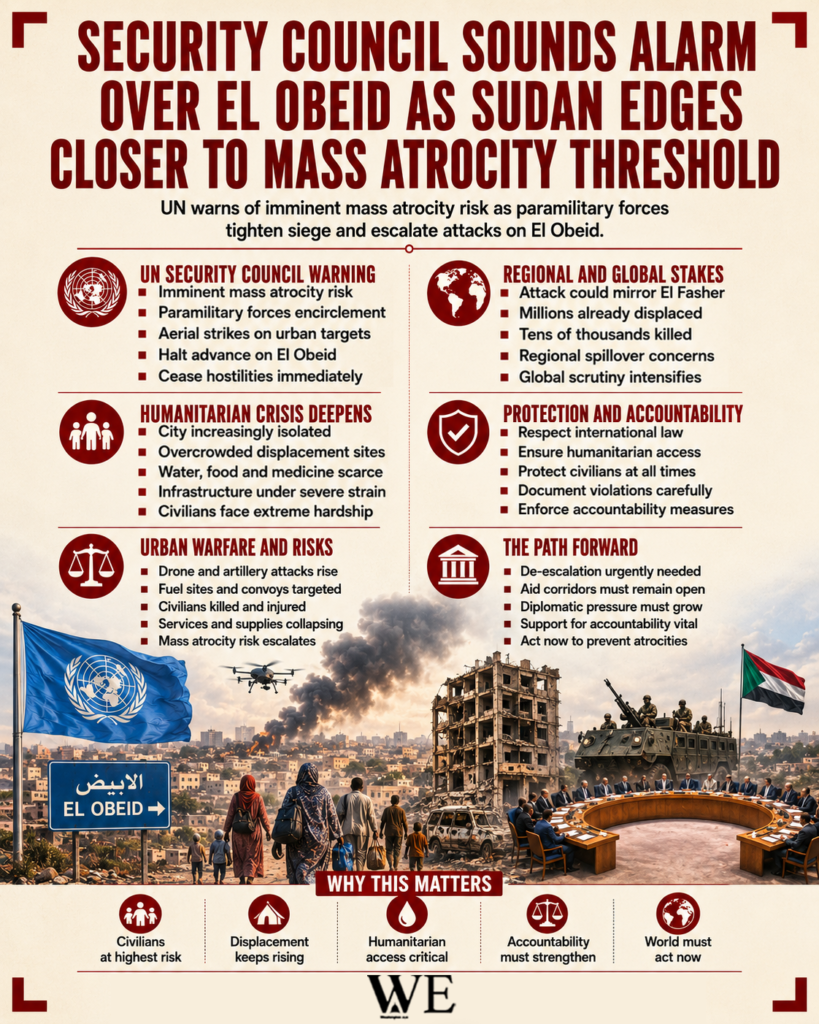
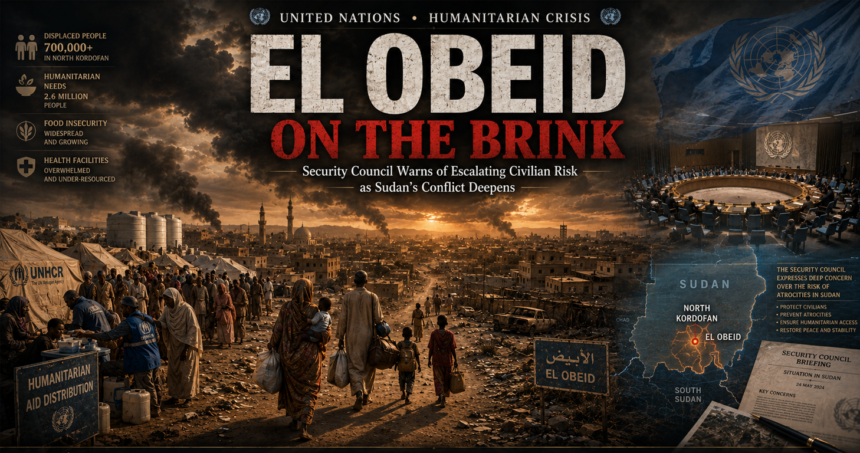
El Obeid has moved to the center of global concern as the UN Security Council warns that the city faces an imminent danger of mass atrocities amid a tightening paramilitary encirclement and escalating aerial attacks. The alert focuses on the reported build up of Rapid Support Forces units and allied fighters around the North Kordofan capital, combined with recent patterns of drone strikes and artillery fire against urban targets. This configuration transforms El Obeid from a stressed refuge for displaced civilians into a frontline battleground where international crimes, including potential genocidal acts, are now explicitly anticipated by UN officials.
Security Council Warning as A Political Signal
The Security Council statement carries significance beyond its immediate humanitarian message because it frames the situation in El Obeid as a mass atrocity risk rather than only as conventional urban warfare. Council members urged the paramilitary forces to halt any advance on the city and demanded a cessation of hostilities, connecting El Obeid to earlier Council concerns over sieges and famine dynamics in El Fasher and broader Kordofan. By recalling previous resolutions and referencing obligations under international humanitarian law, the Council reaffirms Sudan’s territorial integrity while signaling that further fragmentation by parallel authorities or military takeovers could invite heightened international scrutiny and accountability efforts.
Urban Warfare and Civilian Exposure
The tactical evolution around El Obeid illustrates how modern remote warfare multiplies risks for civilians in cities already under strain from displacement and collapsing services. Recent drone strikes reportedly targeting fuel infrastructure, trucks and even a funeral procession have killed and injured dozens, while simultaneously degrading access to water, electricity and health care that residents depend on for survival. Humanitarian assessments describe El Obeid as increasingly isolated, with only one partially functioning route toward White Nile state, rising prices, shortages of essential goods and severely overcrowded displacement sites where thousands share minimal sanitation and inadequate water supplies. Under these conditions, any ground offensive or intensified bombardment would likely push already fragile systems beyond collapse and accelerate patterns of civilian harm that qualify as mass atrocity risks under international human rights standards.
Regional and International Stakes
The focus on El Obeid intersects with broader anxieties about the regional spillover of Sudan’s war and the erosion of norms designed to limit civilian suffering. United States statements echo the Security Council’s concern, warning that an attack on the city could resemble earlier violence in El Fasher that UN representatives have described as having characteristics associated with genocidal acts. With millions displaced nationwide and tens of thousands reported killed, the conflict has already produced one of the gravest humanitarian emergencies worldwide, making additional atrocities in North Kordofan politically significant for neighboring states, regional organizations and global powers monitoring the conflict’s trajectory. In this sense, El Obeid becomes a test case for whether international actors can move beyond warnings toward concrete measures that deter further escalation and reinforce accountability norms.
Implications for Protection and Accountability
The explicit language of imminent mass atrocity risk places a renewed emphasis on protection responsibilities and the need to preserve humanitarian access amidst deepening insecurity. Council members and UN human rights officials call on all parties to respect international humanitarian law, facilitate aid operations and safeguard civilians, suggesting that future documentation and legal processes will pay particular attention to current patterns of siege tactics, remote attacks and obstruction of relief. At the same time, rights advocates argue that only sustained and coordinated external pressure, including targeted sanctions and support for investigative mechanisms, can create meaningful disincentives for commanders who might otherwise view urban offensives as cost free instruments of war.
A Final Note
El Obeid now stands at a critical juncture where diplomatic warning, humanitarian evidence and battlefield dynamics all point toward the possibility of large-scale abuses if the current trajectory continues. Whether the Security Council’s alarm translates into tangible action will shape not only the fate of civilians in North Kordofan but also the credibility of international mechanisms designed to prevent and respond to mass atrocities in contemporary armed conflicts.