
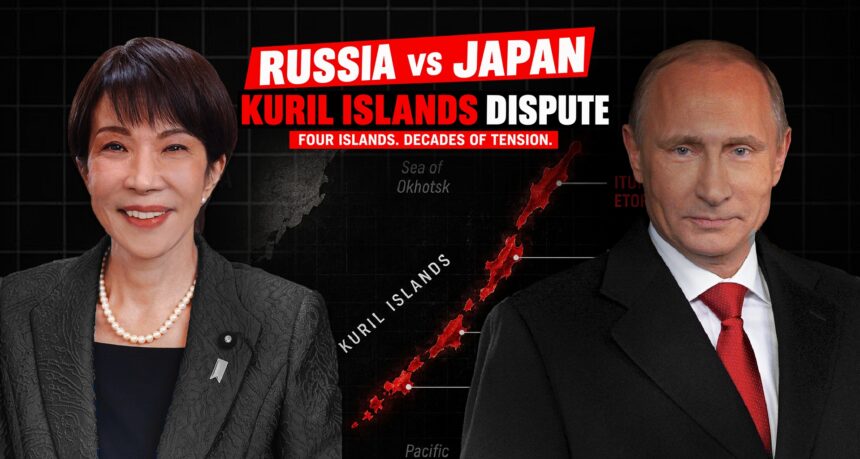
An 80-year-old territorial dispute between Russia and Japan has sharply escalated, after Russian President Vladimir Putin made his first visit to one of the contested Kuril Islands and Moscow subsequently conducted missile exercises in the area. The developments have triggered diplomatic protests, ambassador summons and renewed fears that one of Asia’s longest-running territorial disputes is becoming increasingly militarised.
At the centre of the confrontation are four islands controlled by Russia but claimed by Japan: Iturup, Kunashir, Shikotan and the Habomai islets. Russia calls them part of the southern Kuril Islands, while Japan calls them its Northern Territories. The disagreement has existed since the end of the Second World War and is so serious that Japan and Russia have never signed a formal peace treaty formally resolving their wartime relationship.
Putin’s Visit Reignites the Dispute
The latest confrontation began on August 13, when Putin visited Iturup, known in Japan as Etorofu. It was Putin’s first trip to the disputed islands as Russian president. During the visit, he toured a fish-processing facility, hospital and school and met local residents. Japan reacted immediately. Prime Minister Sanae Takaichi described Putin’s visit as “absolutely unacceptable,” while Tokyo summoned Russian Ambassador Nikolay Nozdrev to lodge a formal protest. Japan maintains that the four islands are inherently Japanese territory and says their status must be resolved before a peace treaty can be concluded.
Moscow rejected the protest, arguing that Putin was travelling within sovereign Russian territory. Russia then summoned Japanese Ambassador Akira Muto, telling him that Moscow’s sovereignty over the southern Kurils was “unshakable.” The dispute intensified further when Russia conducted missile exercises around the contested islands. Russia’s Pacific Fleet fired Bastion anti-ship missiles from Iturup as part of drills simulating attacks against enemy vessels approximately 300 kilometres away. Japan again protested.
Why Do Both Countries Claim the Islands?
The roots of the dispute stretch back more than 150 years, but its modern form emerged from World War II. The Soviet Union entered the war against Japan in August 1945 and subsequently occupied the Kuril chain, including the four southern islands claimed by Tokyo. The Japanese residents were later expelled, and the territory was incorporated into the Soviet Union. When the Soviet Union collapsed in 1991, Russia inherited control.
Japan argues that the four southern islands were historically Japanese and should not be considered part of the Kuril chain that Japan renounced under the 1951 San Francisco Peace Treaty. Russia takes a fundamentally different position. Moscow says Soviet sovereignty over the islands resulted legitimately from the outcome of World War II and is not open to revision. Several Japanese and Russian governments have attempted to find a compromise.

Former Japanese Prime Minister Shinzo Abe invested considerable political effort in building a relationship with Putin and hoped economic cooperation could eventually produce a territorial settlement. Those negotiations failed to deliver an agreement.
Why the Islands Matter So Much
The islands may appear small on a map, but their strategic value is substantial. They sit between Russia’s Kamchatka Peninsula and Japan’s northern island of Hokkaido and help Russia control access between the Pacific Ocean and the Sea of Okhotsk, an important operating area for Russia’s Pacific Fleet and nuclear-powered ballistic-missile submarines.
Control of the islands also provides access to valuable fishing grounds and surrounding maritime resources. For Japan, however, the issue extends beyond economics or military strategy. Tokyo considers the Northern Territories part of its sovereign territory, while former Japanese residents and their descendants maintain emotional and historical connections to the islands. Giving up the claim would therefore carry considerable domestic political consequences for any Japanese government.
Ukraine War Destroyed Hopes of a Settlement
Relations deteriorated dramatically following Russia’s 2022 invasion of Ukraine. Japan joined other Group of Seven countries in imposing sanctions on Russia and provided extensive assistance to Ukraine. Moscow subsequently suspended peace-treaty negotiations with Tokyo and ended several forms of cooperation connected with the disputed islands.
By February 2026, Kremlin spokesman Dmitry Peskov said relations with Japan had effectively been “reduced to zero” and confirmed that no peace dialogue was taking place. Some analysts therefore interpret Putin’s August visit as a deliberate message to Tokyo: Russia is no longer interested in maintaining ambiguity over the islands while Japan supports Ukraine and sanctions Moscow. Putin this week blamed Japan for the deterioration in bilateral relations, while Tokyo continues to point to Russia’s invasion of Ukraine and its actions surrounding the disputed islands.
China, the United States and the Wider Pacific
The dispute has implications beyond Russia and Japan. Japan is one of the United States’ closest Asian allies, and Washington maintains tens of thousands of military personnel in the country. Russia, meanwhile, has strengthened its political and military relationship with China. During the latest dispute, Russian and Chinese representatives have emphasised opposition to attempts to revise the territorial outcomes of World War II.
The confrontation therefore comes amid a much broader military build-up across the western Pacific involving Russia, China, Japan, North Korea, South Korea and the United States. Japan itself is substantially expanding its defence capabilities as it responds to what Tokyo considers an increasingly dangerous regional security environment.
Cost and Economic Impact
A prolonged confrontation carries economic consequences for both countries. Japan previously hoped that investment in Russia’s Far East, including energy, infrastructure and fisheries, could improve relations and create conditions for a territorial settlement. The Ukraine war and sanctions have largely destroyed that strategy.
Japanese fishing communities also have direct economic interests in waters surrounding the disputed territories, while Russia has increasingly sought to develop the islands economically and integrate them more deeply into its Far Eastern regions. The political dispute consequently makes cooperation over fishing, maritime activity, trade and regional development increasingly difficult.
A Dispute With Almost No Room for Compromise
The greatest problem is that the two countries’ positions are now almost completely incompatible. Japan cannot easily abandon a territorial claim maintained for generations. Russia, meanwhile, appears even less willing to surrender strategically important territory after making sovereignty and the defence of wartime territorial gains central elements of its political narrative.
Putin’s visit carries particular symbolic significance because Russian leaders know how sensitive the islands are to Japan. The subsequent missile drills sent an even stronger message: Moscow is not merely administering the islands, it is willing to demonstrate its military control over them.
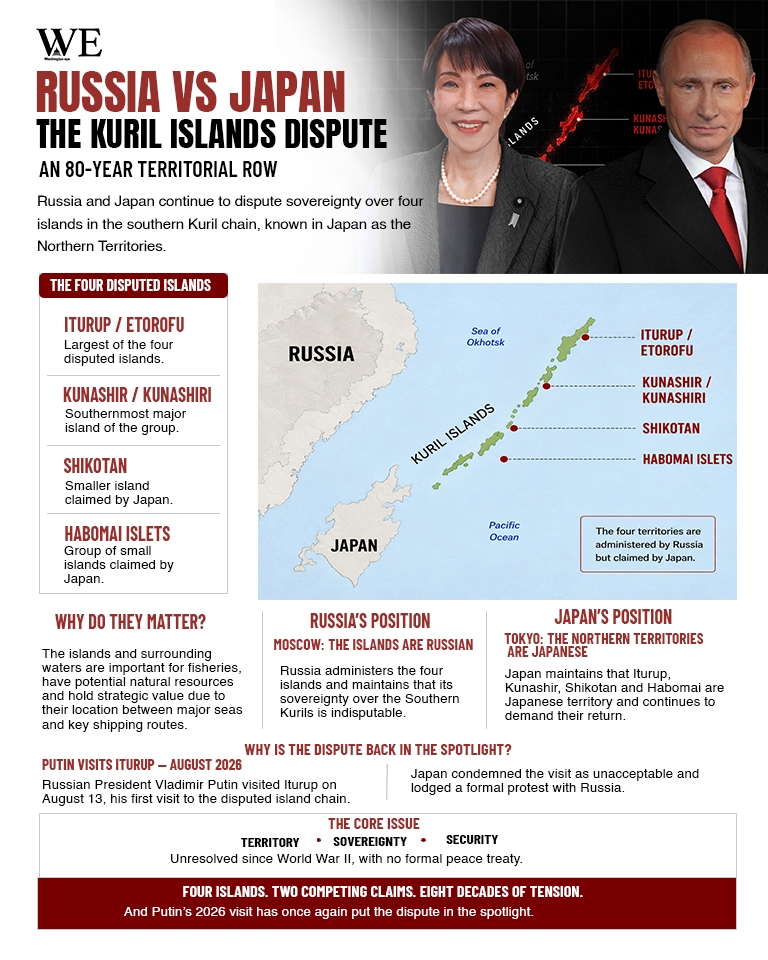
Yet neither country benefits greatly from permanent confrontation. Japan and Russia are geographical neighbours with significant potential economic interests, particularly in fisheries, energy and development of the Russian Far East. For now, however, reconciliation appears more distant than it has in decades. More than 80 years after World War II ended, Russia and Japan still have no formal peace treaty, and Putin’s visit to the disputed islands has made resolving that historic unfinished business even harder.