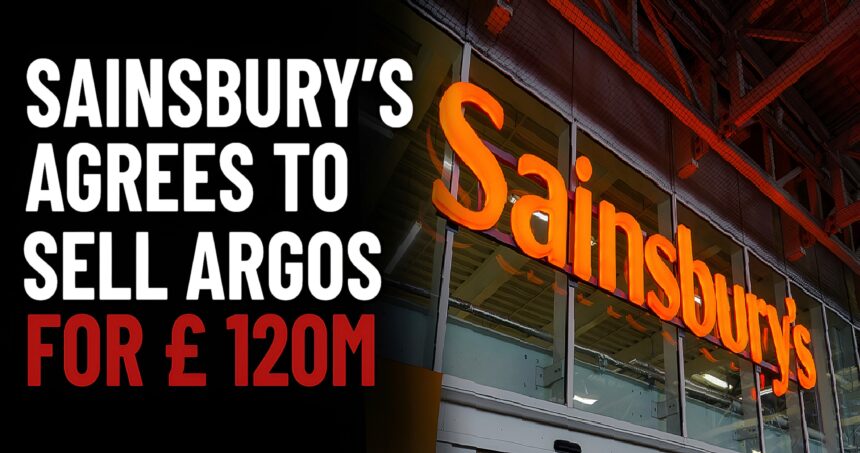
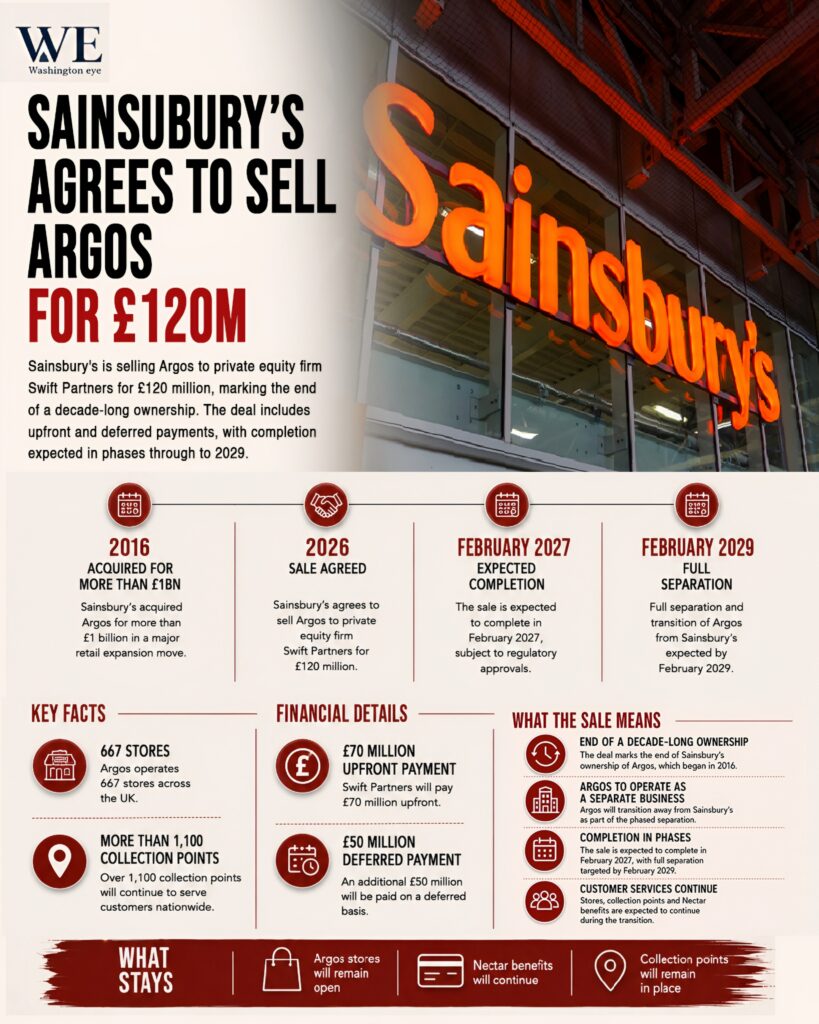
J Sainsbury has agreed to sell Argos for at least £120 million to Swift Partners, ending a decade of ownership of one of Britain’s best-known general-merchandise retailers. Announced in London on Friday, the transaction transfers Argos Limited to Swift Whistle Midco Limited, a newly established company backed by veteran retail executives and specialist investors. The parties expect the sale to complete in February 2027, subject to customary regulatory and completion conditions, with full separation likely to take up to two further years.
Swift’s principal shareholders are Richard Pennycook, a former chief executive of the Co-operative Group, former Morrisons executive Trevor Strain, retail investor Matt Truman and True Capital, the investment firm Truman co-founded. Sainsbury’s will receive at least £70 million when the transaction completes, including proceeds from the sale of an Argos distribution centre, followed by £50 million in deferred payments over three years. Separation costs will offset part of those receipts, while lease-adjusted net debt is expected to fall by about £250 million.
Chief executive Simon Roberts said Sainsbury’s had turned Argos into a leading multichannel business but concluded that dedicated ownership would offer the retailer a stronger future. For Sainsbury’s, the disposal advances the “food first” strategy Roberts has pursued since taking charge in 2020. The supermarket has already reduced its exposure to financial services through disposals involving its banking operations, cash machines and the Argos Financial Services cards portfolio. Management now wants investment, capital and executive attention concentrated on groceries.

The sale price is striking because Sainsbury’s bought Argos through its acquisition of Home Retail Group in 2016 for more than £1 billion. However, the headline comparison is not entirely like-for-like: Sainsbury’s has restructured the chain, sold related financial assets and will retain commercial income from its continuing relationship with Argos. Even so, the transaction illustrates the pressure on British general-merchandise retailers from Amazon and other online competitors, cautious household spending and fast-changing shopping habits. Earlier sale discussions with Chinese ecommerce group JD.com collapsed in September 2025 after terms were revised.
Argos, once famous for thick printed catalogues and handwritten order slips, stopped producing its catalogue in 2020 and now operates as a digital-first retailer selling electrical goods, toys, furniture and household products. Reuters reported that the chain has 667 stores, including 466 inside Sainsbury’s supermarkets and 201 standalone sites, as well as more than 1,100 collection points. The operation being acquired also includes its online channels, logistics network, Argos Care, Argos Pet Insurance, a distribution centre in Daventry and sourcing offices in Shanghai and Hong Kong.
Customers should see little immediate change. Argos will continue trading online, through standalone shops and inside Sainsbury’s stores. Long-term agreements will preserve its use of in-supermarket locations, collection points, the Nectar loyalty programme and Nectar360 services. Sainsbury’s will also continue selling Habitat products. Roberts described the arrangement as “business as usual” for customers, employees and suppliers, and no immediate programme of store closures or job losses was announced. Transitional services will support the businesses until separation, expected by February 2029.
Swift says it plans to invest in Argos’s technology, customer proposition and national reach rather than dismantle the brand. Pennycook argued that its combination of a large digital operation, high-street outlets, supermarket concessions and local fulfilment centres creates a distinctive platform for growth. He has also suggested that Argos could eventually open more standalone shops or outlets inside additional Sainsbury’s supermarkets where opportunities arise. The buyer will work with Argos’s existing management team while taking over most property leases and operational assets.

Financially, Sainsbury’s expects a non-cash impairment charge of about £350 million. Argos contributed only £9 million of underlying operating profit in the 2026 financial year, and the group predicts the disposal will be broadly neutral for underlying operating profit but modestly positive for earnings per share. Investors initially welcomed the sharper focus, pushing Sainsbury’s shares more than 3% higher. The critical test will come after completion: Sainsbury’s must prove that food-focused investment produces better growth, while Swift must show that committed ownership can revive Argos without weakening service, jobs or convenience across Britain’s unforgiving modern retail landscape today.