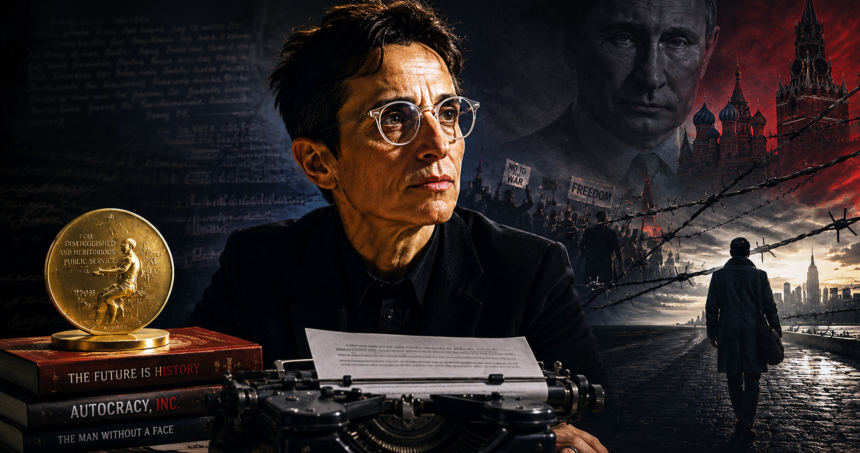
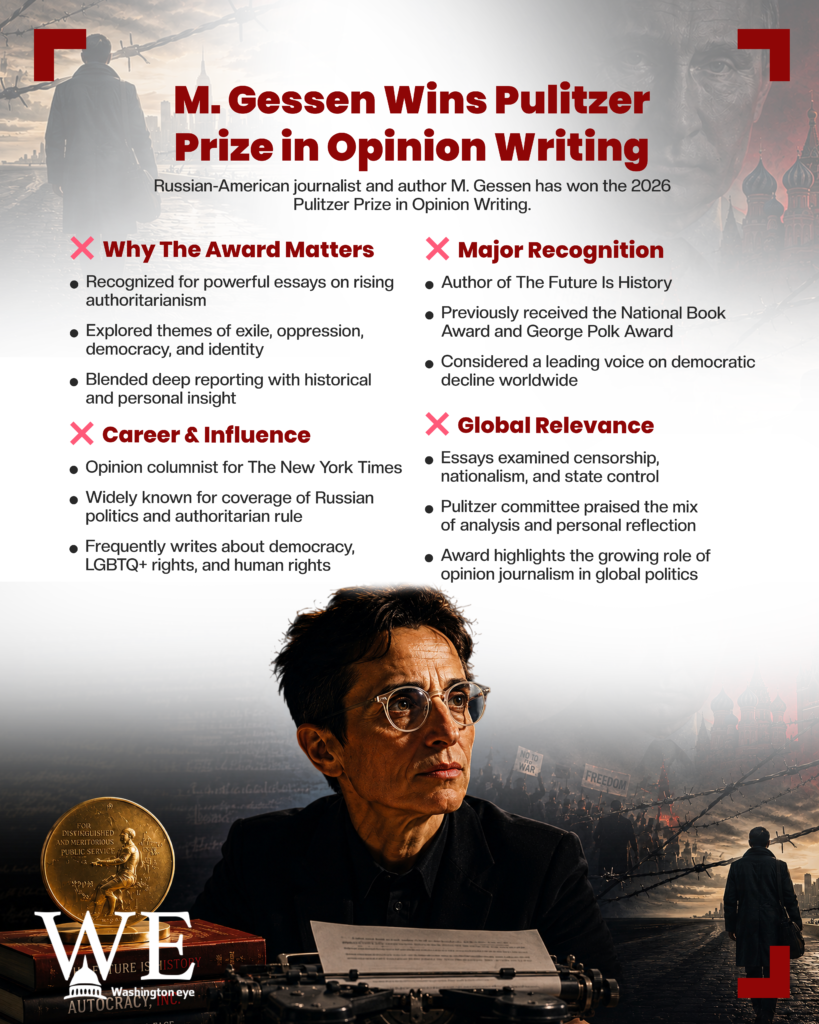
Russian-American journalist and author M. Gessen has won the 2026 Pulitzer Prize in Opinion Writing for a series of essays published in The New York Times, according to the Pulitzer Prize Board. The award recognizes Gessen’s “illuminating collection of reported essays on rising authoritarian regimes” that combined personal experience, historical analysis, and political commentary to examine themes of oppression, exile, identity, and democracy.
The Pulitzer Prizes, among the world’s most prestigious honors in journalism and literature, were announced on May 4, 2026, in the United States by Columbia University’s Pulitzer Prize Board. Gessen received the award in the newly established “Opinion Writing” category, which replaced the former Commentary and Editorial Writing awards beginning in 2026.
Born in Moscow during the Soviet era, Gessen emigrated to the United States as a teenager with their family before later returning to Russia, where they spent years reporting on politics, authoritarianism, and the rise of President Vladimir Putin. Gessen has become internationally known for investigative journalism, political essays, and books examining authoritarian rule, democratic decline, LGBTQ+ rights, and Russian society.
Over the years, Gessen has contributed to several major international publications, including Vanity Fair, The New Yorker, The Washington Post, and The New Republic. In 2024, Gessen joined The New York Times as an opinion columnist after serving as a staff writer at The New Yorker. Their writing frequently focuses on authoritarian politics, social identity, human rights, and democratic institutions.

The Pulitzer committee praised Gessen’s essays for drawing connections between present-day political developments and historical experiences of repression and displacement. The articles explored how authoritarian governments reshape public life and create fear, uncertainty, and exclusion for vulnerable communities. According to the Pulitzer Board, the essays blended rigorous reporting with deeply personal reflections, making complex political issues accessible to readers worldwide.
Gessen’s journalism has often centered on Russia and Eastern Europe, especially under Vladimir Putin’s leadership. Their criticism of the Russian government has made them a controversial figure in Moscow. In 2024, Russian authorities reportedly convicted Gessen in absentia and sentenced them to prison over allegations linked to coverage of the Ukraine war. Gessen has continued writing from the United States, where they remain active in journalism, academia, and human rights advocacy.
The Pulitzer Prize further strengthens Gessen’s reputation as one of the leading contemporary voices writing about authoritarianism and democratic backsliding. Their previous honors include the National Book Award, the Hitchens Prize, the Hannah Arendt Award, and the George Polk Award in Commentary. Gessen is also known for books such as “The Future Is History,” which examined Russia’s political transformation under Putin and won widespread international recognition.

Media analysts say the award reflects the growing importance of opinion journalism that combines reporting with historical interpretation during a time of political polarization, wars, and global democratic challenges. Several of Gessen’s essays addressed issues such as nationalism, exile, censorship, and state power, subjects that have become increasingly relevant amid geopolitical tensions and debates over democracy worldwide.
Other finalists in the Opinion Writing category included columnist Nicholas Kristof of The New York Times and Gustavo Arellano of the Los Angeles Times. Kristof was recognized for columns examining the consequences of cuts to international aid programs, while Arellano was honored for commentary on immigration enforcement and deportation policies in Los Angeles communities.
The Pulitzer Prizes are awarded annually to recognize excellence in journalism, literature, music, and drama. Winning the Pulitzer is widely considered one of the highest achievements in the media industry and often shapes public discussions around major political and social issues. For Gessen, the recognition marks another major milestone in a career dedicated to documenting power, resistance, and the human consequences of authoritarian politics.