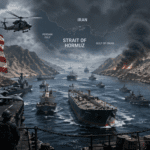
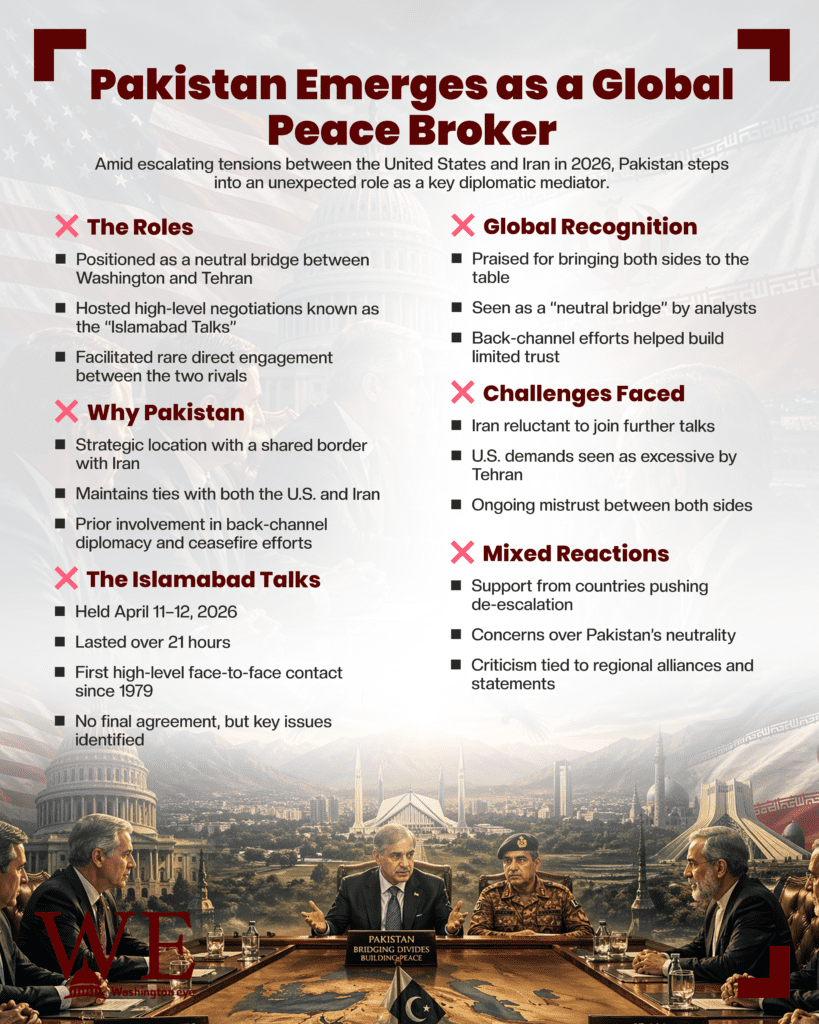
Pakistan has emerged as an unlikely but increasingly significant diplomatic actor in global politics, positioning itself as a peace broker between the United States and Iran during escalating tensions in 2026. The development comes amid a broader Middle East crisis that began in February 2026, when conflict between Iran, the U.S., and regional actors triggered instability, energy disruptions, and fears of a wider war.
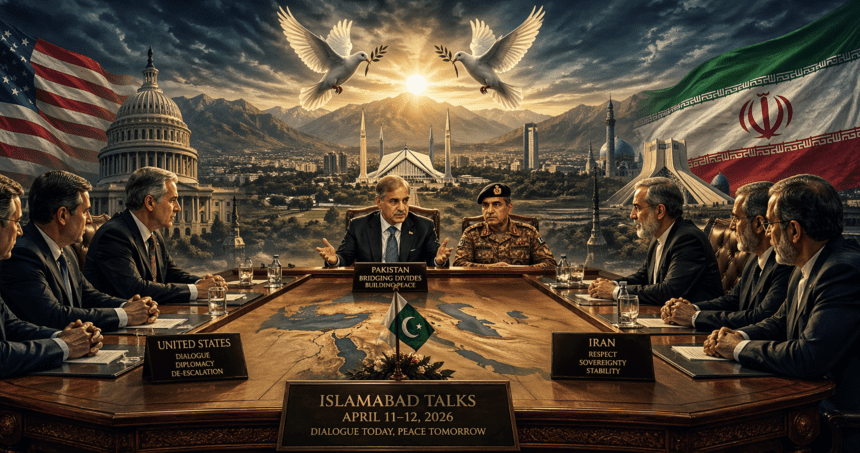
The most visible manifestation of Pakistan’s role was the Islamabad Talks, held on April 11–12, 2026, where senior delegations from Washington and Tehran engaged in rare direct negotiations after decades of hostility. These talks, facilitated by Pakistan’s leadership, including Prime Minister Shehbaz Sharif and military chief Asim Munir, lasted over 21 hours and aimed to stabilize a fragile ceasefire and explore long-term peace options.
Pakistan’s involvement did not emerge overnight. Its strategic geography, shared border with Iran, and longstanding ties with both Tehran and Washington placed it in a unique position of trust. Islamabad had already facilitated indirect communications between the two adversaries and played a role in securing a temporary ceasefire earlier in April. The country also coordinated regional diplomacy, engaging Gulf states and other stakeholders to sustain momentum for dialogue.
The first round of talks in Islamabad marked a historic moment, representing the first high-level, face-to-face engagement between the U.S. and Iran since the 1979 Iranian revolution. While the negotiations did not yield a final agreement, they helped define key areas of consensus, including ceasefire parameters, even as disputes over Iran’s nuclear program and the Strait of Hormuz remained unresolved.

Pakistan’s efforts drew praise from global actors, particularly for bringing both sides to the table under tense circumstances. Analysts described the country as a “neutral bridge” capable of facilitating dialogue where others failed. Donald Trump publicly acknowledged Pakistan’s role, while diplomatic observers noted that Field Marshal Munir’s back-channel engagement helped build trust between rival camps.
However, the process has been far from smooth. A second round of talks faced uncertainty as Iran expressed reluctance to participate, citing what it called “excessive demands” and inconsistency from the U.S. side. American officials, meanwhile, confirmed that negotiators were still prepared to travel to Islamabad, signaling continued reliance on Pakistan as a diplomatic venue.
Reactions to Pakistan’s role have been mixed. On one hand, countries like France and Russia have supported diplomatic efforts, emphasizing de-escalation. On the other, critics question whether Pakistan can maintain neutrality given its defense ties with Saudi Arabia and its own strategic interests in the region. Domestic statements, such as controversial remarks by Pakistani officials about Israel, have also raised concerns about the country’s perceived impartiality.

From a broader perspective, Pakistan’s emergence as a peace broker reflects a shift in its global image, from a security-focused state to a diplomatic facilitator. By hosting high-stakes negotiations and maintaining communication channels with both adversaries, Islamabad has attempted to reposition itself as a responsible stakeholder in international conflict resolution. Yet, a critical analysis suggests that Pakistan’s role is both opportunistic and constrained. While mediation enhances its global standing and opens avenues for economic and strategic partnerships, the outcome ultimately depends on the willingness of the U.S. and Iran to compromise. The breakdown of talks and continued mistrust highlight the limitations of third-party mediation in deeply entrenched conflicts.
Moreover, Pakistan itself faces internal and regional pressures, including economic challenges and its proximity to the conflict zone. The stakes are high: stability in the Middle East directly affects Pakistan’s energy security and economic outlook. In conclusion, Pakistan’s role as a peace broker in 2026 represents a significant diplomatic moment, showcasing its ability to convene adversaries and influence global dialogue. While the long-term success of these efforts remains uncertain, the country has undeniably elevated its global diplomatic profile, demonstrating that middle powers can play critical roles in shaping international peace processes.