
Health authorities in India and several Asian countries are on heightened alert after confirmed cases of the deadly Nipah virus were detected in the eastern Indian state of West Bengal, reigniting global concern over this rare but highly fatal disease. Officials say the outbreak remains limited, with comprehensive containment measures underway, but the situation has triggered precautionary actions across neighbouring nations.
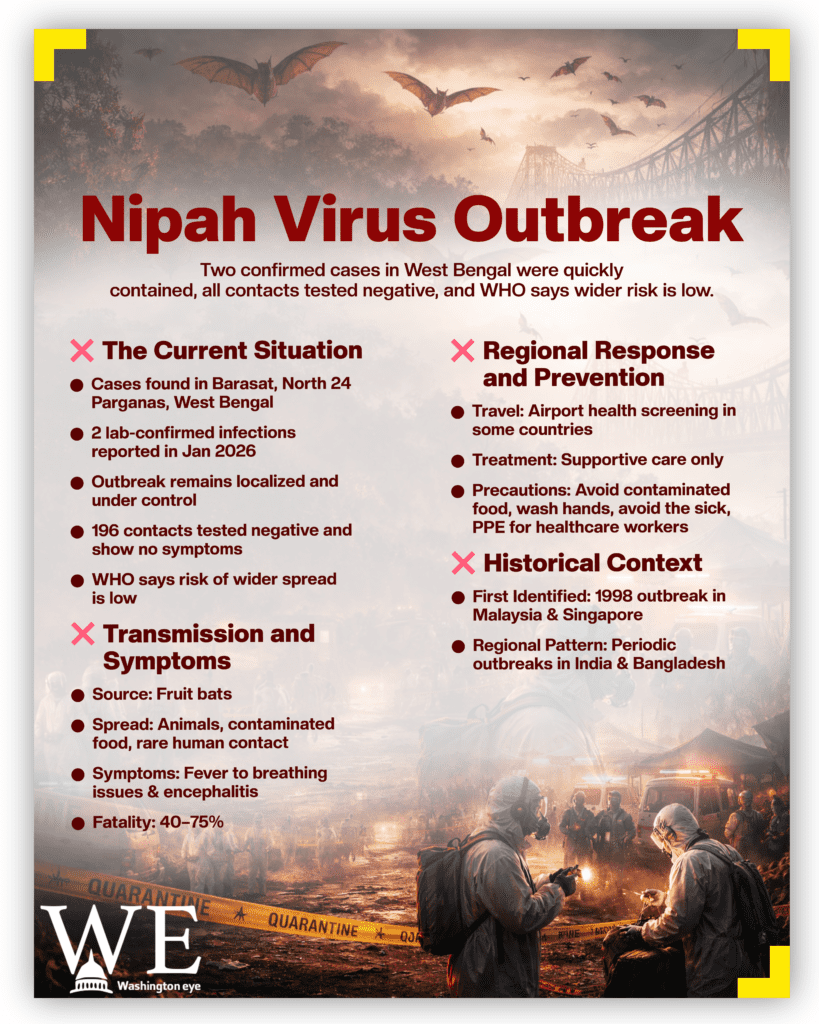
The outbreak was officially reported in January 2026, when the World Health Organization (WHO) and India’s National IHR focal point were notified of two laboratory-confirmed Nipah virus cases in Barasat, a town in North 24 Parganas district near Kolkata. Both patients are healthcare workers at a private hospital who developed symptoms in late December and were diagnosed in early January after testing at a national virology institute. One remains critically ill, while the other is reported to be recovering.
Nipah virus (NiV) is a zoonotic pathogen, meaning it can spread from animals to humans, and is carried naturally by fruit bats of the Pteropodidae family, also known as flying foxes. The virus can pass to humans through direct contact with infected animals or by consuming food contaminated by bat saliva or urine, such as fruits or raw date palm sap. In rare instances, it can spread directly between people through close or prolonged contact with infected individuals or their bodily fluids.

Although initial media reports suggested multiple cases, Indian health authorities clarified that only two confirmed infections have been identified since December 2025, and that no community transmission has been detected beyond those cases. A total of 196 contacts linked to the patients have been traced and tested, with all returning negative results and remaining asymptomatic. This has led officials to describe the outbreak as contained and localized.

Despite the limited number of cases, the outbreak has drawn attention across the region. Several Asian countries, including Thailand, Singapore, Malaysia, Indonesia, Pakistan, Nepal, and Hong Kong, have implemented health screening measures at airports and border checkpoints for travellers arriving from affected areas. Measures such as temperature checks and health declaration forms aim to reassure the public and enhance surveillance, though some health experts argue these steps offer limited scientific protection against a disease with an already low risk of international spread.
The World Health Organization has repeatedly emphasized that, while vigilance is important, the risk of broader spread remains low. WHO’s risk assessment notes that none of the monitored contacts have developed symptoms, and there is no evidence of mutation or sustained transmission that would indicate a wider public health threat at this stage.
Deadly but Rare: Symptoms, Fatality, and Global Concern
Nipah virus infection is known for its high fatality rate, estimated between 40% and 75% depending on case severity and local healthcare capacity. There is no licensed vaccine or specific antiviral treatment available, and care is largely supportive, focusing on monitoring complications and alleviating symptoms.

The incubation period, the time between exposure and symptom onset, typically ranges from 4 to 14 days, though in rare instances it may be longer. Initial symptoms often resemble flu-like illness, including high fever, headache, muscle pain, sore throat, cough, vomiting, and difficulty breathing. As the disease progresses, it can lead to respiratory distress and encephalitis, a dangerous inflammation of the brain, which is frequently fatal. Survivors may suffer lasting neurological effects.
Because early symptoms are common to many illnesses, diagnosis of Nipah virus infection requires laboratory testing, typically using RT-PCR to detect viral genetic material. In hospital settings, strict infection prevention and control measures are critical to protect healthcare workers and limit potential person-to-person transmission.
Precautions and Public Health Messaging
Public health officials stress that ordinary daily activities without close contact with infected individuals or exposure to contaminated animals pose minimal risk. WHO and national health agencies recommend:
- Avoiding consumption of raw date palm sap and fruits that may have bat contamination.
- Practicing good hand hygiene and avoiding close contact with sick individuals.
- Using protective equipment for healthcare workers and caregivers treating suspected cases.
While Nipah outbreaks are sporadic, they have occurred periodically in South Asia. India’s current outbreak is one of several documented since the virus was first identified in 1998 during a major outbreak among pig farmers in Malaysia and Singapore. Since then, cases have been reported intermittently in Bangladesh and India, often with significant public health response efforts.
As India continues to monitor the situation and neighbouring countries maintain surveillance efforts, health authorities worldwide remain vigilant but underscore that the overall danger to the general public is low, provided appropriate infection control and prevention practices are followed.