

Across the world, from crowded metropolitan cities to quiet suburban homes, patience is increasingly disappearing from daily human behavior. In an age dominated by instant messaging, same-day deliveries, and constant digital stimulation, waiting has become uncomfortable, frustrating, and often intolerable. What was once considered a basic human virtue is now being questioned: is patience still a natural trait, or has it become a skill that modern society is slowly forgetting how to practice?
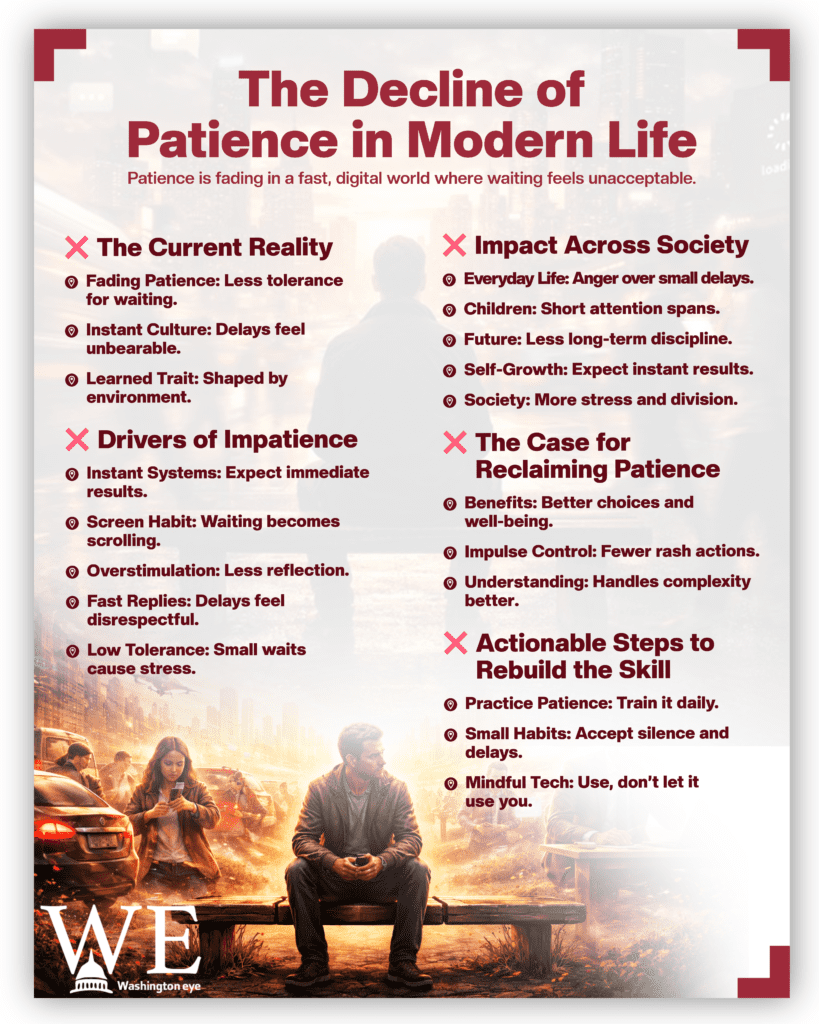
Experts largely agree that patience today functions more like a learned skill rather than an inherent quality. While some individuals may naturally tolerate delays better than others, patience is shaped by environment, habits, and social conditioning. In the past, everyday life required waiting, for letters, results, journeys, or even conversations. Today’s systems, however, are designed to remove delay, conditioning people to expect immediate outcomes. As a result, the ability to remain calm during inconvenience is weakening.
The decline of patience is most visible in the digital age. Smartphones have turned waiting time into scrolling time, reducing moments of stillness to seconds. Whether standing in a queue, sitting in traffic, or waiting for food at a restaurant, people instinctively reach for their screens. This constant engagement leaves little space for reflection or emotional regulation. Psychologists warn that when the brain becomes accustomed to constant stimulation, even short delays can feel mentally distressing.

Communication habits further highlight this shift. Messaging apps, read receipts, and online availability have shortened the acceptable response window. A delayed reply is often interpreted as neglect or disrespect, leading to unnecessary anxiety or conflict. This cultural expectation of instant communication has not only reduced patience but also altered emotional resilience, making people less tolerant of uncertainty or silence.

In daily life, impatience now surfaces in small but frequent ways. Customers grow irritated over minor service delays, commuters react aggressively to traffic congestion, and professionals feel pressured by slow processes rather than trusting long-term outcomes. Even personal growth is affected, as many expect immediate success, fast career progression, or quick emotional healing. When results take time, frustration replaces perseverance.
Children and young adults growing up in this environment may be particularly affected. Educators and parents report shorter attention spans and difficulty coping with delayed gratification. With entertainment and information available instantly, fewer opportunities exist for learning patience organically. This raises concerns about how future generations will handle challenges that require sustained effort, discipline, and emotional endurance.
Despite its decline, patience remains critically important. Studies link patience to better decision-making, stronger relationships, and improved mental health. Individuals who can tolerate delay are less likely to act impulsively and more likely to approach problems thoughtfully. Patience also plays a key role in conflict resolution, leadership, and long-term planning, skills essential in both personal and professional life.

From a societal perspective, impatience carries consequences. Public discourse becomes more polarized, workplaces become more stressful, and social interactions lose depth. When people demand instant results from complex systems, whether governments, institutions, or relationships, disappointment and mistrust grow. Patience allows room for understanding complexity, gradual change, and human imperfection.
Observers argue that reclaiming patience does not require rejecting technology, but rather redefining our relationship with it. Small conscious practices, such as allowing moments of silence, resisting constant multitasking, or accepting delays without distraction, can help rebuild this lost skill. Patience, they say, must be practiced intentionally in a world that rarely encourages it.
As society continues to accelerate, patience may no longer come naturally. Yet its value has not diminished. On the contrary, in a fast-moving world, patience has become a quiet strength, one that must be relearned, protected, and deliberately passed on.