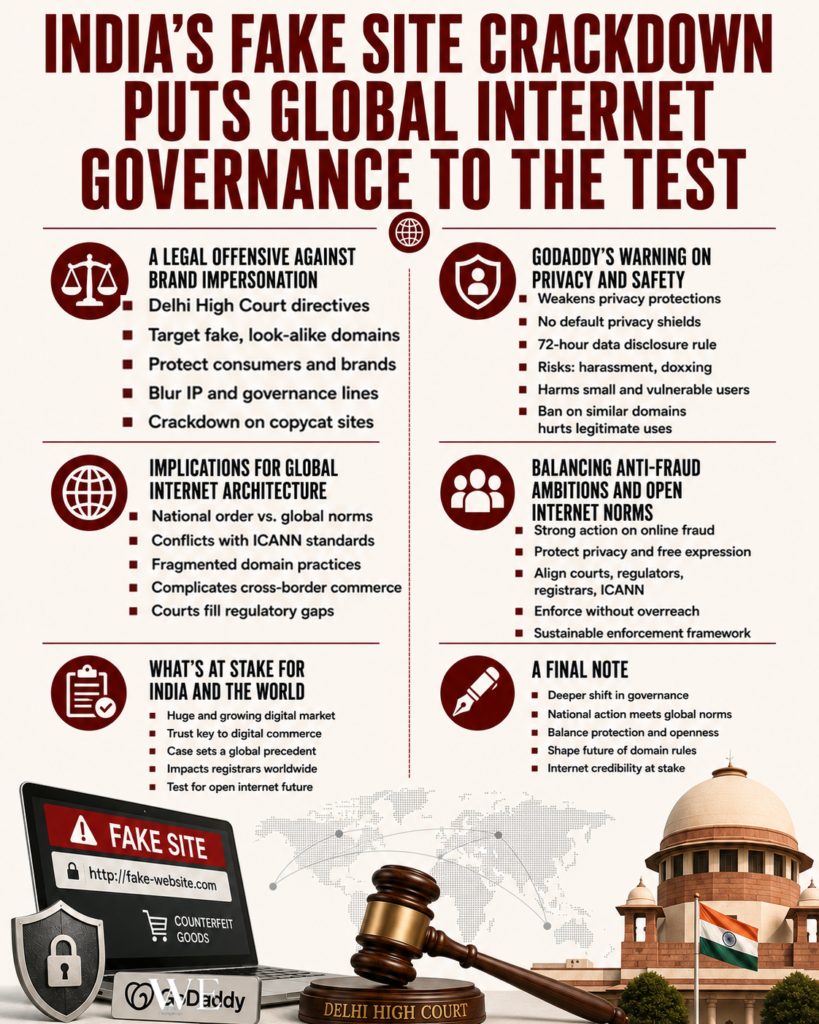

India’s escalating battle against fake commercial websites has unexpectedly opened a wider struggle over how the global internet should be governed, with domain giant GoDaddy warning that recent judicial directives could undermine core features of online security and openness.
A Legal Offensive Against Brand Impersonation
In New Delhi, a case brought by luxury brand Louis Vuitton against sites selling counterfeit goods prompted the Delhi High Court to order extensive measures targeting fake domains that mimic well known trademarks.
The court moved beyond traditional takedown orders, directing registrars to block domain names that are alphanumeric variations of protected brand names, a move intended to stop the long tail of copycat sites that deceive consumers.
These measures reflect India’s growing determination to protect local consumers from fraud and safeguard brand integrity in an expanding digital marketplace, where phishing and counterfeit sales increasingly exploit look alike web addresses.
Yet by embedding trademark protection directly into domain registration rules, the court is effectively blurring the line between intellectual property enforcement and technical internet governance, historically managed by global bodies such as ICANN and industry registrars.
GoDaddy’s Warning on Privacy and Safety
GoDaddy, the largest retail domain registrar in the world, has challenged the Delhi High Court’s directives, arguing they would weaken privacy protections and potentially make the internet less safe for legitimate users.
The court ordered registrars not to offer default privacy shields for domain owners and to disclose registrant data within seventy two hours to any party claiming a legitimate interest, provisions GoDaddy says create new risks for harassment, doxxing, and misuse of personal information.
From GoDaddy’s perspective, restricting default privacy and forcing rapid disclosure of registrant details could deter small businesses, activists, and vulnerable users who rely on anonymity or limited exposure in politically or socially sensitive contexts.
The registrar also contends that a blanket ban on domain names similar to protected trademarks is technically unworkable and could impede legitimate uses of common or surnamelike words that also function as brand names, thus reshaping the balance between trademark rights and free expression online.
Implications for Global Internet Architecture
Although the dispute emerges from a specific brand protection case, it sits at the intersection of national regulation, corporate responsibility, and transnational governance of the domain name system.
By effectively rewriting how registrars can offer privacy services and what kinds of names can be registered, a single national court order risks creating fragmented standards that diverge from practices coordinated by ICANN and followed by registrars across jurisdictions.
If other states emulate India’s approach, registrars could face conflicting compliance obligations, leading to differentiated domain practices in different markets and complicating cross border digital commerce, especially for small firms.
At the same time, the case reveals growing impatience among national authorities with what they see as slow or insufficient industry responses to online fraud, pushing courts to fill perceived regulatory gaps even at the cost of tension with global norms.
Balancing Anti-Fraud Ambitions and Open Internet Norms
The broader policy challenge is to align strong action against fake sites and online scams with safeguards for privacy, speech, and technical stability of the domain system.
India’s assertive stance underscores a legitimate concern about consumer protection in a rapidly digitizing economy, while GoDaddy’s objections highlight the unintended consequences that can arise when judicial remedies extend deeply into internet architecture.
A more durable equilibrium will likely require structured engagement among courts, regulators, registrars, and global governance bodies to refine enforcement tools that target fraudulent activity without eroding user privacy or fragmenting domain rules across borders.
How the Delhi case evolves, including appeals and possible regulatory clarification, will be watched closely as a test of whether national crackdowns on fake websites can be reconciled with the open, interoperable model that has so far underpinned the global internet.
A Final Note
The confrontation between India’s courts and the world’s largest domain registrar illustrates a deeper transition in internet governance, where national efforts to combat fraud increasingly intersect with transnational technical norms. How stakeholders reconcile strong consumer protection with privacy and openness will shape not only the future of domain regulation, but also the broader credibility of the internet as a trusted space for commerce and expression.