
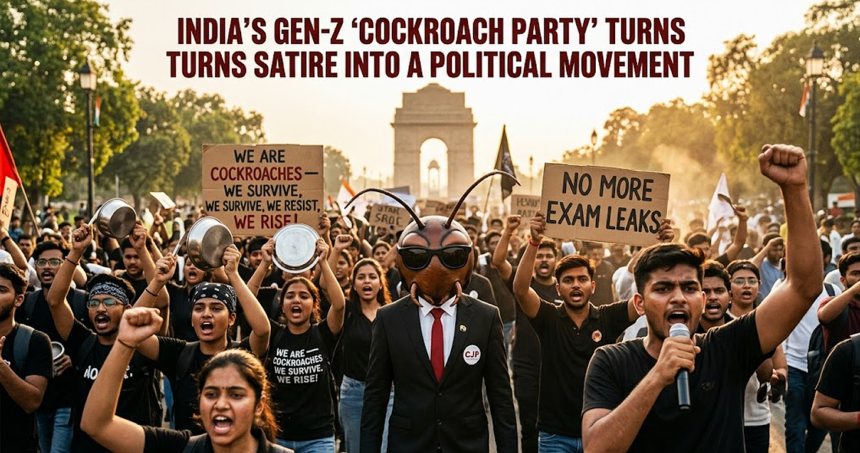
What began as an online joke has rapidly evolved into one of India’s most talked-about youth-led political movements. The self-styled “Cockroach Janta Party” (CJP), founded by political communications strategist Abhijeet Dipke, has transformed a controversial insult into a symbol of resistance, attracting millions of followers and igniting debates about unemployment, education, governance, and the frustrations of India’s Generation Z.
The movement emerged in May 2026 after comments made by India’s Chief Justice, who referred to certain unemployed youths and activists as “cockroaches” and “parasites” during court proceedings. While the remarks were later clarified, many young Indians interpreted them as a broader insult directed at a generation already struggling with job scarcity, exam scandals, and economic uncertainty. Instead of rejecting the label, thousands embraced it. Within days, social media users began calling themselves “cockroaches,” transforming the term into a badge of defiance.
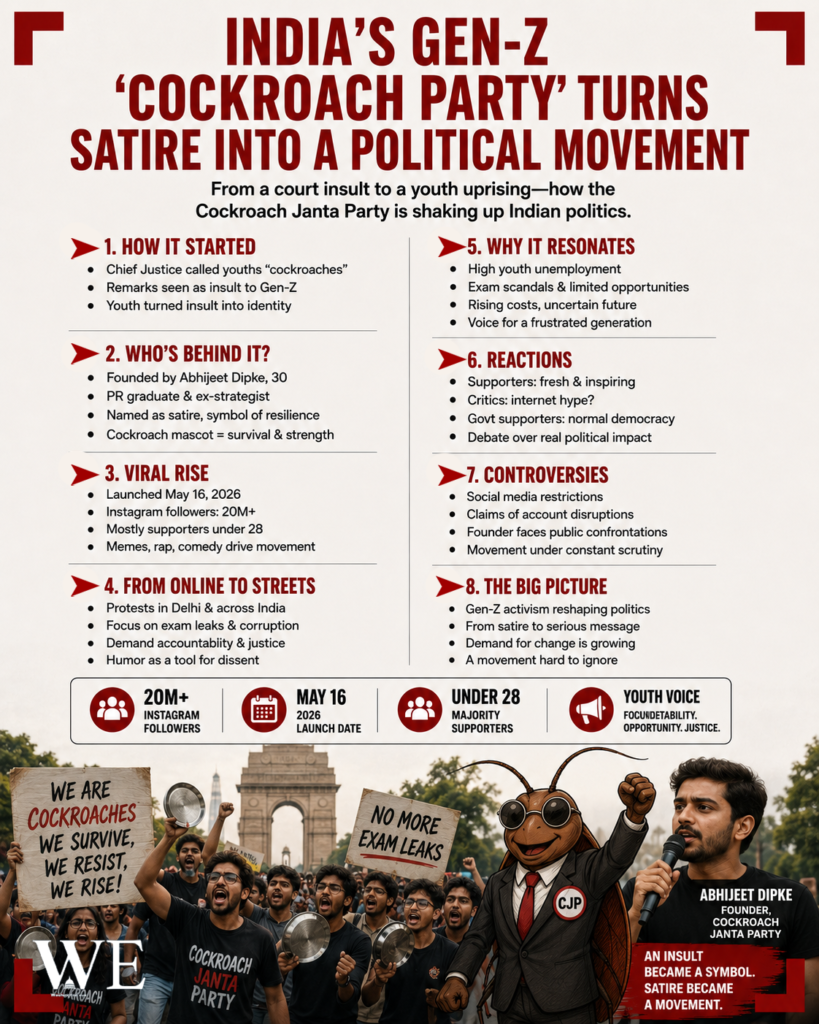
At the center of the phenomenon is 30-year-old Abhijeet Dipke, a public relations graduate and former political strategist. Dipke launched the Cockroach Janta Party on May 16, describing it initially as a satirical response to what many viewed as political and institutional arrogance. The party’s name itself is a parody of mainstream political branding, while its mascot, a cockroach in formal attire, symbolizes resilience. Supporters argue that cockroaches survive under difficult conditions, much like many young Indians facing economic hardship.

The movement’s rise has been fueled largely by social media. In less than a month, the party’s Instagram following surged past 20 million, surpassing the online following of several established political organizations. Reports indicate that most supporters are under the age of 28, making the CJP one of the most significant Gen-Z political phenomena in recent Indian history. The party’s online content combines memes, satire, rap music, stand-up comedy, and political commentary, making complex political issues accessible to younger audiences.
While critics initially dismissed the movement as internet humor, the CJP soon moved beyond social media. The group organized protests in New Delhi and other cities, drawing thousands of participants. Recent demonstrations focused on alleged examination paper leaks, particularly controversies surrounding the NEET medical entrance examination. Protesters demanded accountability and called for the resignation of India’s Education Minister. Demonstrators banged steel plates, staged satirical performances, and used humor as a form of political dissent.
Observers say the popularity of the Cockroach Janta Party reflects deeper structural frustrations among India’s youth. Despite being one of the world’s fastest-growing economies, India continues to face challenges related to youth unemployment, competitive entrance examinations, limited opportunities, and rising living costs. Many young graduates report difficulty finding stable employment despite years of education. Political analysts suggest that the movement resonates because it gives voice to concerns often overlooked by traditional political parties.
Reactions to the movement have been mixed. Supporters view it as a refreshing example of democratic participation and youth engagement. Several public figures and activists have praised the movement for encouraging political awareness among younger generations. Others, however, question whether an internet-driven protest can sustain long-term influence or translate online popularity into meaningful political change. Government supporters have largely downplayed its significance, describing it as part of the normal democratic process.

The movement has also faced controversy. Social media restrictions, allegations of online censorship, and disputes over the group’s activities have sparked further debate. In recent weeks, Dipke claimed that online accounts and websites linked to the movement faced disruptions. Meanwhile, the founder himself has become a recognizable public figure, even facing confrontations during public appearances.
Whether the Cockroach Janta Party evolves into a formal political force or remains a symbolic protest movement remains uncertain. Yet its rapid rise demonstrates how Gen-Z activism is reshaping political communication in India. By turning an insult into a rallying cry, the movement has highlighted a generation’s growing demand for accountability, opportunity, and representation.
For now, India’s “cockroaches” are proving difficult to ignore. What started as satire has become a powerful expression of youth discontent, and many analysts believe it could influence how political engagement unfolds in the world’s largest democracy for years to come.