
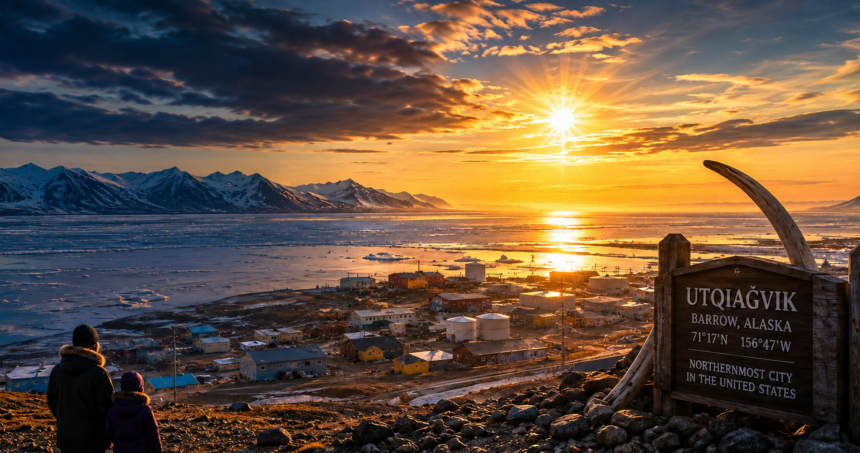
The annual “Midnight Sun” phenomenon has officially begun in northern Alaska, bringing nearly three months of continuous daylight to the Arctic region as the sun now remains above the horizon around the clock. Residents of Utqiaġvik, the northernmost city in the United States, witnessed the season’s final sunset earlier this month before entering an extraordinary 84-day period without darkness that will continue until early August.
Located more than 500 kilometers north of the Arctic Circle, Utqiaġvik experiences one of the world’s most dramatic seasonal light shifts every year. The city, home to around 4,500 people, now remains under constant sunlight both day and night as Earth’s tilt positions the Arctic region directly toward the sun during the Northern Hemisphere’s summer season. Scientists say the phenomenon is expected to continue until August 2, after which sunsets will gradually return to the region.
The Midnight Sun is a natural phenomenon that occurs in areas located above the Arctic Circle and below the Antarctic Circle. During this period, the sun never fully dips below the horizon at midnight, creating continuous daylight for weeks or even months depending on the location. The effect is caused by Earth’s axial tilt of approximately 23.5 degrees as the planet revolves around the sun. During summer in the Northern Hemisphere, the North Pole tilts toward the sun, allowing Arctic regions to receive uninterrupted sunlight.
Astronomers explain that the closer a place lies to the North Pole, the longer the duration of continuous daylight becomes. While Utqiaġvik experiences around 84 days of nonstop sunlight, areas closer to the pole can remain illuminated for nearly six months. The North Pole itself experiences approximately half a year of daylight followed by half a year of darkness.

Although the phenomenon is visually stunning, it significantly affects daily life in Alaska’s Arctic communities. Locals often use blackout curtains and adjusted sleeping schedules to cope with the endless daylight. Children can be seen playing outdoors late at night, while fishing, hunting, and outdoor activities continue well past traditional evening hours. In many Arctic communities, the Midnight Sun season is associated with festivals, tourism, cultural celebrations, and increased economic activity.
The extended daylight also supports important traditional activities among Indigenous Iñupiaq communities in northern Alaska. Seasonal whaling, fishing, and hunting intensify during the Arctic summer as warmer weather and melting sea ice improve accessibility. Events such as the Nalukataq Whaling Festival are commonly held under the persistent sunlight, celebrating culture, food, and community traditions.
Despite the constant sunshine, temperatures in northern Alaska remain relatively cool compared to other parts of the world. Weather experts say average summer temperatures in Utqiaġvik usually remain below 10 degrees Celsius, with July highs often reaching only around 49 degrees Fahrenheit, or roughly 9 degrees Celsius. Snowfall can still occur during summer months due to the region’s Arctic climate.

Scientists note that the Midnight Sun also provides valuable opportunities for climate and environmental research. Arctic regions are warming nearly four times faster than the global average due to climate change, making Alaska an important location for studying melting sea ice, rising temperatures, thawing permafrost, and shifting ecosystems. Researchers often use the long daylight hours during summer to conduct fieldwork and monitor environmental changes across the polar region. Continuous sunlight also affects wildlife behavior, migration patterns, and plant growth cycles.
Tourism authorities say the Midnight Sun attracts thousands of visitors every year who travel to Alaska to witness the unusual spectacle of bright skies at midnight. Travelers often experience hiking, photography, whale watching, and scenic drives under the glowing Arctic sun. Similar Midnight Sun events can also be seen in northern parts of Norway, Sweden, Finland, Greenland, Canada, and Russia during the summer season.
However, experts warn that the constant daylight can disrupt human circadian rhythms, especially for tourists unaccustomed to Arctic conditions. Sleep disorders, fatigue, and confusion about time are common experiences during the season. Health specialists recommend maintaining fixed sleep schedules and limiting light exposure indoors during rest hours.
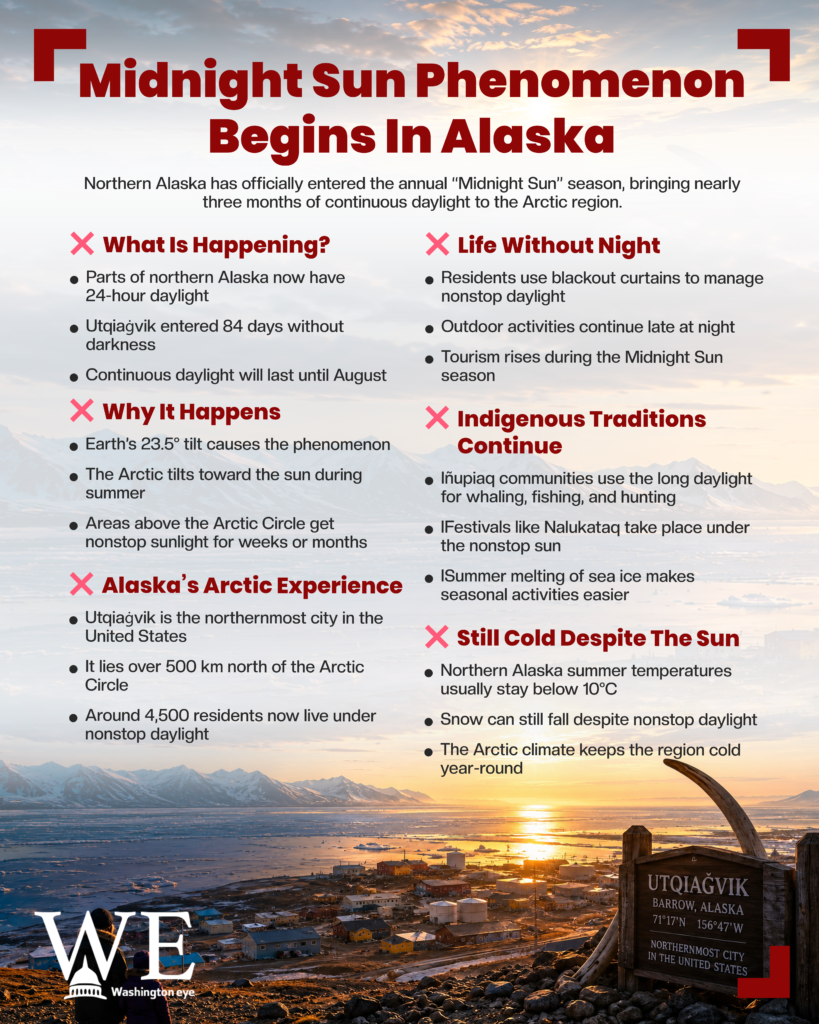
The Midnight Sun will continue illuminating Alaska’s Arctic skies until August, when darkness slowly begins returning to the region. Later in the year, the opposite phenomenon known as “Polar Night” will arrive, plunging parts of northern Alaska into continuous darkness for several weeks during winter.