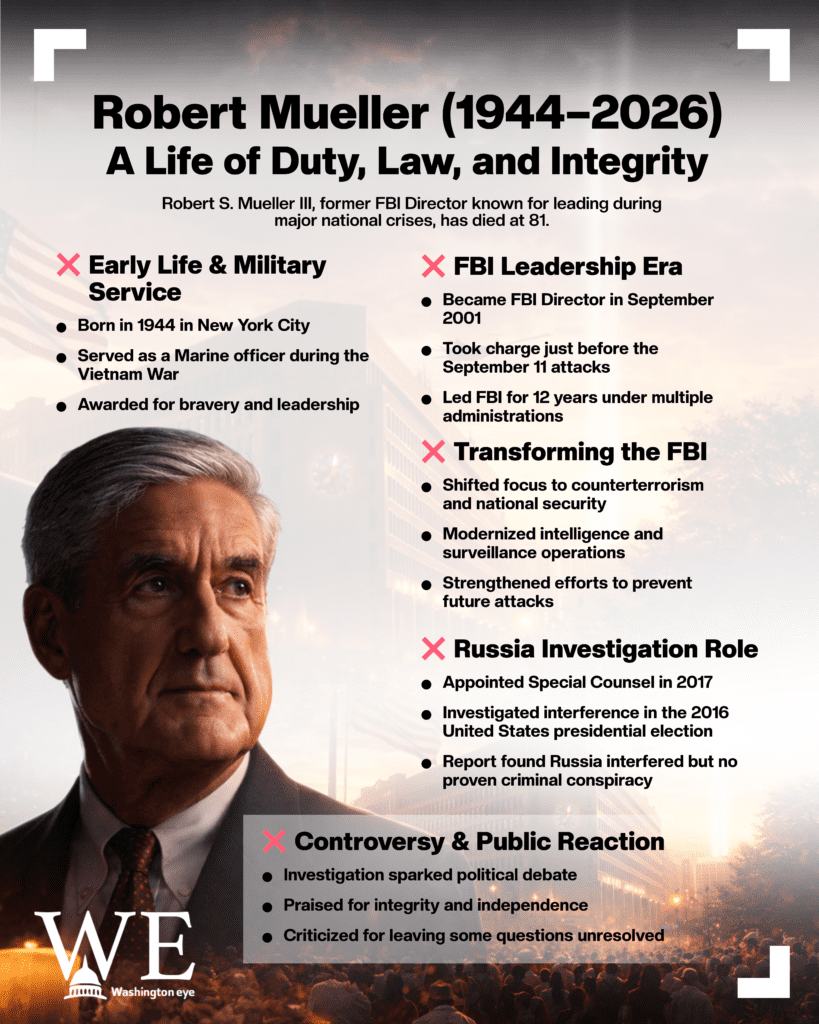
Robert S. Mueller III, the former director of the Federal Bureau of Investigation (FBI) and special counsel who led the high-profile investigation into Russian interference in the 2016 U.S. presidential election, has died at the age of 81. His death was confirmed by his family and former colleagues, who said he passed away on Friday, March 20, with the cause of death not immediately disclosed.
Mueller, widely regarded as one of the most disciplined and principled figures in modern American law enforcement, had a decades-long career that spanned military service, federal prosecution, and leadership at the highest levels of the U.S. justice system. His passing marks the end of a public life defined by integrity, restraint, and a commitment to institutional norms during periods of national crisis and political upheaval.
Born in 1944 in New York City, Mueller served as a decorated Marine officer during the Vietnam War before embarking on a legal career that would eventually take him to the helm of the FBI. He was appointed director of the bureau in September 2001, just days before the September 11 terrorist attacks, and would go on to lead the agency for 12 years under both Republican and Democratic administrations.
During his tenure, Mueller oversaw a fundamental transformation of the FBI, shifting its primary focus from traditional criminal investigations to counterterrorism and national security in the aftermath of 9/11. The period was marked by sweeping institutional reforms as the agency adapted to a new global threat landscape, with Mueller at the center of efforts to modernize intelligence operations and prevent future attacks.
After stepping down as FBI director in 2013, Mueller returned to public service in 2017 when he was appointed as special counsel by the U.S. Department of Justice. His mandate was to investigate Russian interference in the 2016 election and examine potential links between Moscow and the presidential campaign of Donald Trump. The investigation, which lasted nearly two years, resulted in dozens of indictments, including charges against Russian operatives and several individuals associated with Trump’s campaign.
Mueller’s final report, submitted in 2019, concluded that Russia had engaged in “sweeping and systematic” interference in the election. However, it did not establish sufficient evidence of a criminal conspiracy between the Trump campaign and Russian officials. On the question of obstruction of justice, Mueller notably refrained from reaching a definitive prosecutorial conclusion, citing long-standing Justice Department policy against indicting a sitting president.
The investigation placed Mueller at the center of intense political debate in the United States, drawing both praise and criticism. Supporters lauded his independence and adherence to legal standards, while critics argued that his findings left key questions unresolved. Despite the controversy, Mueller maintained a characteristically low profile, avoiding public commentary beyond his official duties.

In his later years, Mueller largely withdrew from public life. Reports had indicated that he had been diagnosed with Parkinson’s disease in 2021, a condition that gradually affected his health. His family had disclosed the diagnosis in 2025, noting the challenges he faced with mobility and speech. Tributes poured in from across the political spectrum following news of his death. Former U.S. presidents, senior officials, and colleagues praised Mueller’s lifelong service, describing him as a “model public servant” and a leader who upheld the rule of law during some of the country’s most turbulent periods.
However, reactions were not universally solemn. Former President Donald Trump, who had been the subject of Mueller’s investigation, sparked controversy with a harsh public response to the news, drawing widespread condemnation from political figures and commentators. Mueller is survived by his wife, Ann, and their two daughters. His legacy, shaped by decades of service in both war and government, remains closely tied to defining moments in recent U.S. history, from the fight against terrorism after 9/11 to the political divisions surrounding the Russia investigation.