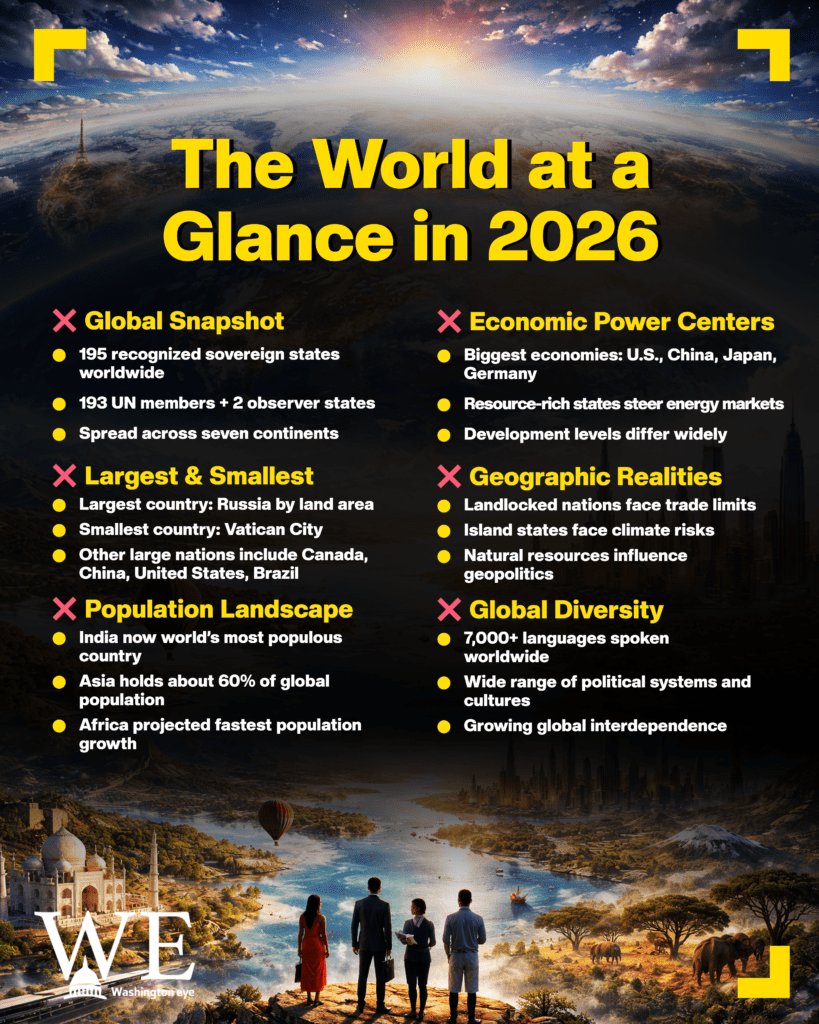
As global interdependence deepens in 2026 amid geopolitical tensions, climate challenges and economic realignments, understanding the world’s countries at a glance has become more important than ever. Today, there are 195 widely recognized sovereign states across the globe, 193 member states of the United Nations and two observer states, the Holy See (Vatican City) and Palestine. These nations are spread across seven continents: Asia, Africa, North America, South America, Europe, Australia (Oceania), and Antarctica. While Antarctica has no permanent population or sovereign government, it remains a continent governed by international treaty, primarily for scientific cooperation.
Asia is the largest and most populous continent, home to around 60 percent of the world’s population. It includes global giants such as China and India, the two most populous countries in the world, each exceeding 1.4 billion people. India recently surpassed China in population, marking a historic demographic shift. Africa follows as the second-largest continent by land area and is projected to experience the fastest population growth in the coming decades.
Europe, though smaller in size, remains politically and economically influential, hosting major powers such as Germany, France and the United Kingdom. North and South America together comprise 35 countries, including the United States, the world’s largest economy, and Brazil, the largest country in South America. Oceania consists of 14 countries, including Australia and numerous Pacific island nations.
In terms of geography, Russia is the largest country in the world by land area, spanning over 17 million square kilometers across Europe and Asia. Canada, China, the United States and Brazil also rank among the largest. At the opposite end of the scale, Vatican City is the smallest country, covering just 0.49 square kilometers within Rome, Italy, and serving as the spiritual and administrative center of the Roman Catholic Church. Monaco and Nauru are also among the smallest sovereign states by land area.

Population distribution varies significantly. While India and China dominate in terms of population, countries such as Tuvalu, Nauru and San Marino have populations of fewer than 100,000 people. The global population crossed 8 billion in 2022, according to United Nations estimates, and continues to grow unevenly, with aging populations in parts of Europe and East Asia, and youthful demographics in Africa and South Asia. Urbanization is another defining feature of the modern world, with more than half of humanity now living in cities.
Historically, the modern nation-state system traces its roots to the Peace of Westphalia in 1648, which established principles of territorial sovereignty. However, the global map has continued to evolve through colonization, decolonization, wars and diplomatic agreements. The 20th century saw a significant rise in the number of independent states following the collapse of European empires and later the dissolution of the Soviet Union and Yugoslavia. South Sudan, which gained independence in 2011, is currently the world’s newest internationally recognized country.
Economically, countries differ widely in terms of development and income levels. The United States, China, Japan and Germany are among the largest economies by nominal GDP. Meanwhile, small states such as Luxembourg and Singapore often rank high in per capita income. Resource-rich countries in the Middle East, including Saudi Arabia and the United Arab Emirates, play a strategic role in global energy markets. At the same time, many developing nations face challenges including debt, climate vulnerability and political instability.

Geography also shapes national identity and economic prospects. Landlocked countries such as Bolivia and Ethiopia often face trade disadvantages due to lack of direct sea access, while island nations confront rising sea levels and climate risks. Countries along the equator experience tropical climates, while those closer to the poles endure extreme seasonal variations. Natural resources, from oil and gas to rare earth minerals, significantly influence geopolitical alignments.
Culturally and linguistically, the world is extraordinarily diverse. There are more than 7,000 languages spoken worldwide, with countries like Papua New Guinea alone accounting for over 800 languages. Religions, political systems and governance models vary widely, from constitutional monarchies and federal republics to absolute monarchies and single-party states.
In an era marked by global crises, ranging from pandemics and climate change to armed conflicts and migration, countries are increasingly interconnected. International organizations such as the United Nations, World Trade Organization and regional blocs like the European Union and African Union play key roles in diplomacy and cooperation.
As 2026 unfolds, the global map remains both stable and dynamic. While borders may appear fixed, demographic trends, political transformations and environmental pressures continue to reshape the realities within them. Understanding countries at a glance is not merely about counting states on a map; it is about recognizing the diversity, complexity and shared challenges that define the modern world.