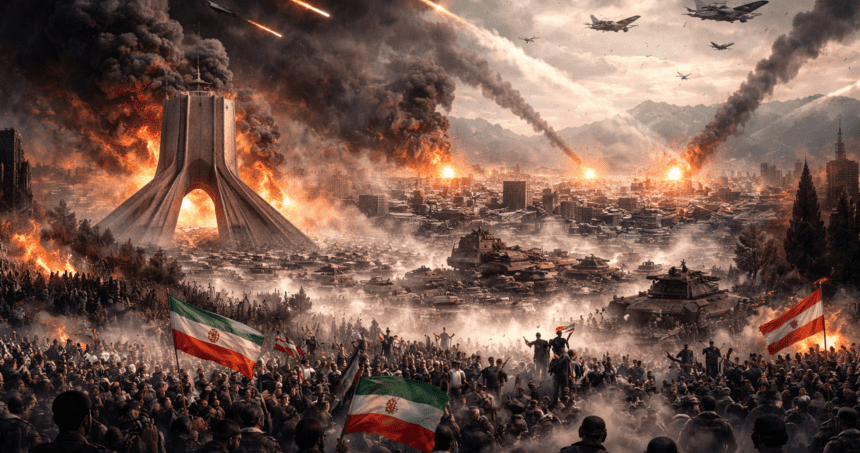
Iran appears to be confronting a rare and complex moment in its modern history, where internal unrest and external conflict are unfolding simultaneously. Over the past year, the country has faced large-scale protests at home while also becoming deeply entangled in military confrontations across the Middle East. Analysts say these overlapping crises raise a critical question: is Iran effectively fighting two battles at once, one against its own dissatisfied citizens and another against regional and global rivals?
The internal turmoil began in late 2025 when widespread protests erupted across Iran over economic hardship, rising inflation, and political dissatisfaction. Demonstrations quickly spread to more than 100 cities, becoming the largest uprising in the country since the 1979 Islamic Revolution. Many protesters demanded political reforms or even the end of the current Islamic Republic system. The unrest was fueled by the collapse of the Iranian currency, high unemployment, and growing frustration among young people and the middle class.
Iranian authorities responded with a heavy security crackdown. Government forces, including the Islamic Revolutionary Guard Corps (IRGC) and the Basij paramilitary units, were deployed across major cities to suppress demonstrations. Reports from human rights groups indicated that thousands of protesters were killed or detained during the crackdown, with some incidents described as massacres in cities such as Rasht and Fardis. Internet shutdowns and communication blackouts were also imposed to limit the spread of information and prevent coordination among protesters.
Despite the crackdown, unrest has not fully disappeared. Many Iranians remain deeply dissatisfied with economic conditions and political restrictions. Analysts say that years of international sanctions, economic mismanagement, and social limitations have created widespread anger within Iranian society. The government, however, argues that foreign powers are encouraging the protests to destabilize the country. Iranian leaders often portray the demonstrations as part of a broader geopolitical struggle involving Western countries and regional rivals.

At the same time, Iran has become increasingly involved in confrontations beyond its borders. Tensions with Israel and the United States have escalated sharply in recent months, including direct military strikes, missile attacks, and threats of wider war. According to recent reports, Israeli and U.S. forces have targeted Iranian military sites and strategic facilities, while Iran has responded with missile and drone attacks against Israeli targets and U.S. installations in the region.
These external conflicts are not entirely new. Iran has long been involved in regional power struggles through alliances with armed groups and political movements in countries such as Lebanon, Iraq, Syria, and Yemen. However, the current escalation appears more direct and dangerous than previous proxy conflicts. Experts warn that the risk of a wider regional war has increased significantly as both sides exchange strikes and threats. The situation has also sparked intense international debate over legality and global security. Some European leaders have criticized military strikes in Iran as violations of international law and called for restraint from all sides.
Diplomats warn that continued escalation could destabilize the entire Middle East and affect global energy markets and trade routes. Inside Iran, reactions to the dual crisis are mixed. Some citizens support the government’s confrontational stance against foreign powers, viewing it as a defense of national sovereignty. Others believe that the country’s leadership is focusing too much on external conflicts while ignoring economic problems and political reforms at home. The death of long-time Supreme Leader Ayatollah Ali Khamenei in a reported missile strike has further intensified uncertainty about the country’s future leadership and political stability.
Political analysts describe the situation as a dangerous balancing act for Iran’s leadership. Maintaining authority at home requires strong security measures, while confronting foreign adversaries demands military readiness and strategic alliances. Trying to manage both challenges simultaneously can strain resources and deepen internal divisions.
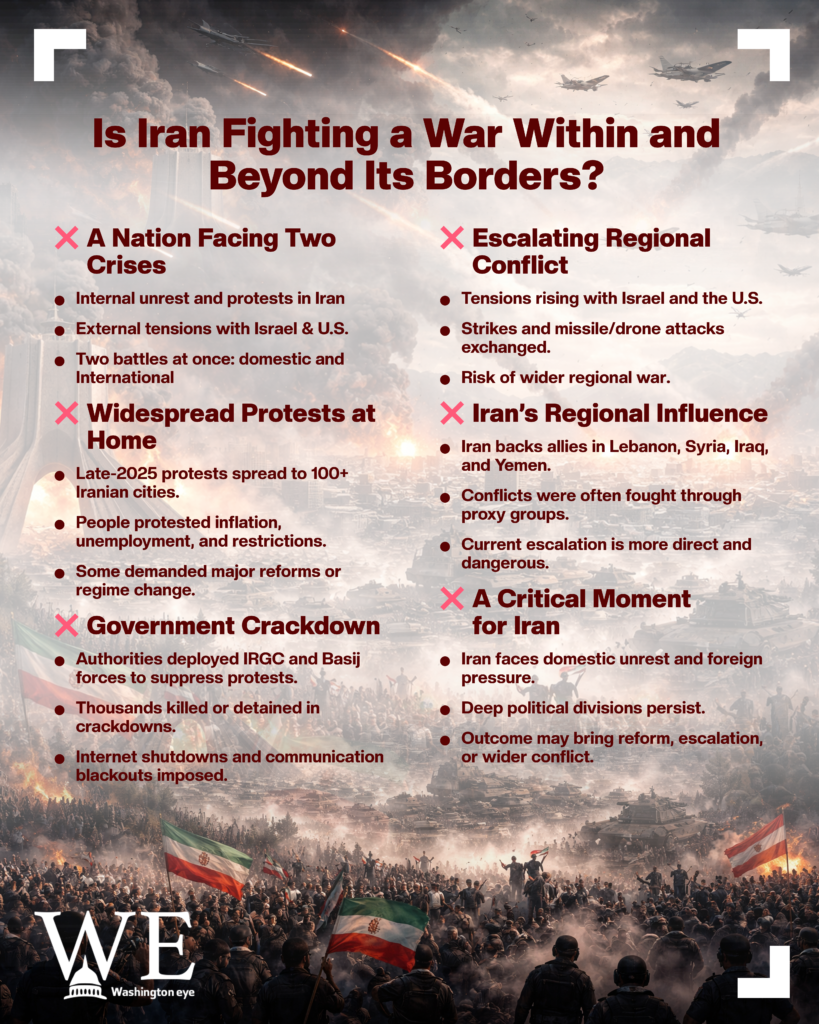
Ultimately, the question of whether Iran is fighting a war both within and beyond its borders reflects the country’s broader struggle over identity, governance, and geopolitical influence. The coming months will likely determine whether these overlapping crises escalate into larger conflicts or push the country toward negotiations and reform. For now, Iran stands at a critical crossroads, facing pressure from its own streets as well as from rival powers across the region.