

Asia, the world’s fastest-growing economic region, is increasingly facing questions about its long-term oil security. Although the continent is not literally running out of oil reserves overnight, recent geopolitical tensions, supply disruptions, and rising demand have raised serious concerns about whether Asia can maintain stable oil supplies in the coming years. Recent events in the Middle East, the primary source of oil imports for many Asian countries, have intensified these worries and pushed governments across the region to rethink their energy strategies.
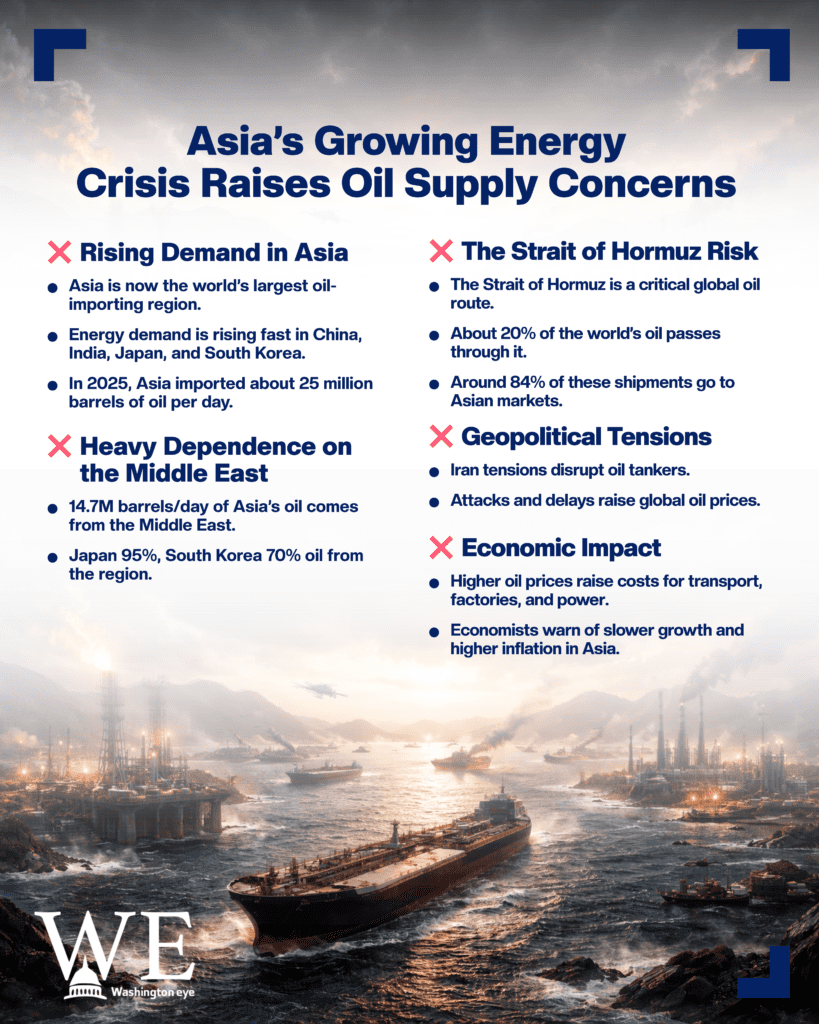
Asia is currently the largest oil-importing region in the world. Rapid industrialization, growing populations, and expanding transportation networks have driven energy demand sharply upward over the past two decades. Countries such as China, India, Japan, and South Korea consume vast quantities of crude oil but produce relatively little domestically. As a result, the region depends heavily on imports, particularly from the Middle East. In 2025 alone, Asia imported about 25 million barrels of crude oil per day, with around 14.7 million barrels coming from the Middle East.
The dependence is particularly strong in East Asia. Japan relies on the Middle East for roughly 95% of its crude oil supply, while South Korea depends on the region for around 70% of its oil imports. These figures highlight the vulnerability of Asia’s energy system, especially during times of geopolitical tension.
A major concern today is the situation in the Strait of Hormuz, a narrow waterway between Iran and Oman. This shipping route is one of the most important oil chokepoints in the world, carrying about 20% of global petroleum supply. Most of the oil transported through this route is destined for Asian markets, making the region highly sensitive to disruptions. In fact, analysts estimate that 84% of oil shipments passing through the strait are ultimately delivered to Asian countries, particularly China, India, Japan, and South Korea.
Recent geopolitical conflicts have made this dependency more visible. Escalating tensions involving Iran and Western powers have led to attacks on oil tankers and disruptions to shipping in the Strait of Hormuz. These incidents have slowed maritime traffic and forced some shipping companies to divert vessels to longer routes around Africa, significantly increasing transportation costs. The resulting uncertainty has caused oil prices to rise sharply in global markets and raised concerns about potential supply shortages across Asia.
The economic consequences could be significant. Higher oil prices directly affect transportation, manufacturing, and electricity generation across the region. Many Asian economies rely on oil to power industries, aviation, shipping, and road transport. According to analysts, a sustained increase in energy prices could slow economic growth, raise inflation, and increase living costs.
Some countries are already preparing for possible supply disruptions. Japan, for example, has instructed oil storage facilities to prepare for potential releases from its strategic reserves to stabilize domestic supply if imports are interrupted. Meanwhile, India has begun diversifying its oil sources, purchasing more crude from the United States, Russia, and West Africa to reduce dependence on the Persian Gulf.

Another factor contributing to the concern is the limited domestic oil production within Asia itself. Apart from a few producers such as Malaysia and Indonesia, most Asian economies rely heavily on imported energy. This structural dependence means that any global supply disruption, whether due to wars, sanctions, or shipping blockades, can quickly affect the region’s energy security.
However, experts emphasize that Asia is not literally running out of oil. Instead, the real issue is energy security, the ability to access affordable and stable supplies. The current crisis highlights how fragile global energy supply chains can be, particularly when they depend on a few strategic routes and suppliers.
To address these risks, many Asian countries are accelerating efforts to diversify their energy mix. Governments are expanding renewable energy programs, investing in liquefied natural gas (LNG) infrastructure, and building larger strategic petroleum reserves. China, for instance, has been stockpiling oil and investing heavily in solar, wind, and electric vehicle technologies. Similarly, Japan and South Korea are pushing forward with hydrogen and renewable energy projects to reduce long-term dependence on imported fossil fuels.
The growing interest in renewable energy reflects a broader shift in global energy policy. While oil will remain an essential resource for decades, the current tensions highlight the importance of alternative energy sources and diversified supply chains.
In conclusion, Asia is not running out of oil in a physical sense, but it faces increasing risks related to supply disruptions, geopolitical conflicts, and price volatility. The ongoing tensions in key oil-shipping routes such as the Strait of Hormuz serve as a reminder that energy security remains a critical challenge for the region. As Asian economies continue to grow, securing stable and sustainable energy supplies will remain one of the defining issues of the coming decades.