
More than a century after it erupted, World War I (WWI) remains one of the most transformative conflicts in modern history, reshaping global politics, borders, and societies. The war, often referred to as the Great War, lasted from 1914 to 1918 and involved many of the world’s major powers. It began in Europe but quickly spread across several continents, drawing in countries from Europe, Asia, Africa, and the Americas. Historians widely regard it as a turning point that set the stage for many political, social, and economic developments of the 20th century.
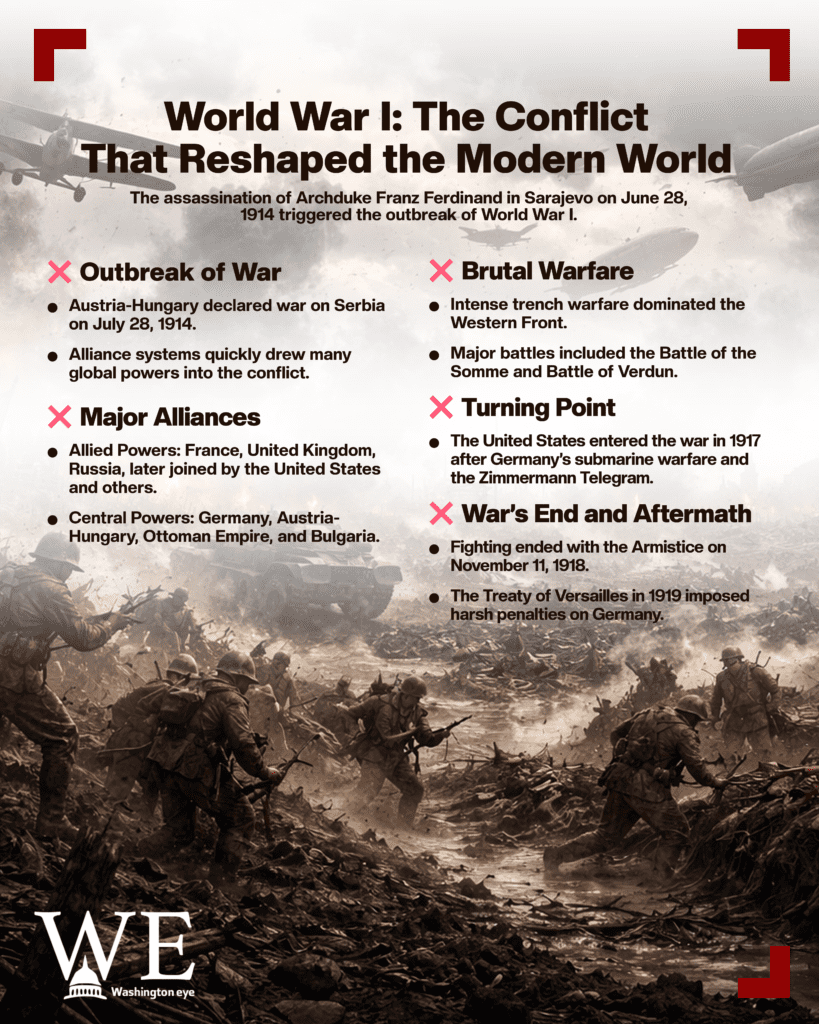
The immediate trigger for the war occurred on June 28, 1914, when Archduke Franz Ferdinand of Austria-Hungary was assassinated in Sarajevo, then part of Bosnia. The assassin, Gavrilo Princip, was linked to a Serbian nationalist group seeking independence from Austro-Hungarian rule. Following the assassination, Austria-Hungary declared war on Serbia on July 28, 1914, setting off a chain reaction among European alliances. Within weeks, major powers were drawn into the conflict.
Two main alliances emerged during the war. The Allied Powers included France, the United Kingdom, Russia, and later the United States, Italy, and several other countries. Opposing them were the Central Powers, mainly Germany, Austria-Hungary, the Ottoman Empire, and Bulgaria. These alliances turned what might have been a localized conflict into a global war.
Several deeper causes contributed to the outbreak of the war. Rising nationalism, growing militarism, intense imperial rivalries, and a complex network of alliances among European powers created an environment of tension and competition. Industrialization had also led to the development of more destructive weapons, making the war far deadlier than previous conflicts.

Much of the fighting in Europe took place along the Western Front, stretching across France and Belgium, where soldiers fought from trenches in brutal conditions. Battles such as the Battle of the Somme and the Battle of Verdun became symbols of the war’s horrific human cost, with hundreds of thousands of soldiers killed or wounded. The Eastern Front saw large-scale battles between Germany, Austria-Hungary, and Russia, while other fronts emerged in the Middle East, Africa, and Asia.
A major turning point came in 1917, when the United States entered the war on the side of the Allies. The U.S. decision was influenced by Germany’s unrestricted submarine warfare and the interception of the Zimmermann Telegram, in which Germany attempted to persuade Mexico to join the war against the United States. The arrival of American troops and resources strengthened the Allied forces significantly.
By 1918, the Central Powers began to collapse under military pressure, economic hardship, and internal political unrest. Germany’s allies started to surrender one by one. On November 11, 1918, Germany agreed to an armistice, effectively ending the fighting. The formal peace settlement came with the Treaty of Versailles in 1919, which imposed heavy penalties and territorial losses on Germany.
More Read
The human cost of World War I was staggering. Historians estimate that around 16 to 20 million people died, including both soldiers and civilians, while more than 20 million were wounded. Entire communities across Europe were devastated, and millions of families lost loved ones.
The war also led to the collapse of several major empires, including the German Empire, Austro-Hungarian Empire, Ottoman Empire, and Russian Empire. New countries emerged in Europe and the Middle East as borders were redrawn. Politically, the war contributed to revolutions, including the Russian Revolution of 1917, which eventually led to the creation of the Soviet Union.
World War I had lasting economic and social impacts as well. European economies were heavily damaged, and many countries faced massive debts and reconstruction challenges. The war also accelerated technological innovations in aviation, communication, and medicine, while fundamentally changing warfare through the use of tanks, submarines, machine guns, and chemical weapons.
Despite hopes that the war would be “the war to end all wars,” the political tensions and harsh terms imposed on Germany contributed to instability in Europe. Many historians believe that unresolved issues from World War I eventually paved the way for World War II in 1939.
Today, World War I remains a powerful reminder of the consequences of geopolitical rivalry and unchecked nationalism. Memorials, museums, and annual remembrance ceremonies around the world continue to honor the millions who lost their lives in the conflict. As historians reflect on the war more than a century later, its lessons about diplomacy, alliances, and global stability remain highly relevant.