EU leaders have opened a new push for economic reforms aimed at boosting Europe’s competitiveness and resilience, as the bloc faces mounting geopolitical pressure from Russia’s war on Ukraine, intensifying US-EU frictions, and a tougher global trade environment shaped by China’s industrial dominance and supply-chain leverage.
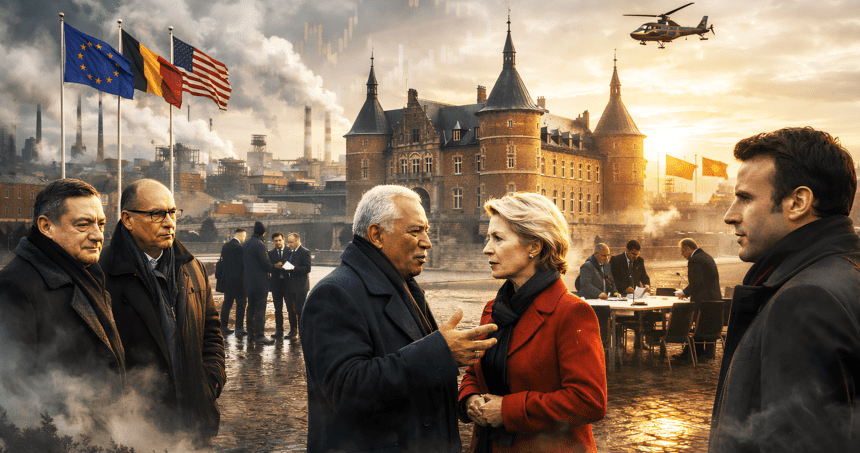
The latest effort took shape at an informal EU leaders’ retreat on 12 February 2026 at Alden Biesen Castle in Bilzen-Hoeselt, Belgium, convened by European Council President António Costa with European Commission President Ursula von der Leyen and featuring input from former Italian prime ministers Mario Draghi and Enrico Letta, whose recent reports have become touchstones for the debate on Europe’s economic future.
Officials and diplomats describe the moment as a response to a rapidly hardening “geoeconomic” landscape: Europe is being asked to spend more on defence, shield critical industries, and secure energy and raw-material supply chains, while also lifting growth in an economy that many leaders say is too fragmented and too slow to scale companies and investment compared with the United States and China.

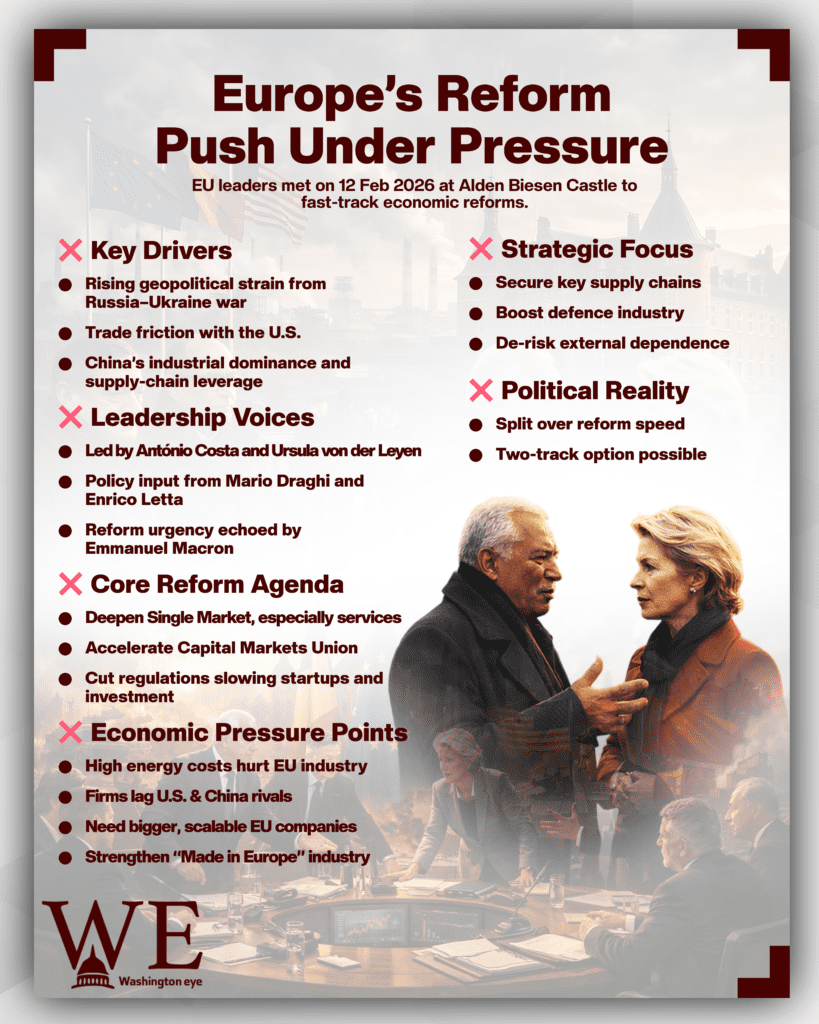
At the retreat, leaders broadly aligned around a reform menu that includes deepening the Single Market, especially for services and cross-border business; speeding up work on a more integrated Capital Markets Union to unlock private investment; and cutting regulatory and administrative burdens that leaders argue discourage startups, innovation, and industrial expansion. Costa said the discussion focused on building a “more competitive and resilient economy” that supports prosperity, jobs and affordability, and that leaders would return with concrete measures at the March European Council.
Energy costs are a central driver. Business groups and policymakers have repeatedly warned that European industry pays significantly higher electricity and energy prices than competitors, feeding deindustrialisation fears and undermining the transition to clean technologies. At the retreat, leaders flagged pragmatic solutions, particularly for energy-intensive sectors, while keeping the longer-term transition framed as a strategic autonomy project.
The geopolitical backdrop is sharpening the urgency. Recent transatlantic tensions, alongside concerns about future US tariffs and disputes spanning trade, technology rules and strategic autonomy, have reinforced calls in several capitals to reduce dependence on external powers and to “de-risk” key economic relationships. In interviews and summit reporting around the retreat, French President Emmanuel Macron argued Europe should use the current moment to accelerate delayed reforms, including exploring common EU borrowing and stronger “Made in Europe” industrial capacity.
Still, divisions remain over how far and how fast the EU should go, and whether all 27 countries must move together. Reporting in the days after the retreat described governments weighing a “two-track” approach, with coalitions of willing member states potentially advancing parts of the agenda faster than the full bloc, reflecting frustration that unanimity requirements and differing economic models can slow decisions.
Several reform themes surfaced repeatedly in the debate. One is market integration and scale: easing cross-border barriers and adjusting rules so European firms can grow larger and compete globally, including discussion around competition policy and merger rules. Another is investment mobilisation, where leaders and central figures argue that Europe must turn savings into productive investment through deeper capital markets and simpler financing channels. A third is strategic industrial policy, including stronger defence-industrial cooperation and procurement, and preference mechanisms that direct some public spending toward European suppliers, an approach sometimes summarised as “Buy European,” though it raises questions about cost, trade retaliation and how it fits with EU competition rules.
Supply-chain security has also moved from niche policy to mainstream agenda item. The Commission has been advancing initiatives aimed at reducing dependencies in areas such as critical raw materials, drawing lessons from the energy shock after Russia’s invasion of Ukraine. Leaders view these efforts as part of a broader economic-security doctrine, designed to protect sensitive sectors while avoiding full decoupling from major trading partners.
The political calendar now shifts to implementation. EU officials say the retreat was designed to build consensus ahead of the March summit, where leaders expect proposals linked to competitiveness, Single Market deepening and investment, alongside the ever-present constraints of national budgets, differing views on shared EU debt, and domestic politics across key capitals.
For European households, the stakes are immediate: leaders are linking reforms to affordability, jobs and cost-of-living pressures. For Europe’s strategic posture, the argument is even broader, an EU that cannot grow, invest and innovate at scale will struggle to finance defence, sustain the green and digital transitions, and withstand coercion in an era where economics and security increasingly blur.