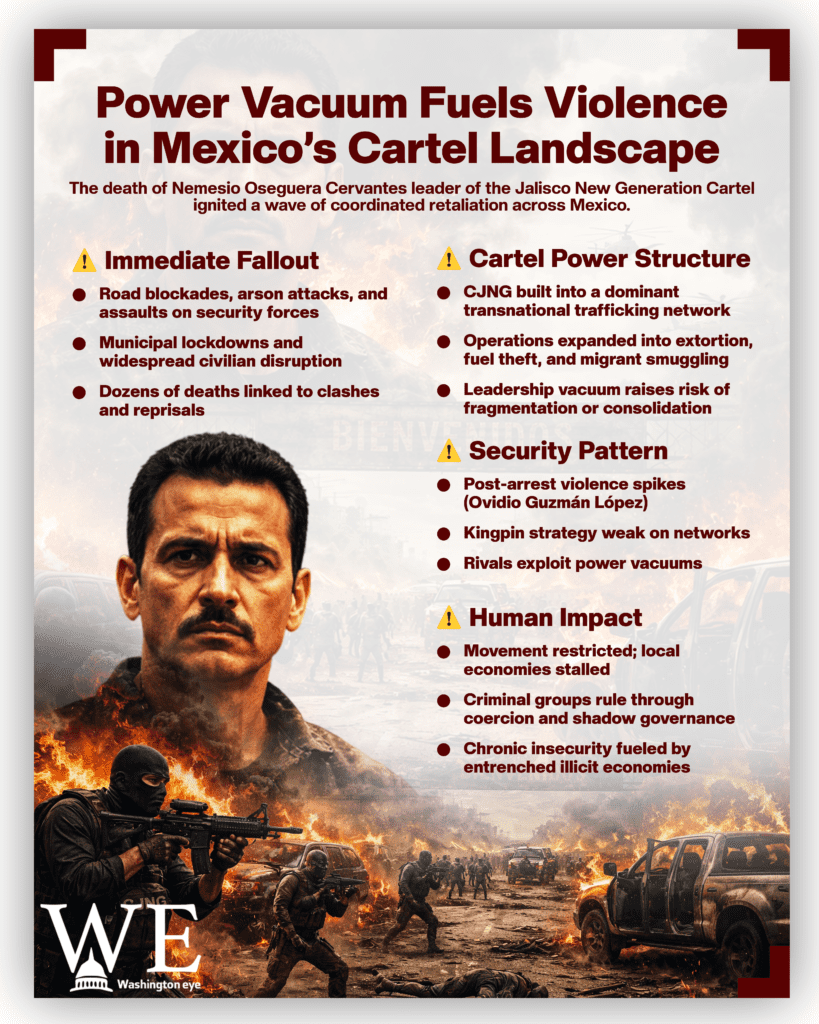
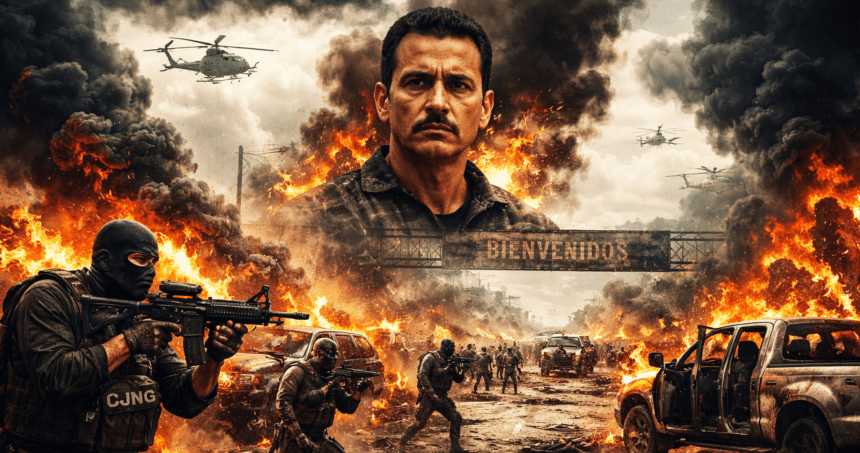
Mexico is confronting a renewed surge of cartel violence after the death of notorious crime boss Nemesio Oseguera Cervantes, popularly known as El Mencho. The leader of the Jalisco New Generation Cartel (CJNG) died from wounds sustained during a security operation on 22 February 2026, triggering a wave of coordinated retaliation that has left dozens dead and disrupted daily life across multiple states.
Cities under siege
Within hours of news of his death, armed CJNG factions mounted road blockades, set vehicles ablaze and launched attacks on police and military units. Entire municipalities were forced into lockdown as authorities urged residents to remain indoors. The tactics reflected the cartel’s long-standing strategy of public intimidation consisting of visible acts of violence designed to signal resilience and deter rivals or government incursions.
The architect of a criminal powerhouse
El Mencho rose from low-level trafficking to command one of the hemisphere’s most aggressive criminal organizations. Since its emergence in the early 2010s, CJNG expanded rapidly across Mexico and into international markets, while branching into extortion, fuel theft and migrant smuggling. Its operational style included heavily armed convoys, propaganda videos and direct assaults on state forces.
Power vacuum risks
Security specialists warn that the cartel’s future now hinges on succession dynamics. If internal leadership arrangements hold, the group may maintain cohesion. If not, fragmentation could spark turf wars among lieutenants or incursions by rival organizations seeking to capture lucrative trafficking corridors. Both scenarios typically bring spikes in homicides, kidnappings and extortion in contested regions.
A familiar cycle in Mexico’s drug war
Mexico has repeatedly experienced violence surges following the removal of major cartel figures, including after operations against figures such as Ovidio Guzmán López. These crackdowns produce short-term disruption but rarely dismantle underlying criminal economies, which remain embedded in local political and social structures.

Beyond the kingpin strategy
Despite recent declines in national homicide rates, criminal groups continue to exert influence over communities through coercion and parallel governance. Analysts argue that focusing primarily on eliminating cartel leaders delivers symbolic victories yet fails to weaken the broader networks that sustain organized crime.
El Mencho’s death removes one of Mexico’s most feared traffickers. But the violent backlash now unfolding suggests the country’s deeper security challenges like institutional fragility, entrenched illicit markets and cartel fragmentation remain unresolved.