
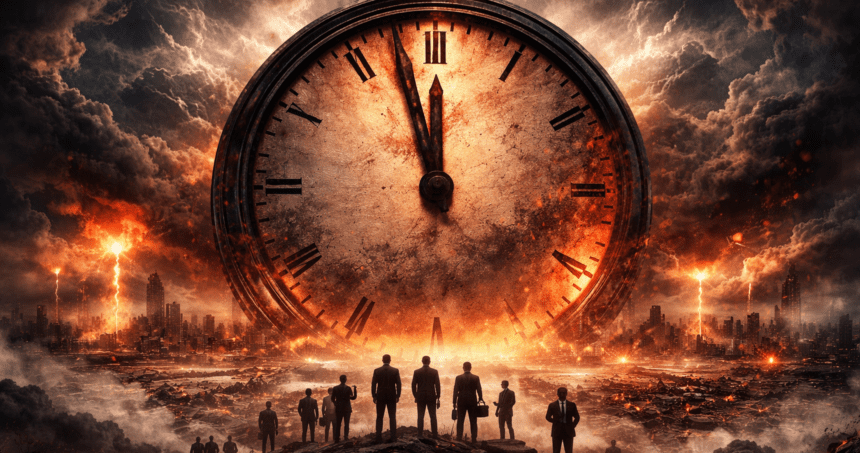
The Doomsday Clock is a symbolic timepiece that represents how close humanity is to self-inflicted global catastrophe. Rather than measuring real time, the clock shows how near the world is to “midnight,” a metaphor for existential disaster caused by threats such as nuclear war, climate change, pandemics, and emerging technologies. When the clock moves closer to midnight, it signals heightened global danger; when it moves back, it suggests reduced risk.
The concept of the Doomsday Clock originated in 1947 in the United States, shortly after World War II and the atomic bombings of Hiroshima and Nagasaki. It was created by scientists involved in the Manhattan Project who had grown deeply concerned about the consequences of nuclear weapons. The idea was first introduced on the cover of the Bulletin of the Atomic Scientists, a magazine founded by physicists who wanted to warn policymakers and the public about the dangers of unchecked scientific power.
Initially, the clock focused almost entirely on the threat of nuclear annihilation during the Cold War. In its early years, the time was adjusted based on events such as nuclear tests, arms races between the United States and the Soviet Union, and progress or setbacks in arms control agreements. For example, the clock moved farther from midnight in the 1990s after the end of the Cold War and the signing of major nuclear arms reduction treaties, reflecting a brief period of optimism.

Over time, however, the scope of the Doomsday Clock expanded. Today, decisions about the clock are made annually by the Bulletin of the Atomic Scientists’ Science and Security Board, in consultation with experts including Nobel laureates. The assessment now includes not only nuclear weapons but also climate change, biological threats, cyber risks, artificial intelligence, and the erosion of democratic institutions. According to the Bulletin, these factors interact with one another, increasing overall global instability.

In recent years, the clock has moved closer to midnight than ever before. Ongoing geopolitical conflicts, nuclear saber-rattling, slow progress on climate action, and the rapid development of disruptive technologies have all contributed to this grim assessment. The clock is not meant to predict the future or specify when a disaster will occur; instead, it is a warning system designed to provoke debate, responsibility, and policy change at the highest levels.
Despite its scientific origins, the Doomsday Clock has also become the subject of conspiracy theories and public misunderstanding. Some believe it is controlled by secret elites or that it predicts an exact date for the end of the world. Others interpret each movement as proof of an inevitable apocalypse. Experts involved with the Bulletin repeatedly stress that these interpretations are false. The clock is symbolic, not prophetic, and its purpose is educational rather than sensational.
Critics of the Doomsday Clock argue that it oversimplifies complex global risks and can create unnecessary fear. Supporters counter that its simplicity is precisely what makes it effective. In a world overwhelmed by data and competing narratives, the image of a clock nearing midnight delivers a clear and urgent message that scientific warnings should not be ignored.


Ultimately, the Doomsday Clock reflects humanity’s collective choices. Its creators emphasize that the clock can move away from midnight if governments cooperate, reduce nuclear arsenals, address climate change seriously, regulate emerging technologies, and strengthen international institutions. The message behind the clock is not one of despair, but of responsibility: the future is not fixed, and informed action can still change the time.