
In the wake of the 2026 Grammy Awards ceremony, a sharp public dispute erupted between former U.S. President Donald J. Trump and comedian and host Trevor Noah over a joke made onstage that referenced Trump’s alleged historical ties to Jeffrey Epstein. The controversy, which dominated political and entertainment headlines in early February 2026, underscores how cultural events continue to intersect with broader national debates about power, accountability, and free expression.
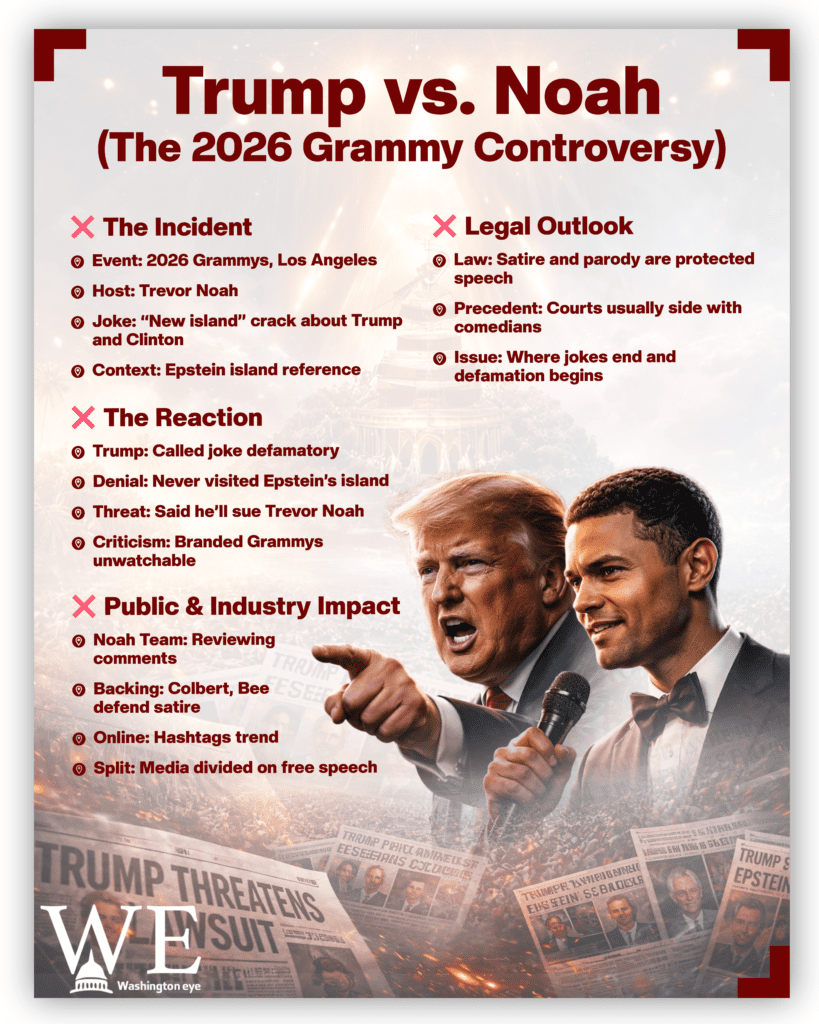
The Grammy Awards, held on February 4, 2026, at the Crypto.com Arena in Los Angeles, were broadcast live to millions of viewers around the United States and abroad. Trevor Noah, the South African-born comedian and former longtime host of “The Daily Show,” was invited to emcee this year’s ceremony. Known for his incisive political humor, Noah’s opening monologue included a joke referencing Epstein’s private Caribbean island, a location that has figured prominently in public and legal scrutiny surrounding Epstein’s sex-trafficking network.
As part of his set, Noah quipped that with Epstein’s estate closed, Trump would now need “a new island to hang out on with Bill Clinton.” The joke played on longstanding tabloid and public speculation about high-profile figures associated with Epstein, who was convicted in 2008 on sex-related offenses and later died by suicide in 2019 while awaiting federal charges. While neither Trump nor Clinton has been charged in connection with Epstein’s crimes, both men’s past associations with Epstein have been part of public discussion and media coverage for years, particularly after the federal government released millions of pages of Epstein-related files that contained references to numerous public figures.
Almost immediately after the broadcast concluded, Trump, now a political figure wielding substantial influence on social media platforms, responded forcefully to Noah’s joke. Posting on his Truth Social account late Wednesday night, Trump called Noah’s remark “false and defamatory” and categorically denied ever visiting Epstein’s Caribbean island. Trump wrote that he had “never been there” and that Noah’s joke was “an outrageous and defamatory attack” on his reputation. The former president also threatened legal action, saying he was “preparing to sue Trevor Noah for defamation and damages” and would “have some fun with him in court.”
Trump’s legal threat adds to a pattern in recent years of the former president saying he will pursue lawsuits against journalists, entertainers and news organizations over perceived slights or unfavorable coverage. In his post, Trump cited previous litigation against broadcast networks and compared Noah unfavorably to late-night hosts like Jimmy Kimmel, whom he has also attacked publicly. Trump described the Grammy broadcast as “virtually unwatchable” and said that comedians should “stick to jokes they can actually tell without lies.”
In response to Trump’s statements, representatives for Trevor Noah said they were reviewing the comments but did not immediately announce any legal developments. In the hours after Trump’s social-media post, clips of Noah’s original joke were widely shared across social platforms, with many users defending Noah’s comedic freedom and noting that his comment was clearly framed as humor. Some legal analysts on cable news pointed out that parody and satire are traditionally protected under U.S. free-speech law, particularly when delivered in a clearly comedic context at an awards show.
Public reaction has been sharply divided along familiar partisan lines. Supporters of Trump applauded his readiness to defend his reputation, with some commentators arguing that public figures should take action against what they see as defamatory commentary, even in comedy. Conservative media outlets ran segments analyzing Noah’s comments and questioning whether entertainment figures have crossed traditional boundaries by engaging in politically charged humor about individuals who have not been criminally implicated.

By contrast, many comedians, entertainers and press freedom advocates condemned the threatened lawsuit as an attack on free expression. Social-media posts tagged #ComedyIsNotDefamation and #LetTrevorSpeak trended for much of Thursday, with users posting past examples of widely accepted political humor about presidents and other leaders. Some late-night hosts, including Samantha Bee and Stephen Colbert, referenced the controversy in their own monologues, defending comedic critique and warning against legal suppression of satire.
Legal experts note that if Trump does file suit, the case could raise complex questions about the boundaries between satire and defamation, especially when the supposed defamatory statement is presented as a joke by a public figure at a major entertainment event. Past cases involving public figures and satire, such as lawsuits over parody news sites, have generally favored free-speech protections, especially when there is no clear assertion of factual misrepresentation. Whether Trump follows through on his threat or ultimately uses the gambit as a political tool remains to be seen.
As the legal and cultural debates unfold, the Grammy Awards controversy has become more than an isolated moment of headline-grabbing humor, it reflects ongoing tensions in American public life about accountability, humor, free expression and the long shadows cast by unresolved scandals.